

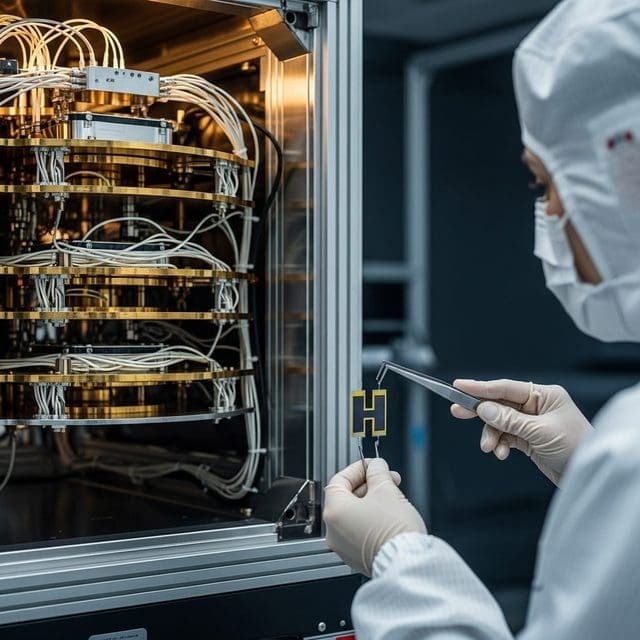
Microsoft reports a thousand-fold increase in quantum stability with its new Majorana 2 chip, though physicists remain skeptical of the un-peer-reviewed data.
The quest for a functional quantum computer has long been the ‘space race’ of the 21st century, promising to unlock computational power that would render today’s supercomputers obsolete. This week, Microsoft intensified the competition by unveiling its Majorana 2 chip, an upgraded version of its highly debated quantum hardware. According to a preprint paper released on June 2, 2026, the new chip has demonstrated the ability to hold quantum information for more than 20 seconds. This represents a 1,000-fold improvement over the previous Majorana 1 iteration, a leap that Microsoft suggests could bring practical quantum computing to the market as early as 2029.
The Majorana 2 device features a sophisticated “H-shaped” architecture and a complete overhaul of its material composition. Engineers swapped out traditional aluminum for lead in the superconducting layer and redesigned the semiconductor region using a combination of indium arsenide and indium arsenide antimonide. This specific materials stack reportedly doubled the “topological gap,” a critical metric for protecting the fragile quantum states from environmental noise. By stabilizing these states, Microsoft aims to create topological qubits, which are theoretically more robust and easier to scale than the superconducting loops or trapped ions used by competitors like IBM or Google.
Despite the impressive technical specifications, the announcement has been met with a measured dose of skepticism from the broader physics community. The shadow of the past looms large over the Majorana program; a foundational 2021 paper in the journal Nature was retracted following concerns over undisclosed data processing. Critics currently point out that while the Majorana 2 has shown long-lived “parity states”—essentially the ability to maintain an even or odd number of electrons—the company has only provided evidence for one of the two measurements necessary to prove a fully operational topological qubit. Without peer-reviewed confirmation, many physicists argue that Microsoft’s marketing is once again outstripping its scientific reality.
Microsoft is not just relying on traditional engineering to bridge this gap. The company revealed that the Majorana 2 was co-designed using its new “Discovery” agentic-AI platform. This AI-driven R&D tool, which Microsoft has now moved to general availability, is designed to accelerate the discovery of new materials and chemical compounds. By merging artificial intelligence with condensed matter physics, the company claims it can achieve microsecond-scale gate speeds and eventually fit one million qubits onto a single chip. This marriage of AI and hardware represents a significant shift in how American technology firms are approaching the limits of Moore’s Law.
The implications of this technology extend far beyond the laboratory. A scalable quantum computer would have the power to break modern encryption, revolutionize the development of fertilizers, and optimize global supply chains. However, for those who value national sovereignty and the integrity of scientific discourse, the lack of transparency remains a sticking point. If the United States is to lead the world into the quantum era, that leadership must be built on a foundation of verifiable truth rather than corporate press releases. The 2029 target is ambitious, but it remains to be seen if the Majorana 2 is a genuine breakthrough or another chapter in a long-running controversy.
As the debate continues, the industry watches closely. The tension between Silicon Valley’s “move fast and break things” ethos and the rigorous standards of the scientific method has rarely been more apparent. For now, the Majorana 2 sits at the intersection of immense promise and significant doubt, serving as a reminder that the frontier of physics is as much about the integrity of the data as it is about the speed of the processor.

Mason Reed serves as a Staff Writer for Just Right News, where he spearheads the Future Frontiers & Special Projects desk. In an era defined by rapid technological shifts and evolving social landscapes, Mason provides a steady, principled voice, examining the innovations of tomorrow through the lens of traditional American values. His work is most prominently featured in his signature series, “The Next Horizon,” where he explores the intersection of emerging technology, national sovereignty, and the preservation of individual liberty.
A native of San Diego, California, Mason’s worldview was shaped by the unique culture of his hometown. Growing up in a region defined by its strong military presence and its history of maritime industry, he developed a deep-seated respect for the institutions that provide national stability and the entrepreneurial spirit that drives the American economy. This upbringing instilled in him a belief that true progress is not found in discarding the past, but in building upon a foundation of proven principles. His reporting often reflects this San Diego influence, emphasizing the importance of a robust national defense and the necessity of maintaining a competitive edge in the global marketplace.
Now based in San Francisco, Mason operates from the heart of the world’s technological engine. Living and working in the Bay Area provides him with a front-row seat to the advancements—and the ideological challenges—emanating from Silicon Valley. While many in the region embrace a “move fast and break things” mentality, Mason’s reporting serves as a vital counterweight. He offers Just Right News readers a “boots on the ground” perspective, documenting how radical local policies and the concentration of tech power impact the everyday lives of citizens. His proximity to the industry allows him to cut through the marketing jargon of big tech to uncover the real-world implications for privacy, free speech, and the nuclear family.
In his “Future Frontiers” beat, Mason tackles complex subjects ranging from the ethics of artificial intelligence to the burgeoning private space race. He approaches these topics with a healthy skepticism toward centralized bureaucracy, championing instead the decentralized innovations that empower individuals. Through “The Next Horizon,” he highlights the pioneers and thinkers who are working to ensure that the future remains a place where human dignity and constitutional rights are protected. He believes that the rapid pace of change requires more than just technical expertise; it requires a moral compass rooted in the Western tradition.
Throughout his tenure at Just Right News, Mason has remained committed to the idea that the future is something to be shaped, not merely accepted. His writing is characterized by a rigorous defense of American exceptionalism and a belief that the country’s best days lie ahead, provided it remains true to its founding ideals. Whether he is investigating the impact of automation on the American workforce or profiling the next generation of aerospace engineers, Mason Reed ensures that his readers are equipped with the insights they need to navigate a changing world with confidence and clarity.