

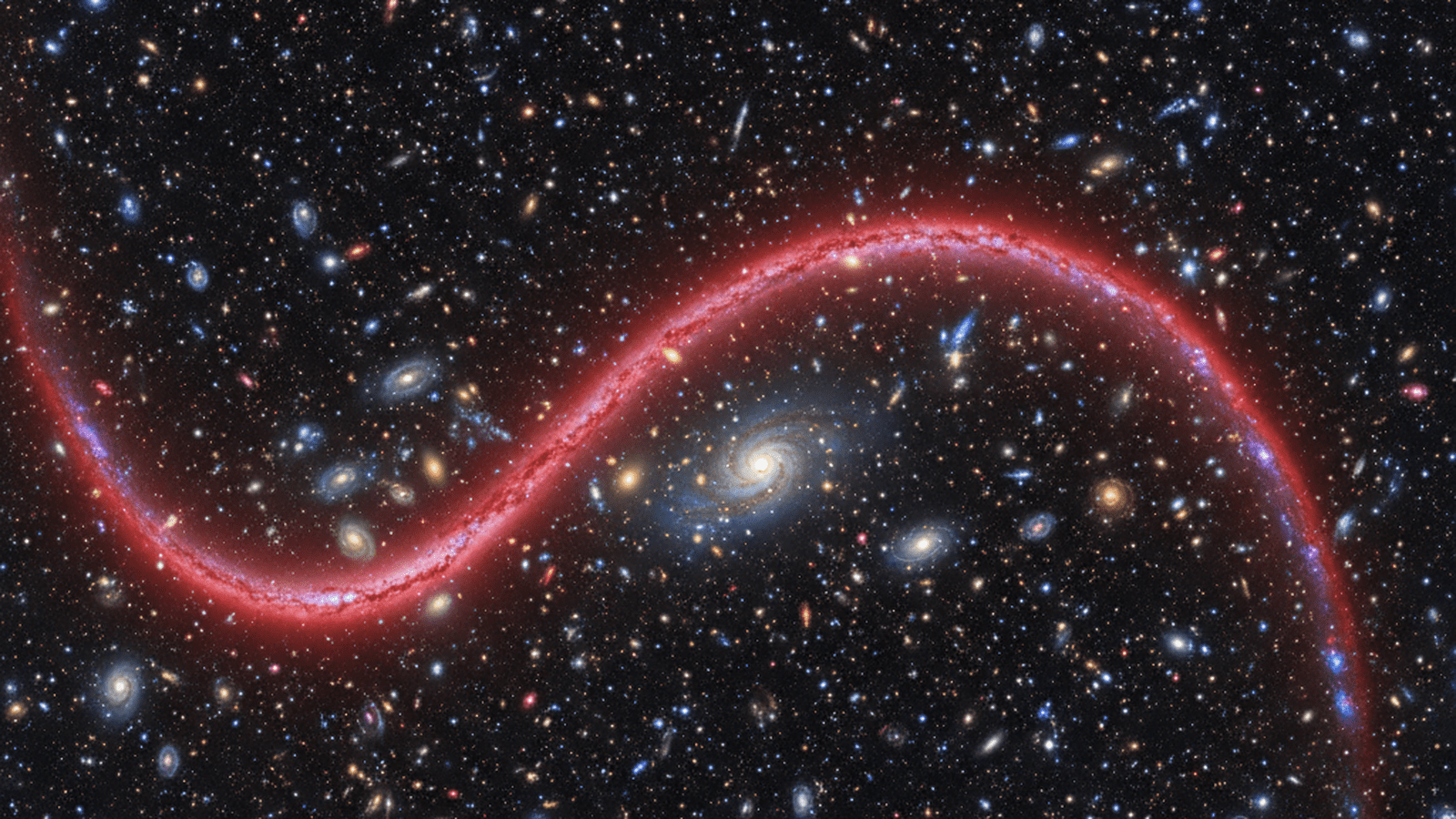
Astronomers using the James Webb Space Telescope have identified five massive star clusters within a galaxy that existed just 460 million years after the Big Bang. This discovery, made possible through gravitational lensing, provides the first direct look at the building blocks of early galaxies.
TLDR: Researchers have discovered the oldest known star clusters in a distant galaxy called the Cosmic Gems arc. Using the James Webb Space Telescope’s infrared capabilities and gravitational lensing, the team identified five dense clusters that formed less than 500 million years after the Big Bang, offering new insights into early galactic evolution.
The James Webb Space Telescope has provided astronomers with an unprecedented look at the early universe, revealing five distinct star clusters within a galaxy that existed a mere 460 million years after the Big Bang. This discovery, centered on a galaxy known as the Cosmic Gems arc, represents the first time researchers have been able to resolve individual stellar structures within a galaxy from the epoch of reionization. The findings offer a critical window into the processes that shaped the first galaxies and the stars within them.
The Cosmic Gems arc was initially detected by the Hubble Space Telescope, but its true nature remained obscured until the infrared sensitivity of the James Webb Space Telescope was applied. To observe such a distant and faint object, the international research team utilized a phenomenon known as gravitational lensing. A massive cluster of galaxies located between Earth and the Cosmic Gems arc acted as a cosmic magnifying glass, warping and brightening the light from the distant background galaxy. This natural amplification allowed the telescope to see details that would otherwise be invisible to even the most powerful human-made instruments.
Analysis of the telescope data revealed five compact regions of intense star formation. These clusters are remarkably small and dense, each measuring approximately one parsec in diameter. Despite their small size, they contain a significant portion of the galaxy’s total mass. The density of these clusters is orders of magnitude higher than typical star-forming regions found in the local universe. This suggests that the conditions in the early universe favored the creation of extremely tightly packed stellar environments.
The international collaboration, led by researchers at Stockholm University and involving scientists from across the globe, suggests these clusters may be the ancestors of globular clusters. Globular clusters are ancient, spherical collections of stars that orbit the cores of modern galaxies, including the Milky Way. Until now, the origin of these structures has been a subject of intense theoretical debate. The discovery of similar clusters in the Cosmic Gems arc provides the first observational evidence that such structures formed very early in cosmic history.
These findings also shed light on the role of star clusters in the reionization of the universe. During this period, the first stars and galaxies emitted enough high-energy radiation to ionize the neutral hydrogen gas that filled space. By observing the intense ultraviolet light emanating from these clusters, astronomers can better understand how early stellar populations contributed to this fundamental cosmic transition. The high density of stars within these clusters likely produced a significant amount of ionizing radiation, potentially making them primary drivers of reionization.
The discovery of the Cosmic Gems arc clusters marks a significant milestone in extragalactic astronomy. It demonstrates the telescope’s capability to probe the internal dynamics of galaxies at the very edge of the observable universe. Previous observations were limited to seeing galaxies as unresolved smudges of light, but the ability to identify specific star-forming regions allows for a more detailed study of galactic assembly.
Future research will involve spectroscopic analysis to determine the chemical composition and exact ages of the stars within these clusters. Astronomers hope to find other examples of lensed galaxies from the same era to determine if such dense star clusters were common or unique to the Cosmic Gems arc. These investigations will continue to refine models of how the first structures in the universe evolved into the complex galactic systems observed today.

Mason Reed serves as a Staff Writer for Just Right News, where he spearheads the Future Frontiers & Special Projects desk. In an era defined by rapid technological shifts and evolving social landscapes, Mason provides a steady, principled voice, examining the innovations of tomorrow through the lens of traditional American values. His work is most prominently featured in his signature series, “The Next Horizon,” where he explores the intersection of emerging technology, national sovereignty, and the preservation of individual liberty.
A native of San Diego, California, Mason’s worldview was shaped by the unique culture of his hometown. Growing up in a region defined by its strong military presence and its history of maritime industry, he developed a deep-seated respect for the institutions that provide national stability and the entrepreneurial spirit that drives the American economy. This upbringing instilled in him a belief that true progress is not found in discarding the past, but in building upon a foundation of proven principles. His reporting often reflects this San Diego influence, emphasizing the importance of a robust national defense and the necessity of maintaining a competitive edge in the global marketplace.
Now based in San Francisco, Mason operates from the heart of the world’s technological engine. Living and working in the Bay Area provides him with a front-row seat to the advancements—and the ideological challenges—emanating from Silicon Valley. While many in the region embrace a “move fast and break things” mentality, Mason’s reporting serves as a vital counterweight. He offers Just Right News readers a “boots on the ground” perspective, documenting how radical local policies and the concentration of tech power impact the everyday lives of citizens. His proximity to the industry allows him to cut through the marketing jargon of big tech to uncover the real-world implications for privacy, free speech, and the nuclear family.
In his “Future Frontiers” beat, Mason tackles complex subjects ranging from the ethics of artificial intelligence to the burgeoning private space race. He approaches these topics with a healthy skepticism toward centralized bureaucracy, championing instead the decentralized innovations that empower individuals. Through “The Next Horizon,” he highlights the pioneers and thinkers who are working to ensure that the future remains a place where human dignity and constitutional rights are protected. He believes that the rapid pace of change requires more than just technical expertise; it requires a moral compass rooted in the Western tradition.
Throughout his tenure at Just Right News, Mason has remained committed to the idea that the future is something to be shaped, not merely accepted. His writing is characterized by a rigorous defense of American exceptionalism and a belief that the country’s best days lie ahead, provided it remains true to its founding ideals. Whether he is investigating the impact of automation on the American workforce or profiling the next generation of aerospace engineers, Mason Reed ensures that his readers are equipped with the insights they need to navigate a changing world with confidence and clarity.