

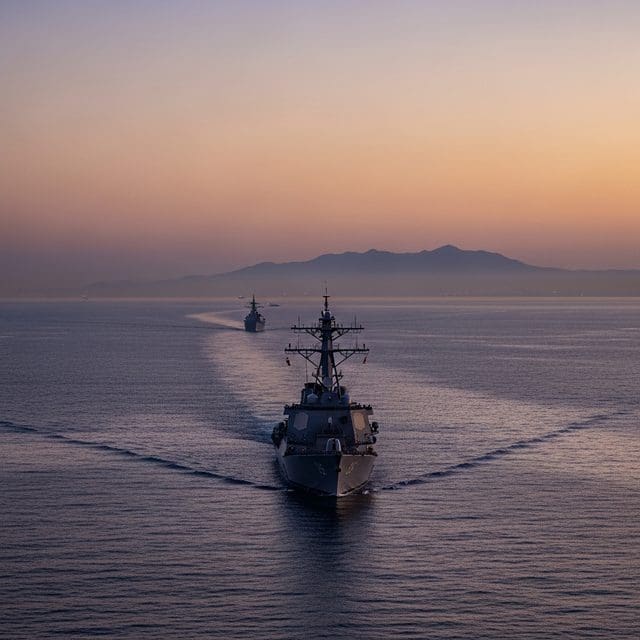
President Trump announced a pause in Strait of Hormuz operations following naval clashes, while China steps in to mediate a potential final agreement between Washington and Tehran.
The Trump administration signaled a potential shift in Middle Eastern strategy on Wednesday, announcing a pause in the military operation known as Project Freedom. This decision follows a period of heightened kinetic activity in the Strait of Hormuz, where U.S. forces reportedly sank seven Iranian small boats following a series of drone and cruise missile attacks on commercial shipping. While the administration maintains that no American warships were struck, the engagement resulted in a fire aboard a South Korean-operated vessel.
Secretary of State Marco Rubio stated that the offensive stage of the U.S.-Israeli war on Iran has concluded, moving the focus toward a diplomatic resolution. President Trump expressed optimism regarding a “complete and final agreement,” citing significant progress in back-channel communications. These developments had an immediate impact on global energy markets, with oil prices plunging as investors anticipated a reduction in regional volatility and the potential for a stabilized supply chain through the critical waterway.
However, the path to a lasting peace remains fraught with institutional friction and skepticism from Tehran. Iranian President Masoud Pezeshkian characterized the current U.S. demands as “impossible,” suggesting that Washington is seeking unilateral concessions that Iran is not prepared to grant. Amidst this deadlock, Iranian Foreign Minister Abbas Araghchi traveled to Beijing to meet with Chinese Foreign Minister Wang Yi. China has signaled a desire to occupy a more prominent role as a regional power broker, with Wang Yi stating that Beijing is ready to play a greater role in restoring tranquility to the Middle East, potentially challenging traditional Western influence in the region.
Domestically, the administration’s focus on sovereignty and strength is being tested by legislative and humanitarian concerns. In Washington, thirty House Democrats have challenged the long-standing policy of ambiguity regarding Israel’s nuclear program, urging Secretary Rubio to provide transparency on the regional nuclear balance. This move breaks a decades-old bipartisan consensus dating back to the Nixon era and reflects growing pressure on the administration to define the long-term security architecture of the Middle East while maintaining its alliance with Israel.
Beyond the diplomatic theater, the human cost of the ongoing friction persists. Nobel Peace Prize winner Narges Mohammadi remains hospitalized under guard, with her family’s requests for medical transfer from Zanjan Prison to Tehran denied by authorities. In Gaza, despite a U.S.-brokered ceasefire, sporadic strikes continue to result in casualties, with at least 830 deaths reported since October. As the Trump administration pivots from the battlefield to the negotiating table, the challenge will be reconciling the “peace through strength” doctrine with the complex demands of international mediation and the persistent instability of the Levant.

Olivia Kendall serves as the Senior Correspondent for Geopolitics, Defense, and Foreign Policy at Just Right News, where she provides a principled, conservative perspective on the complex forces shaping the global stage. With a career dedicated to deconstructing the intricacies of international relations, Kendall has become a trusted voice for readers who value national sovereignty, a robust military, and a foreign policy that prioritizes American interests above all else.
A native of Washington, D.C., Kendall’s professional journey is deeply rooted in her upbringing within the nation’s capital. Growing up in the epicenter of American political life, she developed an early and profound understanding of how policy is crafted and, more importantly, how it often fails to account for the values of the American heartland. This unique vantage point allowed her to witness firsthand the rise of globalist bureaucracies, fueling her commitment to reporting that champions the constitutional foundations of the United States. Her background as a British White American further informs her worldview, providing her with a keen appreciation for the Western tradition and the enduring importance of the “Special Relationship” in maintaining global stability.
Now based in Arlington, Virginia, Kendall operates from the doorstep of the Pentagon and the heart of the nation’s defense establishment. Her proximity to the decision-makers in the military and intelligence communities allows her to provide boots-on-the-ground reporting that is both timely and deeply informed. For Kendall, Arlington is more than just a base of operations; it is a daily reminder of the sacrifices made by the men and women in uniform. This connection to the defense community drives her rigorous coverage of military readiness and her advocacy for a “peace through strength” approach to diplomacy.
At Just Right News, Kendall is perhaps best known for her acclaimed feature series, “The World’s Shadow on America.” In this ongoing project, she explores the direct correlation between international developments and the daily lives of American citizens. Whether she is analyzing the encroachment of foreign adversaries in domestic supply chains or the impact of international treaties on local economies, Kendall’s work serves as a vital bridge between distant geopolitical shifts and their consequences at home. She rejects the notion that foreign policy is an abstract concern for elites, instead proving that what happens in the corridors of power in Brussels or Beijing has a tangible “shadow” that falls across every American doorstep.
Throughout her tenure, Kendall has remained a steadfast critic of international overreach and a vocal proponent of a clear-eyed, realistic foreign policy. She brings a sharp analytical mind to her beat, often challenging the prevailing narratives of the mainstream media to uncover the underlying truths that affect national security. Her reporting is characterized by a refusal to compromise on the truth and a dedication to the idea that a strong, secure America is the world’s best hope for liberty. As a Senior Correspondent, Olivia Kendall continues to lead the charge in providing the essential context and conservative insight necessary to navigate an increasingly volatile world.