

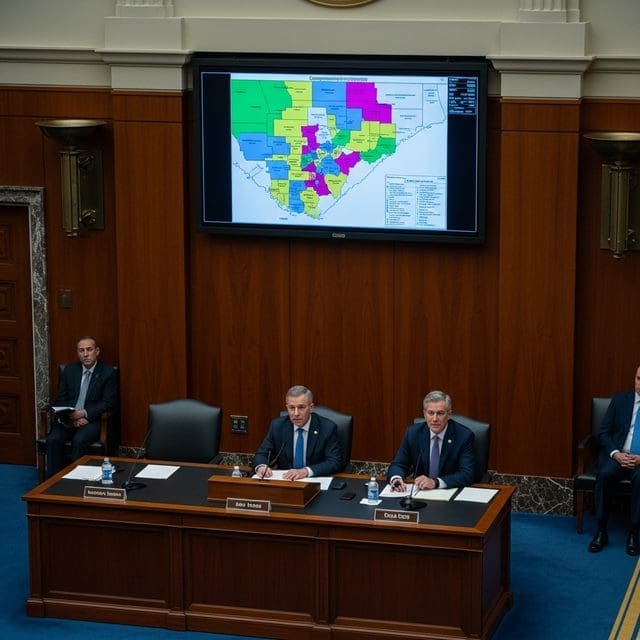
State-level redistricting battles and federal regulatory disputes highlight the growing tension between administrative authority and partisan strategy in a shifting political landscape.
The structural integrity of the American electoral system is facing a dual-front challenge as state legislatures in Tennessee and Virginia move to finalize congressional maps that could fundamentally reshape the House of Representatives. In Tennessee, a newly unveiled map seeks a clean sweep of the state’s nine districts for Republicans, effectively eliminating the seat currently held by Rep. Steve Cohen. This move coincides with an FBI probe in Virginia, where state Senator L. Louise Lucas has come under scrutiny for maps that would favor Democrats in four congressional seats. These developments underscore a period of intense partisan maneuvering that tests the limits of legislative discretion in the redistricting process.
At the federal level, the administrative state is navigating internal friction between executive priorities and regulatory protocols. Despite the FDA’s May 6 authorization of several flavored e-cigarette products from Glas—including menthol and fruit varieties equipped with age-gating technology—President Trump has reportedly expressed dissatisfaction with FDA Commissioner Marty Makary over the pace of approvals. This tension highlights the ongoing struggle between political directives and the scientific review processes intended to protect public health, particularly as Health Secretary Robert F. Kennedy Jr. simultaneously moves to reduce psychiatric drug prescriptions.
In the halls of Congress, the House Oversight Committee is intensifying its scrutiny of the executive branch. Commerce Secretary Howard Lutnick testified today regarding his historical mentions in Jeffrey Epstein’s files, a line of inquiry that poses significant political risk for the Cabinet official. This hearing reflects a broader trend of aggressive legislative oversight as the administration manages a volatile global environment, including a pause on Project Freedom and the closure of the U.S. Consulate in Peshawar due to security concerns.
Economic indicators are reacting sharply to these geopolitical shifts. Oil prices saw a marked decline as rumors of U.S.-Iran peace negotiations surfaced, even as the U.S. Navy maintains its blockade of the Strait of Hormuz. While the administration threatens increased intensity in its dealings with Iran, the domestic economy is also adjusting to new labor realities, evidenced by successful Teamsters organizing efforts at Smithfield Foods and Pepsi-Cola facilities. These events collectively illustrate a nation grappling with the friction between establishment institutions and the anti-establishment forces currently defining the political era.
The legislative landscape is further complicated by the Senate’s advancement of the CLARITY Act, a cryptocurrency bill that defies banking industry opposition regarding stablecoin yields. This move, much like the redistricting battles in New York where Governor Kathy Hochul is eyeing maps to secure 22 of 26 seats for Democrats, signals a shift toward high-stakes policy victories over traditional consensus. As Rahm Emanuel noted, the defining challenge of the last quarter-century remains the clash between establishment and anti-establishment forces, a struggle now playing out through the very mechanics of democracy.

Sophie Carter serves as a Staff Writer for Just Right News, where she anchors the outlet’s critical coverage of Elections, Influence, and Democracy Infrastructure. In an era where the mechanics of voting and the flow of political capital are under constant scrutiny, Sophie provides a steady, principled voice dedicated to the preservation of American institutional integrity and the rule of law.
Raised in Charlotte, North Carolina, Sophie’s perspective was forged in a community that balances rapid modern growth with a deep respect for tradition and civic duty. Growing up in the Queen City, she witnessed firsthand how a robust local culture depends on the trust between the citizen and the state. This upbringing instilled in her a foundational belief that the right to vote is a sacred trust—one that must be protected from both administrative overreach and the encroaching influence of special interest groups. Her reporting reflects these North Carolina roots, emphasizing the importance of community-led governance and the preservation of the individual’s voice in the face of nationalized political movements.
Now based in Atlanta, Georgia, Sophie operates from the heart of one of the nation’s most pivotal and contested political landscapes. Her location allows her to report from the front lines of the debate over election security, legislative reform, and the modernization of voting systems. For Sophie, the “infrastructure” of democracy is not merely a matter of machines and ballots; it is the collection of laws, people, and transparent processes required to maintain public confidence. Her work often highlights the necessity of clear, enforceable standards that ensure every legal vote is counted fairly and that the machinery of our republic remains accountable to the taxpayers who fund it.
Central to her work at Just Right News is her acclaimed feature series, “The Price of a Vote.” Through this ongoing project, Sophie explores the complex web of influence that shapes modern campaigns and policy decisions. She delves into how high-level lobbying, non-governmental organizations, and shifting bureaucratic regulations impact the weight of an individual citizen’s ballot. By examining the financial and structural pressures placed on the electoral process, she provides readers with a comprehensive look at the forces vying for control over the American political system.
Sophie’s approach to journalism is rooted in a commitment to the constitutional framework. She views her role as a watchdog for the voter, ensuring that the systems meant to serve the public remain transparent and free from corruption. Whether she is analyzing the implementation of new voting technologies or investigating the influence of outside money on state-level policy, her work is characterized by a rigorous adherence to facts and a refusal to succumb to the sensationalism that often plagues modern political reporting.
At Just Right News, Sophie Carter continues to be a vital resource for readers who value clarity, conviction, and a defense of traditional American values. Her deep ties to the Southeast and her specialized focus on the mechanics of our republic make her an essential voice in the ongoing conversation about the future of American self-governance. Through her reporting, she remains dedicated to the idea that a secure and honest electoral system is the bedrock of a free and prosperous society.