

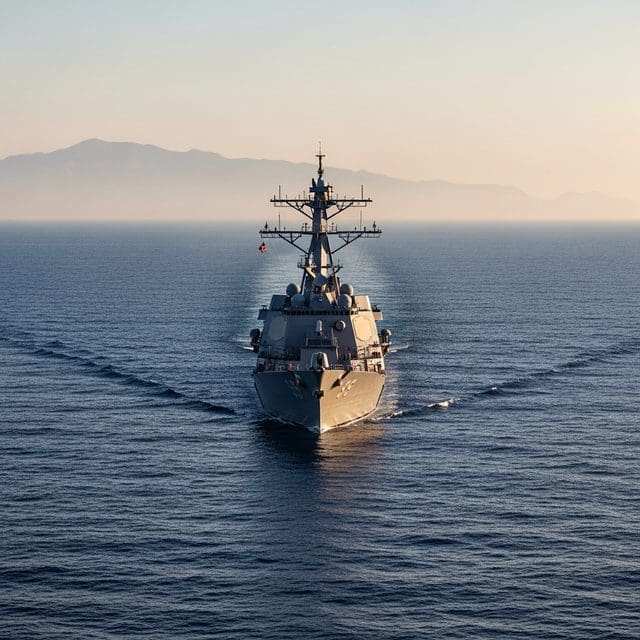
President Trump deployed 15,000 troops and 100 aircraft to escort commercial vessels through the Strait of Hormuz following Iranian threats and reported naval skirmishes.
The geopolitical standoff in the Middle East reached a critical inflection point on May 4 as the Trump administration initiated “Project Freedom,” an aggressive maritime escort operation designed to secure the Strait of Hormuz. The deployment includes guided-missile destroyers, over 100 aircraft, and 15,000 U.S. service members tasked with ensuring the unhindered passage of commercial and military vessels through the world’s most vital energy artery.
This escalation follows a series of kinetic engagements and conflicting narratives between Washington and Tehran. Iranian state media claimed on Monday that the Revolutionary Guard struck a U.S. Navy vessel with two missiles after it allegedly ignored warnings to halt. However, U.S. Central Command (CENTCOM) flatly denied that any American warship was hit, instead reporting that U.S. forces successfully sank six to seven Iranian small boats that were targeting commercial and military traffic. This maritime friction coincides with a drone and missile attack on the UAE’s Fujairah oil port, further destabilizing regional infrastructure.
At the heart of the conflict is a stalled diplomatic framework. President Trump confirmed he has reviewed a 14-point peace proposal submitted by Iran, which reportedly includes demands for a total U.S. troop withdrawal and the lifting of economic sanctions. While Iranian Foreign Minister Abbas Araghchi characterized a potential deal as being “inches away,” he accused U.S. negotiators of maintaining “maximalist demands.” The President has signaled a low tolerance for further delays, warning that the U.S. is prepared to resume strikes if Tehran continues to interfere with international shipping.
The domestic consequences of the conflict are becoming increasingly tangible for American families. National gas prices have surged to $4.45 per gallon, representing a 50% increase since the onset of hostilities. This economic pressure has fueled domestic dissent, exemplified by an ongoing protest on the Frederick Douglass Bridge in Washington, D.C., where an anti-war activist has remained entrenched for several days to protest the military campaign.
From a defense perspective, the administration’s strategy reflects a commitment to the “peace through strength” doctrine, viewing the protection of the Strait of Hormuz not merely as a regional skirmish, but as a defense of global trade norms. However, the human cost of the campaign remains a point of contention. While Iran’s Ministry of Health reports thousands of casualties, the U.S. military has confirmed 13 combat deaths and 381 service members wounded to date.
As the Supreme Court manages domestic legal shifts—including a temporary stay by Justice Samuel Alito on mifepristone restrictions and the striking down of Louisiana’s congressional maps—the executive branch remains focused on the Persian Gulf. With no further diplomatic talks scheduled, the burden of stability now rests on the U.S. Navy’s ability to deter Iranian aggression without triggering a broader conflagration.

Olivia Kendall serves as the Senior Correspondent for Geopolitics, Defense, and Foreign Policy at Just Right News, where she provides a principled, conservative perspective on the complex forces shaping the global stage. With a career dedicated to deconstructing the intricacies of international relations, Kendall has become a trusted voice for readers who value national sovereignty, a robust military, and a foreign policy that prioritizes American interests above all else.
A native of Washington, D.C., Kendall’s professional journey is deeply rooted in her upbringing within the nation’s capital. Growing up in the epicenter of American political life, she developed an early and profound understanding of how policy is crafted and, more importantly, how it often fails to account for the values of the American heartland. This unique vantage point allowed her to witness firsthand the rise of globalist bureaucracies, fueling her commitment to reporting that champions the constitutional foundations of the United States. Her background as a British White American further informs her worldview, providing her with a keen appreciation for the Western tradition and the enduring importance of the “Special Relationship” in maintaining global stability.
Now based in Arlington, Virginia, Kendall operates from the doorstep of the Pentagon and the heart of the nation’s defense establishment. Her proximity to the decision-makers in the military and intelligence communities allows her to provide boots-on-the-ground reporting that is both timely and deeply informed. For Kendall, Arlington is more than just a base of operations; it is a daily reminder of the sacrifices made by the men and women in uniform. This connection to the defense community drives her rigorous coverage of military readiness and her advocacy for a “peace through strength” approach to diplomacy.
At Just Right News, Kendall is perhaps best known for her acclaimed feature series, “The World’s Shadow on America.” In this ongoing project, she explores the direct correlation between international developments and the daily lives of American citizens. Whether she is analyzing the encroachment of foreign adversaries in domestic supply chains or the impact of international treaties on local economies, Kendall’s work serves as a vital bridge between distant geopolitical shifts and their consequences at home. She rejects the notion that foreign policy is an abstract concern for elites, instead proving that what happens in the corridors of power in Brussels or Beijing has a tangible “shadow” that falls across every American doorstep.
Throughout her tenure, Kendall has remained a steadfast critic of international overreach and a vocal proponent of a clear-eyed, realistic foreign policy. She brings a sharp analytical mind to her beat, often challenging the prevailing narratives of the mainstream media to uncover the underlying truths that affect national security. Her reporting is characterized by a refusal to compromise on the truth and a dedication to the idea that a strong, secure America is the world’s best hope for liberty. As a Senior Correspondent, Olivia Kendall continues to lead the charge in providing the essential context and conservative insight necessary to navigate an increasingly volatile world.