

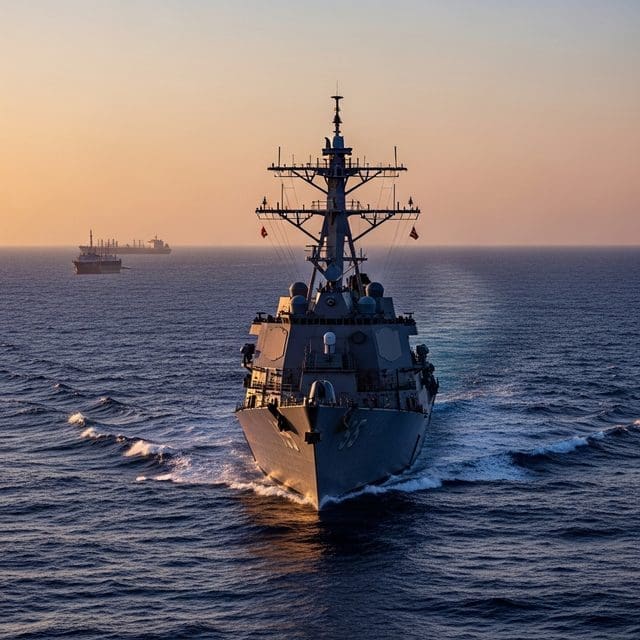
U.S. forces destroyed six Iranian speedboats Monday as President Trump’s ‘Project Freedom’ initiative to secure the Strait of Hormuz faced immediate military challenges and a crumbling regional ceasefire.
The strategic silence in the Persian Gulf was shattered Monday as the United States military engaged Iranian forces in the Strait of Hormuz, marking a violent start to the Trump administration’s ‘Project Freedom.’ The operation, designed to provide a defensive layer for commercial shipping without formal escorts, faced an immediate test when Iranian speedboats and missiles targeted vessels in the critical waterway.
U.S. Central Command confirmed that U.S. Apache and SH-60 Seahawk helicopters destroyed six Iranian fast boats after the Islamic Revolutionary Guard Corps (IRGC) launched cruise missiles and drones at both U.S. Navy assets and commercial ships. President Trump, speaking to Fox News, warned that Iranian forces would be “blown off the face of the Earth” if they continued to target American vessels. Despite the exchange, the President noted that two U.S.-flagged merchant vessels successfully transited the Strait, though a South Korean cargo ship sustained damage.
The escalation extended beyond the water’s edge as the United Arab Emirates reported a significant aerial assault. Emirati air defenses engaged 19 Iranian projectiles, including 12 ballistic missiles and three cruise missiles. While most were intercepted—some reportedly by Israeli-operated Iron Dome systems stationed in the UAE—a drone strike hit an oil facility in Fujairah, causing a major fire and injuring three Indian nationals. The UAE Ministry of Foreign Affairs condemned the strikes as a “dangerous escalation” and a violation of international law.
At the heart of the friction is the ambiguous status of the April ceasefire. When pressed on whether the truce has officially collapsed, President Trump declined to provide a definitive answer, suggesting that revealing his next move would be strategically unwise. However, the rhetoric from Tehran remains defiant; the IRGC dismissed U.S. reports of successful merchant transits as “outright lies,” while Hezbollah leadership in Lebanon declared that the ceasefire is non-existent in the face of continued “Israeli-American aggression.”
The domestic implications of this maritime friction are becoming acute. Global oil prices surged past $110 per barrel following the reports of hostilities, and market analysts warn that a sustained closure of the Strait could push American gas prices to $5 per gallon. This economic pressure arrives as the administration navigates a complex domestic landscape, including the recent withdrawal of Surgeon General nominee Casey Means and ongoing legal developments regarding the attempted assassination of the President in late April.
As the U.S. Navy continues its mission to clear a “one-way path” for vessels held in the Gulf, the administration maintains that the military’s role is purely defensive. However, with 15,000 service members and over 100 aircraft committed to Project Freedom, the line between maritime protection and active combat continues to thin. Defense Secretary Pete Hegseth is expected to provide further clarity on the rules of engagement during a scheduled briefing Tuesday morning.

Olivia Kendall serves as the Senior Correspondent for Geopolitics, Defense, and Foreign Policy at Just Right News, where she provides a principled, conservative perspective on the complex forces shaping the global stage. With a career dedicated to deconstructing the intricacies of international relations, Kendall has become a trusted voice for readers who value national sovereignty, a robust military, and a foreign policy that prioritizes American interests above all else.
A native of Washington, D.C., Kendall’s professional journey is deeply rooted in her upbringing within the nation’s capital. Growing up in the epicenter of American political life, she developed an early and profound understanding of how policy is crafted and, more importantly, how it often fails to account for the values of the American heartland. This unique vantage point allowed her to witness firsthand the rise of globalist bureaucracies, fueling her commitment to reporting that champions the constitutional foundations of the United States. Her background as a British White American further informs her worldview, providing her with a keen appreciation for the Western tradition and the enduring importance of the “Special Relationship” in maintaining global stability.
Now based in Arlington, Virginia, Kendall operates from the doorstep of the Pentagon and the heart of the nation’s defense establishment. Her proximity to the decision-makers in the military and intelligence communities allows her to provide boots-on-the-ground reporting that is both timely and deeply informed. For Kendall, Arlington is more than just a base of operations; it is a daily reminder of the sacrifices made by the men and women in uniform. This connection to the defense community drives her rigorous coverage of military readiness and her advocacy for a “peace through strength” approach to diplomacy.
At Just Right News, Kendall is perhaps best known for her acclaimed feature series, “The World’s Shadow on America.” In this ongoing project, she explores the direct correlation between international developments and the daily lives of American citizens. Whether she is analyzing the encroachment of foreign adversaries in domestic supply chains or the impact of international treaties on local economies, Kendall’s work serves as a vital bridge between distant geopolitical shifts and their consequences at home. She rejects the notion that foreign policy is an abstract concern for elites, instead proving that what happens in the corridors of power in Brussels or Beijing has a tangible “shadow” that falls across every American doorstep.
Throughout her tenure, Kendall has remained a steadfast critic of international overreach and a vocal proponent of a clear-eyed, realistic foreign policy. She brings a sharp analytical mind to her beat, often challenging the prevailing narratives of the mainstream media to uncover the underlying truths that affect national security. Her reporting is characterized by a refusal to compromise on the truth and a dedication to the idea that a strong, secure America is the world’s best hope for liberty. As a Senior Correspondent, Olivia Kendall continues to lead the charge in providing the essential context and conservative insight necessary to navigate an increasingly volatile world.