

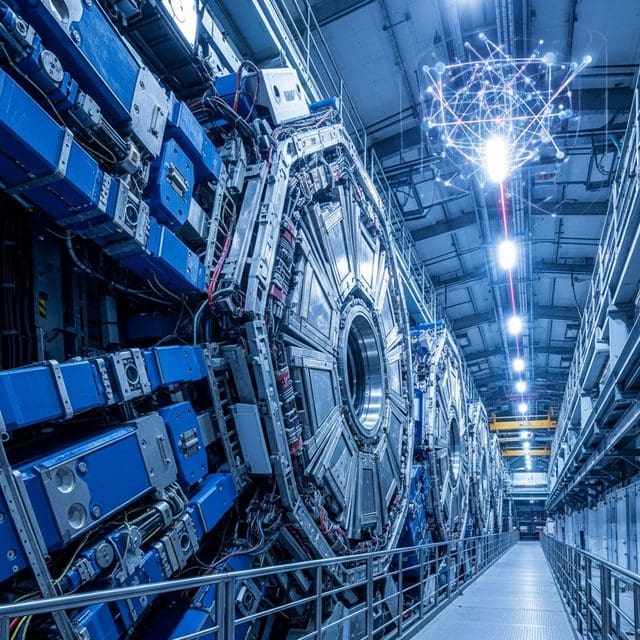
Recent discoveries at the Large Hadron Collider and milestones in quantum teleportation are challenging long-held assumptions about the building blocks of the universe and the future of secure communication.
The spring of 2026 has emerged as a watershed moment for the physical sciences, marked by a series of discoveries that bridge the gap between the subatomic world and the vast reaches of our solar system. At the forefront is the Large Hadron Collider (LHC) at CERN, where the LHCb experiment has confirmed the existence of a new proton-like particle dubbed the Ξcc⁺⁺. This heavy particle contains two charm quarks and possesses four times the mass of a standard proton, offering a rare glimpse into the strong nuclear forces that bind matter together.
This discovery comes during a “short but intense” 2026 run at the LHC, which is scheduled to conclude on June 29. Engineers have pushed the facility to its limits, achieving stable beams since early March and testing high-intensity proton bunches that carry 40 percent more particles than previous iterations. These advancements are not merely academic; they represent a commitment to mastering the fundamental mechanics of our physical reality, free from the constraints of older, less precise models.
In the realm of information sovereignty and security, researchers have achieved a significant milestone in quantum teleportation. On April 30, scientists successfully teleported a photon’s state between two separate quantum dots over a 270-meter open-air link. Unlike previous experiments confined to fiber-optic cables, this achievement proves that quantum information can be transmitted between independent devices through the atmosphere with 82 percent fidelity. This paves the way for a decentralized quantum network that could eventually bypass traditional, centralized telecommunications infrastructure.
Stability remains the primary hurdle for quantum systems, but new theoretical work from Chalmers University of Technology may provide a solution. Researchers there have detailed “giant superatoms” designed to protect quantum information and enable multi-qubit entanglement. By creating stable environments for these fragile states, the path toward practical, high-performance quantum computing becomes clearer, promising a future where individual privacy is protected by the laws of physics rather than the whims of corporate policy.
Beyond our atmosphere, the Japan-led XRISM space telescope has resolved a decades-old mystery regarding a naked-eye star that emits unusually powerful X-rays. Simultaneously, new analysis of Cassini data has explained why Saturn’s magnetic field is uniquely skewed compared to Earth’s symmetrical shield. The interaction between the planet’s rapid rotation and plasma from the moon Enceladus creates a complex magnetic environment that challenges our understanding of planetary formation.
From the frictionless flow of electrons in graphene to the manipulation of sound at the quantum level via “phonon lasers,” these developments signal a shift toward a more profound mastery of nature. As these technologies move from the laboratory to the field, they offer the potential to strengthen national infrastructure and empower individual innovation through a deeper understanding of the universe’s foundational laws.

Mason Reed serves as a Staff Writer for Just Right News, where he spearheads the Future Frontiers & Special Projects desk. In an era defined by rapid technological shifts and evolving social landscapes, Mason provides a steady, principled voice, examining the innovations of tomorrow through the lens of traditional American values. His work is most prominently featured in his signature series, “The Next Horizon,” where he explores the intersection of emerging technology, national sovereignty, and the preservation of individual liberty.
A native of San Diego, California, Mason’s worldview was shaped by the unique culture of his hometown. Growing up in a region defined by its strong military presence and its history of maritime industry, he developed a deep-seated respect for the institutions that provide national stability and the entrepreneurial spirit that drives the American economy. This upbringing instilled in him a belief that true progress is not found in discarding the past, but in building upon a foundation of proven principles. His reporting often reflects this San Diego influence, emphasizing the importance of a robust national defense and the necessity of maintaining a competitive edge in the global marketplace.
Now based in San Francisco, Mason operates from the heart of the world’s technological engine. Living and working in the Bay Area provides him with a front-row seat to the advancements—and the ideological challenges—emanating from Silicon Valley. While many in the region embrace a “move fast and break things” mentality, Mason’s reporting serves as a vital counterweight. He offers Just Right News readers a “boots on the ground” perspective, documenting how radical local policies and the concentration of tech power impact the everyday lives of citizens. His proximity to the industry allows him to cut through the marketing jargon of big tech to uncover the real-world implications for privacy, free speech, and the nuclear family.
In his “Future Frontiers” beat, Mason tackles complex subjects ranging from the ethics of artificial intelligence to the burgeoning private space race. He approaches these topics with a healthy skepticism toward centralized bureaucracy, championing instead the decentralized innovations that empower individuals. Through “The Next Horizon,” he highlights the pioneers and thinkers who are working to ensure that the future remains a place where human dignity and constitutional rights are protected. He believes that the rapid pace of change requires more than just technical expertise; it requires a moral compass rooted in the Western tradition.
Throughout his tenure at Just Right News, Mason has remained committed to the idea that the future is something to be shaped, not merely accepted. His writing is characterized by a rigorous defense of American exceptionalism and a belief that the country’s best days lie ahead, provided it remains true to its founding ideals. Whether he is investigating the impact of automation on the American workforce or profiling the next generation of aerospace engineers, Mason Reed ensures that his readers are equipped with the insights they need to navigate a changing world with confidence and clarity.