

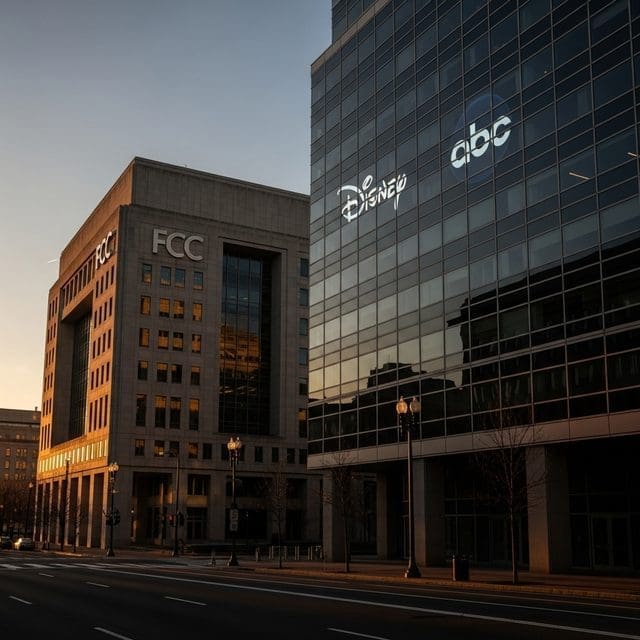
Federal regulators are scrutinizing Disney-owned ABC’s broadcast licenses as the White House demands accountability for rhetoric and hiring practices following the recent assassination attempt.
The Federal Communications Commission (FCC) has initiated a review of broadcast licenses held by Disney-owned ABC, following intense pressure from the White House and a series of regulatory disputes. The move comes after late-night host Jimmy Kimmel made a remark on April 24 referring to First Lady Melania Trump as an “expectant widow,” just two days before a gunman opened fire at the White House Correspondents Association (WHCA) dinner.
President Trump has publicly called for Kimmel’s termination, stating the joke exceeded the bounds of acceptable discourse. While Kimmel has defended his comments and criticized the administration’s handling of national affairs, the controversy has provided a catalyst for federal regulators to examine the network’s broader operations. FCC Chair Brendan Carr is reportedly monitoring the situation to determine if the network’s conduct aligns with public interest obligations.
This license review does not exist in a vacuum. Since March 2025, the FCC has been conducting a probe into Disney’s diversity, equity, and inclusion (DEI) hiring practices. The administration has alleged that these internal policies may constitute discriminatory hiring, providing a secondary lever of regulatory pressure against the media conglomerate. Analysts suggest the intersection of these investigations places Disney in a difficult position between defending its creative talent and maintaining its terrestrial broadcast standing.
The heightened scrutiny arrives at a moment of significant tension in the capital. Following the April 26 shooting, where suspect Cole Allen was apprehended after traveling from Los Angeles to Washington, D.C., the administration has prioritized national security and the tone of public rhetoric. While Senate Republicans propose a $400 million secure ballroom at the White House to prevent future security breaches, the executive branch appears focused on the cultural and corporate entities it views as contributing to a volatile domestic climate.
For Disney, the regulatory squeeze represents a challenge to the traditional autonomy of broadcast networks. The FCC’s willingness to link programming content and internal HR policies to the renewal of broadcast licenses marks a shift in how the federal government interacts with major media stakeholders. As King Charles III continues his state visit and Congress debates the future of Homeland Security funding, the outcome of the Disney inquiry will likely set a precedent for corporate compliance under the current administration’s interpretation of the social contract.

Julie Harris serves as a Staff Writer for Just Right News, where she tackles some of the most pressing and complex issues facing the nation today. As the lead reporter for the Migration, Demographics & Cultural Shifts beat, Julie provides a grounded, principled perspective on how the movement of people and the changing makeup of communities are reshaping the American landscape. Her work is defined by a commitment to exploring the long-term consequences of social change, prioritizing the stability of local institutions and the preservation of national identity.
Her deep understanding of these issues is rooted in her upbringing in Tucson, Arizona. Growing up in a prominent border state, Julie witnessed firsthand the intricate realities of migration and the profound impact it has on local infrastructure, law enforcement, and the social fabric. This early exposure instilled in her a respect for the rule of law and a keen awareness of the challenges that arise when federal policies fail to align with the needs of border communities. Her reporting often reflects this lived experience, bringing a necessary level of nuance to topics that are often treated with abstraction in coastal newsrooms.
Now based in Santa Fe, New Mexico, Julie continues to report from the heart of the American Southwest. Her location provides a unique vantage point to observe the intersection of traditional regional cultures and the modern shifts brought about by both internal and external migration. In Santa Fe, a city defined by its rich history and distinct cultural heritage, she finds a perfect environment to explore how communities strive to maintain their character while navigating the pressures of a rapidly changing world. This perspective allows her to bridge the gap between policy debates in Washington and the reality of life in the high desert.
At Just Right News, Julie’s work is characterized by a dedication to examining the data and the human stories that define the “New Mosaic” of America. Her signature feature series, “The New Mosaic,” has become a cornerstone of her reporting. Through this series, Julie explores the evolving social architecture of the United States, documenting how shifts in population affect everything from local economies to the political landscape. She brings a critical eye to the narrative of demographic inevitability, instead asking how these shifts impact the average citizen’s sense of belonging and the integrity of the American social contract.
Julie’s background and her dedication to conservative principles make her a vital voice in contemporary journalism. She understands that demographics are more than just numbers on a spreadsheet; they represent the future of the American family and the nation’s enduring legacy. Through her diligent reporting and insightful analysis, Julie Harris ensures that her readers are informed about the forces shaping their world, providing a perspective that is as thoughtful as it is necessary for the modern era.