

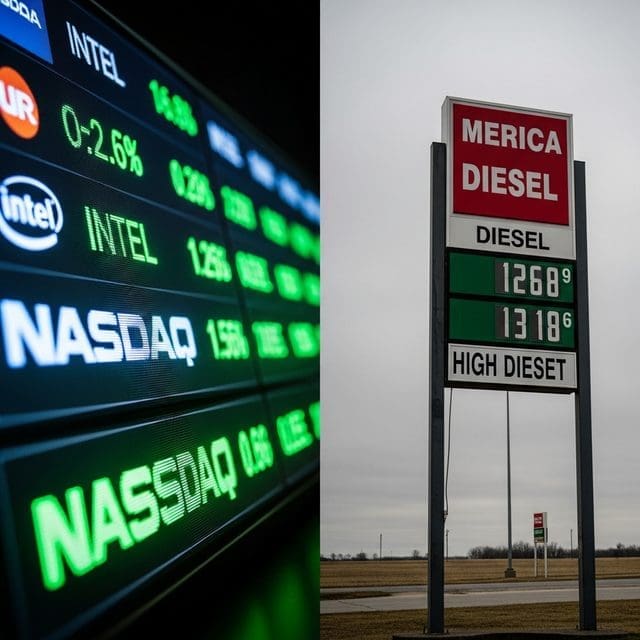
Surging diesel and oil prices push U.S. consumer sentiment to record lows while a leadership transition at the Federal Reserve accelerates following the dismissal of legal charges against Chairman Powell.
The American economic landscape is currently defined by a sharp disconnect between the record-breaking performance of Wall Street technology shares and the fiscal anxieties of Main Street. While the Nasdaq 100 reached new heights on the back of a semiconductor rally, the University of Michigan’s Consumer Sentiment Index has plunged to a record low of 49.8. This erosion of confidence is driven primarily by a 46% surge in diesel prices over the last nine weeks and a one-year inflation expectation that has climbed to 4.7%.
Central to this instability is the tightening grip of energy costs. Brent crude has surpassed $105 per barrel as the Strait of Hormuz remains effectively closed. Although Iran has reportedly proposed a plan to reopen the vital waterway by deferring nuclear negotiations, President Trump recently canceled high-level diplomatic missions to the region, citing the Iranian negotiating position. For the American taxpayer, this geopolitical friction translates directly to higher costs for fuel, fertilizers, and consumer goods, as evidenced by Goldman Sachs raising its year-end oil price forecasts.
In Washington, the institutional framework of the U.S. monetary system is preparing for a significant transition. The Department of Justice has dropped its case against outgoing Federal Reserve Chairman Jerome Powell regarding alleged false statements to Congress about headquarters renovation costs. This legal resolution has cleared the political logjam in the Senate, with Senator Thom Tillis ending his hold on the confirmation of Kevin Warsh. A Senate Banking Committee vote is expected this Wednesday, potentially installing Warsh as a proponent of fiscal discipline just as the Fed faces a critical interest rate decision.
Despite the domestic and international turmoil—including a security breach at the White House Correspondents’ Dinner that necessitated the evacuation of the President—the technology sector remains insulated. Companies like Microsoft and OpenAI have restructured their partnerships to end exclusivity, while Apple has reclaimed the top global smartphone position despite a general market slump. Furthermore, the integration of AI into daily commerce continues, with Starbucks and Little Caesars launching ordering applications via ChatGPT.
However, the stability of the broader economy remains tethered to energy and interest rates. The Bank of Japan is expected to maintain its current rate despite 10-year yields hitting levels not seen since 1999, contributing to a complex global currency environment. For the American household, the immediate concern remains the ‘Invisible Economy’ of rising prices, where the cost of living continues to outpace the gains seen in high-tech equity indices.

Jordan Lee serves as the Senior Correspondent for Wall Street, Finance, and Monetary Systems at Just Right News. Based in the heart of the world’s financial capital, New York City, Lee brings a sharp, principled eye to the complex mechanisms that drive the global economy. His reporting is defined by a commitment to fiscal responsibility, the defense of the free market, and a deep-seated belief that a transparent monetary system is the bedrock of a free society.
Raised in Portland, Oregon, Lee’s perspective was forged in a city that has undergone significant cultural and economic shifts. His upbringing in the Pacific Northwest instilled in him a profound appreciation for the industriousness of small business owners and the importance of local economic stability. Watching the evolution of his hometown’s landscape sparked an early interest in how federal fiscal policy and large-scale financial trends eventually trickle down to the average citizen. This background provides him with a unique vantage point; he understands the growing disconnect between the policy-making elite and the reality of Main Street, a theme that frequently resonates throughout his work.
Now operating from his base in New York City, Lee bridges the gap between the high-stakes trading floors of Manhattan and the households of everyday Americans. He views the financial sector not merely as a collection of numbers and tickers, but as a vital engine of American prosperity that requires constant vigilance and accountability. His reporting often highlights the dangers of centralized financial control and the necessity of maintaining a system that rewards merit, risk-taking, and innovation.
As the creator and lead of the featured series, “The Invisible Economy,” Lee pulls back the curtain on the often-opaque world of monetary systems. He specializes in translating the dense jargon of central banking and international finance into actionable insights for the Just Right News audience. His work explores the “invisible” forces—such as inflationary pressures, regulatory creep, and the expansion of the administrative state—that erode the purchasing power of American families. By focusing on these systemic issues, Lee empowers readers to understand the hidden forces shaping their financial independence.
Lee’s journalistic philosophy is rooted in a steadfast commitment to traditional American values. As an Asian American professional who has navigated the competitive corridors of the financial world, he is a vocal advocate for meritocracy and the preservation of the American Dream. He believes that a stable currency and a predictable regulatory environment are essential for national sovereignty and individual liberty. His reporting frequently warns against the risks of government overreach in the private sector, arguing that the most effective solutions to economic challenges arise from competition and individual enterprise rather than bureaucratic mandates.
At Just Right News, Jordan Lee remains dedicated to providing a clear-eyed defense of the taxpayer. Whether he is analyzing market volatility or investigating the long-term implications of national debt, his mission is to provide the truth about where the money is going and what it means for the future of the country. Through his rigorous analysis and principled stance, Lee has become a trusted voice for those who value a strong, sovereign, and fiscally sound America.