

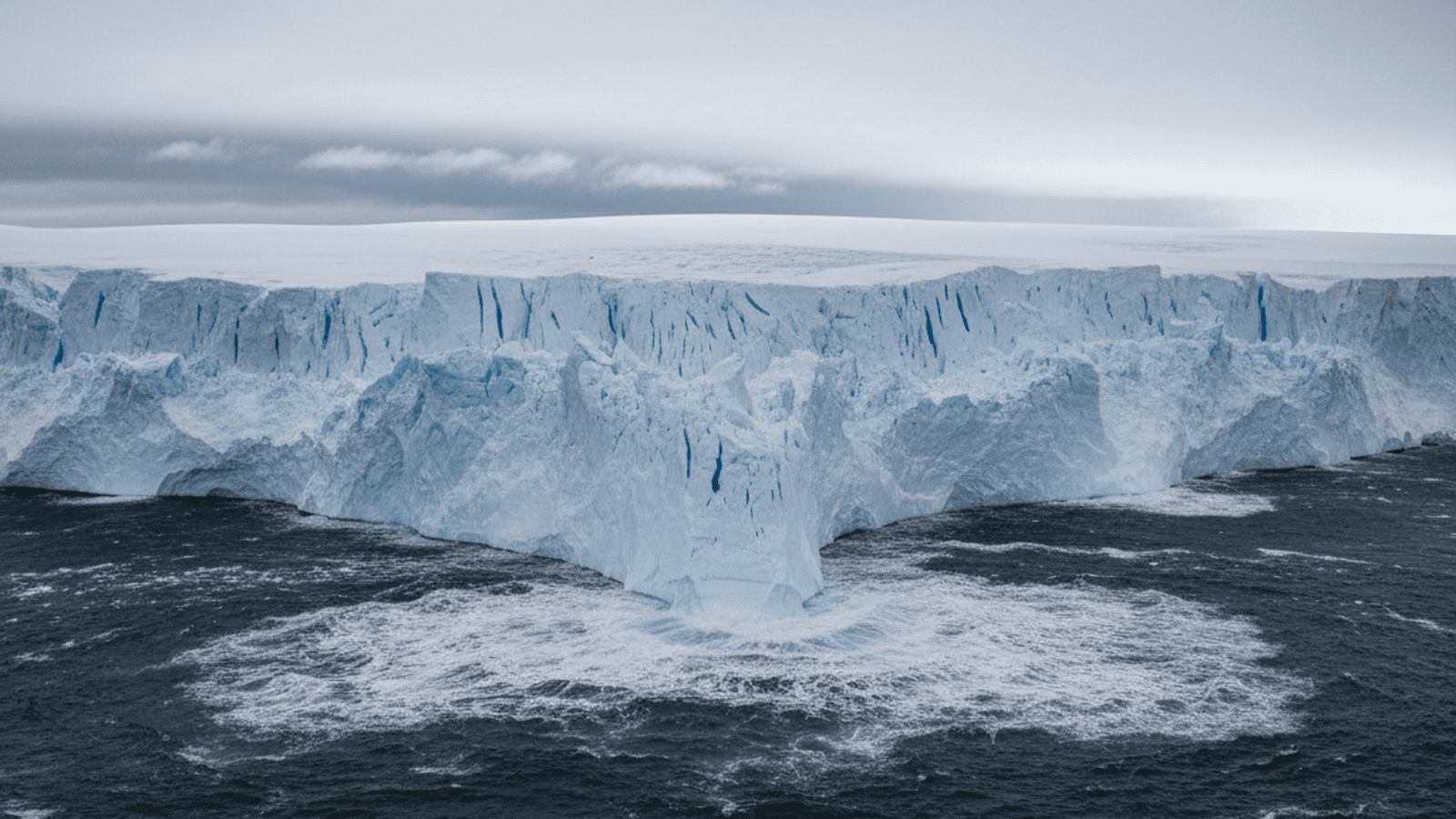
Researchers have discovered that warm seawater is being pushed deep beneath the Thwaites Glacier in West Antarctica, causing much faster melting than previously modeled. This tidal pumping mechanism suggests that current sea-level rise projections may be conservative.
TLDR: A study using high-resolution satellite radar has revealed that warm, high-pressure seawater is intruding kilometers beneath Antarctica’s Thwaites Glacier. This tidal pumping mechanism accelerates ice melt from below, indicating that the Doomsday Glacier is more vulnerable to rapid collapse and sea-level rise than previously estimated.
The Thwaites Glacier in West Antarctica, a massive ice formation roughly the size of Florida, has long been a focal point for climate scientists due to its potential to significantly raise global sea levels. Recent findings published in the Proceedings of the National Academy of Sciences have revealed a previously unknown vulnerability in this critical ice mass. A team of researchers, utilizing advanced satellite radar technology, discovered that warm, high-pressure seawater is being forced kilometers beneath the glacier’s grounded ice. This process, described as a tidal pumping mechanism, suggests that the glacier is melting from below at a rate far exceeding previous estimates.
To achieve these results, the research team, led by glaciologists from the University of California, Irvine, relied on data from the ICEYE satellite constellation. This Finnish-based network provides high-frequency, high-resolution synthetic aperture radar imagery that can penetrate through clouds and darkness. Unlike traditional satellite observations that may only capture snapshots of the ice surface every few weeks, this technology allowed scientists to monitor minute deformations in the ice shelf with unprecedented precision. By tracking these changes over several months in 2023, the team identified the specific areas where the ice lifts and falls in response to tidal cycles.
The discovery centers on the grounding line, the boundary where the glacier transitions from sitting on the seafloor to floating on the ocean. Previously, scientists believed this boundary was relatively static and that seawater intrusion was limited to a narrow zone near the edge. However, the new data shows that during high tides, the ice sheet lifts enough to allow seawater to rush as far as six kilometers inland. This pressurized water carries significant thermal energy, which is transferred directly to the base of the glacier, melting the ice from the inside out.
This tidal pumping creates a feedback loop that accelerates the thinning of the ice. As the base melts, the glacier loses its grip on the seafloor, allowing it to flow more rapidly into the ocean. The researchers noted that this mechanism is not currently accounted for in most large-scale ice sheet models. The salinity and temperature of the intruding seawater are particularly effective at eroding the ice, creating large cavities that further destabilize the structure. Consequently, the projections used by international climate bodies to predict sea-level rise may be overly conservative, failing to capture the true speed of Antarctic ice loss.
The implications of a Thwaites Glacier collapse are severe for global infrastructure. Often referred to as the Doomsday Glacier, it acts as a natural dam, holding back the vast West Antarctic Ice Sheet. If Thwaites were to melt completely, it could raise global sea levels by more than 60 centimeters. Furthermore, its removal could destabilize neighboring glaciers, potentially leading to an additional three meters of sea-level rise over several centuries. Such a scenario would permanently alter global coastlines and displace millions of people in low-lying regions.
This study underscores the critical importance of high-resolution monitoring in polar regions. While the physical environment of Antarctica remains difficult to access for direct field measurements, satellite technology is bridging the gap in understanding sub-glacial processes. The research team emphasizes that the next phase of climate science must involve integrating these tidal dynamics into global circulation models. Understanding the complex interaction between the ocean and the ice is essential for providing accurate forecasts and allowing coastal nations to prepare for the coming changes in sea level. Future expeditions will likely focus on deploying sensors directly into these sub-glacial cavities to measure water flow and temperature in real-time.

Mark Davis serves as the Senior Correspondent for Energy, Climate, and Resource Economics at Just Right News. In an era where the conversation around the environment is often dominated by alarmism and top-down mandates, Mark provides a vital, market-oriented perspective on the complex forces shaping our world. As the lead voice behind the acclaimed feature series “Power and the Planet,” he explores the intersection of environmental policy, global energy markets, and the fundamental economic principles that sustain modern civilization.
Mark’s pragmatic approach to resource management was forged in the high desert of his hometown, Albuquerque, New Mexico. Growing up in a region defined by both its breathtaking natural beauty and its rugged, resource-dependent landscape, he developed an early appreciation for the delicate balance between conservation and utilization. New Mexico’s unique position as a hub for both traditional energy production and cutting-edge scientific research provided Mark with a front-row seat to the evolution of the American energy sector. This upbringing instilled in him a deep-seated belief that true environmental stewardship is inseparable from economic prosperity and technological innovation.
Now based in Boulder, Colorado, Mark operates from the heart of the nation’s climate research community. While Boulder is often seen as a bastion of environmental idealism, Mark utilizes his post to provide a necessary counterweight, grounded in the realities of resource economics. He understands that energy policy does not exist in a vacuum; it has tangible consequences for the American taxpayer, the stability of the national power grid, and the strength of the domestic manufacturing sector. By reporting from the front lines of the climate debate, he is able to challenge prevailing narratives with hard data and a commitment to the principles of the free market.
Throughout his tenure at Just Right News, Mark has distinguished himself by focusing on the “Resource Economics” aspect of his beat. He frequently highlights the hidden costs of rapid energy transitions and advocates for an “all-of-the-above” energy strategy that prioritizes American energy independence. His work often shines a light on the geopolitical implications of resource scarcity, arguing that a secure nation must first be an energy-secure nation. Whether he is analyzing the impact of federal land-use regulations or investigating the supply chains required for new technologies, Mark remains focused on how policy decisions affect the lives and livelihoods of everyday citizens.
In “Power and the Planet,” Mark continues to bridge the gap between complex scientific concepts and the economic realities facing the country. He rejects the false choice between a healthy environment and a thriving economy, instead seeking out solutions that leverage American ingenuity and private-sector competition. For Mark, reporting on the climate is not about following the latest trends, but about ensuring that the conversation remains tethered to the foundational values of liberty, property rights, and fiscal responsibility. His contributions ensure that Just Right News readers receive a comprehensive, clear-eyed view of the challenges and opportunities defining the future of our planet.