

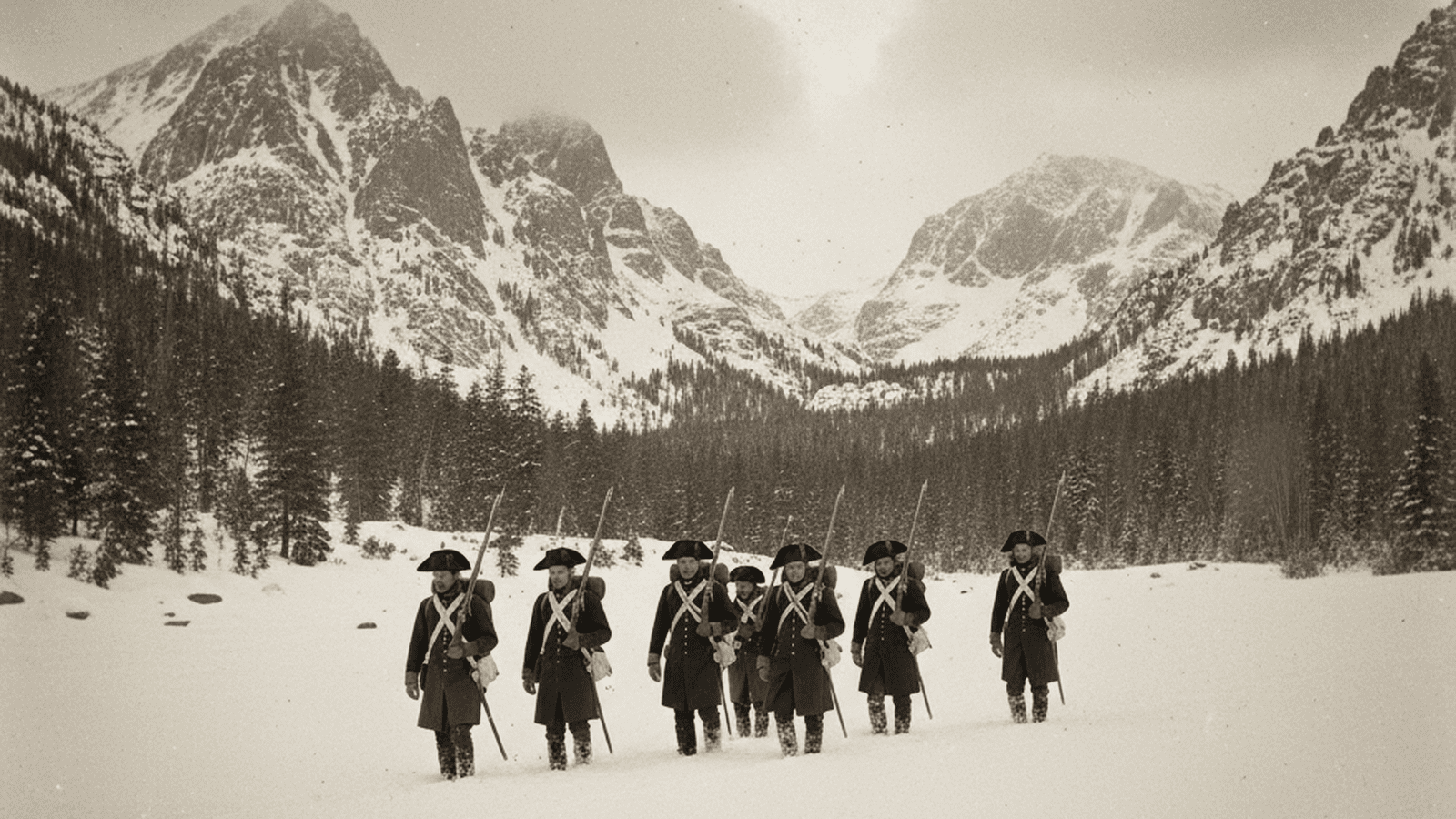
In 1806, President Thomas Jefferson authorized the Pike Expedition to explore the southern reaches of the Louisiana Purchase. This exercise of executive power in the United States led to a diplomatic crisis with Spain and the first official U.S. mapping of the Mountain West.
TLDR: President Thomas Jefferson’s 1806 authorization of the Pike Expedition tested the limits of executive power in the early United States. By sending Zebulon Pike into disputed Spanish territory in the Mountain West, the administration asserted federal authority over vast new lands, sparking international tension and shaping future westward expansion.
In July 1806, Captain Zebulon Pike departed from Fort Bellefontaine near St. Louis, embarking on a mission that would fundamentally test the boundaries of executive authority in the early American republic. While the more famous Lewis and Clark expedition had focused on the northern reaches of the Louisiana Purchase, President Thomas Jefferson and General James Wilkinson sought to define the southwestern borders of the newly acquired territory. This mission, authorized without explicit congressional debate or oversight, represented a significant assertion of the executive branch’s power to conduct sensitive geopolitical reconnaissance in disputed regions.
Pike’s formal instructions directed him to explore the headwaters of the Arkansas and Red Rivers, but the mission’s true objectives were deeply intertwined with the complex politics of the era. General Wilkinson, then the Governor of Upper Louisiana and a man of questionable loyalties, likely had ulterior motives involving the Spanish Empire. Some historians suggest the expedition was a component of the Burr Conspiracy, while others view it as a calculated effort by the Jefferson administration to challenge Spanish claims in the Mountain West. Regardless of the underlying intent, Pike’s journey into the heart of the continent was a bold exercise of federal power.
The expedition moved across the vast Great Plains, negotiating with the Osage and Pawnee nations to establish American influence. As they reached the front range of the Rocky Mountains in late 1806, Pike attempted to scale the massive peak that would later bear his name. However, the party was ill-prepared for the brutal winter conditions of the high altitudes. Pike’s men, dressed in summer uniforms and lacking adequate supplies, suffered immensely from frostbite and starvation. Despite these harrowing challenges, Pike pushed his command southward, eventually crossing the Sangre de Cristo Mountains into the San Luis Valley.
In February 1807, Pike established a small fort on the Conejos River, a tributary of the Rio Grande. This location was firmly within Spanish-held territory in present-day New Mexico. Whether by navigational error or deliberate provocation, Pike’s presence triggered an immediate response from the Spanish authorities. A detachment of Spanish troops captured the American party, accusing them of trespassing on the lands of New Spain. The capture of a U.S. military unit by a foreign power created a diplomatic firestorm for the Jefferson administration, highlighting the risks of executive-led frontier maneuvers.
Pike and his men were escorted as “guests” through Santa Fe and Chihuahua, providing Pike with a unique opportunity to observe Spanish military strength, social structures, and the economic potential of the region. Although the Spanish confiscated many of his papers, Pike managed to hide several journals in his men’s gun barrels. Upon his release at the Louisiana border in July 1807, Pike’s reports provided the federal government with its first detailed maps and descriptions of the southern Rockies and the Great Plains. These observations fueled American interest in the Santa Fe Trail and the eventual annexation of the Southwest.
The Pike Expedition highlighted the enduring tensions between executive initiative and constitutional constraints. Jefferson’s use of the military for western exploration established a precedent for the explorer-soldier model that would dominate 19th-century expansion. It demonstrated how the executive branch could unilaterally shape foreign policy and territorial claims through clandestine or semi-official missions. In the years following Pike’s return, the federal government increasingly relied on executive orders to manage territorial disputes. While the controversy surrounding General Wilkinson’s conduct led to scrutiny, the mission ultimately reinforced the president’s role as the primary architect of westward growth, setting the stage for the formal organization of the Mountain West.

Miles Harrington serves as the Senior Correspondent for Federal Systems & Executive Power at Just Right News, where he brings a disciplined, constitutionalist lens to the inner workings of the American government. With a focus on the mechanics of the federal bureaucracy and the limits of executive authority, Harrington has established himself as a vital voice for readers who value transparency, accountability, and the preservation of the separation of powers.
A native of Richmond, Virginia, Harrington’s perspective is deeply rooted in the traditions of the Old Dominion. Growing up in a city defined by its historical significance and its role as a center of American jurisprudence, he developed an early appreciation for the foundational principles of the Republic. His upbringing in Richmond—a place where the legacy of the Founding Fathers is woven into the landscape—instilled in him a belief that the federal government should remain within its constitutional bounds. This background informs his skepticism of centralized overreach and his commitment to reporting on the ways in which the administrative state impacts the lives of everyday citizens.
In his current role, Harrington specializes in the complexities of federal systems. He doesn’t just report on the headlines of the day; he digs into the structural shifts within the executive branch that often go unnoticed by the mainstream press. Whether he is analyzing the implications of a new federal regulation or investigating the expansion of agency jurisdiction, his work is characterized by a rigorous adherence to the facts and a dedication to the rule of law.
Harrington is perhaps best known for his signature feature series, “How Washington Works.” Through this ongoing project, he demystifies the often-opaque processes of the nation’s capital, pulling back the curtain on the “Deep State” and the unelected officials who wield significant influence over national policy. By breaking down complex legislative maneuvers and executive orders, he empowers Just Right News readers to understand the true levers of power in Washington. His reporting serves as a necessary check on the federal government, ensuring that the actions of those in power are held up to the light of public scrutiny.
Now based in Washington, D.C., Harrington operates at the epicenter of the political world, yet he remains intentionally distanced from the “Beltway bubble.” His proximity to the halls of power allows him to maintain a robust network of sources across the federal landscape, but his heart remains in the principled conservatism of his Virginia roots. He views his role not merely as a reporter, but as a steward of the public trust, dedicated to providing the clarity and context that conservative voters need to navigate an increasingly complex political environment.
Through his sharp analysis and unwavering commitment to the truth, Miles Harrington continues to be a cornerstone of the Just Right News team. His work ensures that the principles of limited government and executive restraint remain at the forefront of the national conversation, providing a crucial service to those who believe in a government that is truly of, by, and for the people.