

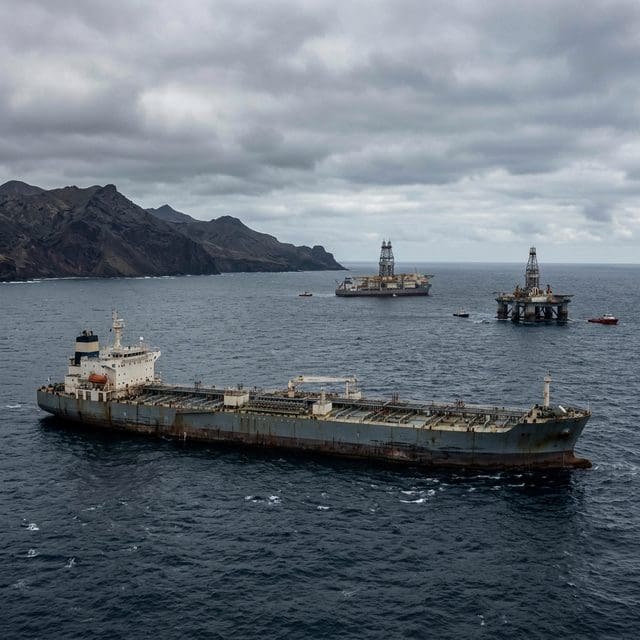
A tribunal rejected Argentina’s request to halt oil activity near the Falklands, while tanker attacks around Hormuz continue to complicate oil-market expectations of a surplus.
An international tribunal has rejected Argentina’s request to halt oil activity near the UK-held Falkland Islands, leaving a disputed offshore project in play even as a separate legal challenge remains unresolved. The ruling lands amid a volatile oil market in which expectations of recovering supply are pulling prices down, while attacks on tankers and energy infrastructure preserve a significant geopolitical risk premium.
The International Tribunal for the Law of the Sea declined Argentina’s request for provisional measures on November 28, according to reports by ABC News and Al Jazeera. The tribunal’s reasoning, as described in the supplied account, was that Argentina’s claims did not prima facie establish jurisdiction: deciding them would require determining territorial sovereignty, an issue outside the tribunal’s authority under the UN Convention on the Law of the Sea.
That is a procedural ruling, not a final decision on sovereignty or the merits of the dispute. Argentina’s separate UNCLOS arbitration against the United Kingdom remains pending. The provisional-measures order does not prejudge the arbitral tribunal’s jurisdiction, admissibility decisions or ultimate ruling, according to the tribunal’s account summarized in the source material.
The distinction matters for the project’s prospects. The ruling removes one immediate legal obstacle to UK-authorized activity, but it does not settle the broader dispute or eliminate the chance of future legal and political complications. The tribunal also recorded UK assurances that drilling would not begin before March 21, 2027, and that no further licences would be granted while the licensing regime is suspended. The source material’s date for the start of extraction is incomplete, so it cannot establish a reliable timetable for production.
The legal decision comes as traders weigh a different set of constraints on oil supply. CNBC reported that Brent crude closed Friday at $95.44 a barrel and West Texas Intermediate at $83.08. Those levels were about 20% and 21% below their respective late-October wartime highs, as recovering Middle East crude exports revived expectations of a market surplus.
That recovery remains partial. CNBC said exports were still below pre-war levels because tankers around the Strait of Hormuz are attacked on a near-daily basis. A separate Reuters report, carried by Dawn, quoted Brent at $96.19 and WTI at $85.41 in early trading and attributed the risk premium to attacks on Hormuz-bound tankers and Saudi energy infrastructure. The different snapshots reflect separate reporting times; together they show how quickly prices can move when supply expectations and security fears collide.
For consumers and businesses, the competing forces have practical consequences. A genuine surplus could ease fuel and shipping costs, but continued disruption can reverse that relief and feed volatility into budgets and investment plans. New offshore production could eventually add supply and diversify sources, though the tribunal ruling alone does not establish when, or whether, commercial volumes will reach the market.
The case also illustrates why energy policy is difficult to reduce to a choice between production and environmental protection. The supplied reports do not quantify the project’s expected output, costs, emissions or environmental risks, and they provide no new Tesla development that would materially change the energy-market picture. Those gaps limit what can be concluded about the project’s economic or climate effects.
For now, the clearest facts are narrower: Argentina failed to obtain an immediate tribunal order stopping the activity; the larger legal dispute is still open; and global oil prices have retreated from recent peaks even as Hormuz-related threats keep supply uncertain. The balance between legal risk, secure supply, cost and emissions will depend on developments not resolved by this ruling.

Mark Davis serves as the Senior Correspondent for Energy, Climate, and Resource Economics at Just Right News. In an era where the conversation around the environment is often dominated by alarmism and top-down mandates, Mark provides a vital, market-oriented perspective on the complex forces shaping our world. As the lead voice behind the acclaimed feature series “Power and the Planet,” he explores the intersection of environmental policy, global energy markets, and the fundamental economic principles that sustain modern civilization.
Mark’s pragmatic approach to resource management was forged in the high desert of his hometown, Albuquerque, New Mexico. Growing up in a region defined by both its breathtaking natural beauty and its rugged, resource-dependent landscape, he developed an early appreciation for the delicate balance between conservation and utilization. New Mexico’s unique position as a hub for both traditional energy production and cutting-edge scientific research provided Mark with a front-row seat to the evolution of the American energy sector. This upbringing instilled in him a deep-seated belief that true environmental stewardship is inseparable from economic prosperity and technological innovation.
Now based in Boulder, Colorado, Mark operates from the heart of the nation’s climate research community. While Boulder is often seen as a bastion of environmental idealism, Mark utilizes his post to provide a necessary counterweight, grounded in the realities of resource economics. He understands that energy policy does not exist in a vacuum; it has tangible consequences for the American taxpayer, the stability of the national power grid, and the strength of the domestic manufacturing sector. By reporting from the front lines of the climate debate, he is able to challenge prevailing narratives with hard data and a commitment to the principles of the free market.
Throughout his tenure at Just Right News, Mark has distinguished himself by focusing on the “Resource Economics” aspect of his beat. He frequently highlights the hidden costs of rapid energy transitions and advocates for an “all-of-the-above” energy strategy that prioritizes American energy independence. His work often shines a light on the geopolitical implications of resource scarcity, arguing that a secure nation must first be an energy-secure nation. Whether he is analyzing the impact of federal land-use regulations or investigating the supply chains required for new technologies, Mark remains focused on how policy decisions affect the lives and livelihoods of everyday citizens.
In “Power and the Planet,” Mark continues to bridge the gap between complex scientific concepts and the economic realities facing the country. He rejects the false choice between a healthy environment and a thriving economy, instead seeking out solutions that leverage American ingenuity and private-sector competition. For Mark, reporting on the climate is not about following the latest trends, but about ensuring that the conversation remains tethered to the foundational values of liberty, property rights, and fiscal responsibility. His contributions ensure that Just Right News readers receive a comprehensive, clear-eyed view of the challenges and opportunities defining the future of our planet.