

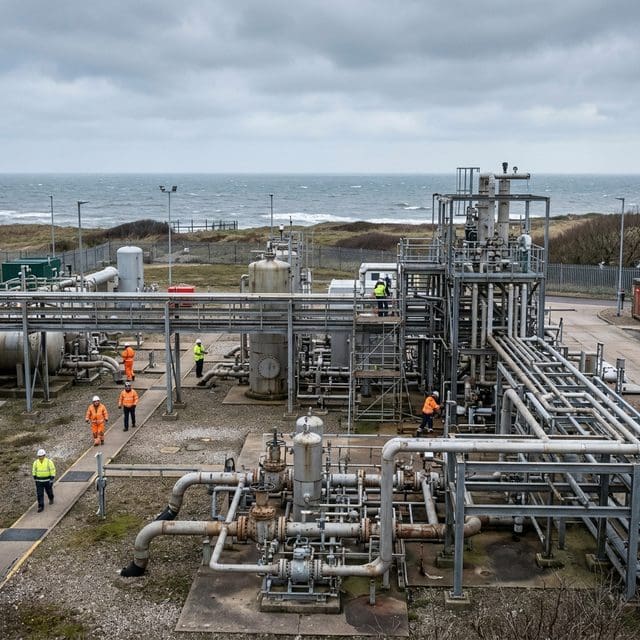
Centrica is seeking urgent talks over Rough’s future as cold-weather grid warnings sharpen questions about reliability, cost and Britain’s energy plans.
Centrica, the owner of British Gas, is pressing the UK government for urgent talks over the future of Rough, the country’s largest gas-storage facility. Its operating consent expires next spring, while cold-weather conditions have put additional attention on the reliability of Britain’s energy system.
The dispute illustrates a basic challenge for energy policy: having enough gas for the coming winter does not necessarily settle where it will be stored, how quickly it can be delivered or what investment will support supply in future years. Storage offers flexibility, but maintaining capacity requires a commercial case or public support.
Centrica said the government rejected a proposed short-term storage arrangement for winter 2026–27 and delayed its full response until sometime in 2027, according to ITV News. Rough’s current consent expires April 30, 2027, and the North Sea Transition Authority has approved cessation of operations. The Guardian reported that Centrica’s chief executive told workers at the Yorkshire-coast facility the company was doing what it could to save their jobs.
The question is not simply whether Britain has sufficient gas today. A storage facility can help manage swings in supply and demand, but its value depends on whether operators can earn enough to justify the expense of keeping it available. Public support could preserve capacity while shifting some cost or risk to taxpayers and consumers. Leaving the decision to private operators avoids that direct commitment, but could mean less domestic storage if returns do not justify investment.
The Department for Energy Security and Net Zero said National Gas’s Winter Outlook indicates enough gas for the coming winter and that it is considering options for future commercial support, ITV reported. That addresses near-term adequacy, but does not settle what level of storage Britain wants over the longer term or who should pay for it. The available reporting does not provide verified figures for last winter’s share of supply from storage or the number of jobs potentially affected by closure.
The issue has gained urgency as Britain’s grid operator asked market participants to prepare additional backup generation for an unprecedented fourth consecutive day, according to ITV. Maintenance coincided with a cold snap; the report did not specify how much backup capacity was sought. Gas storage and electricity backup are different resources, but both highlight the value—and cost—of preparing for tight conditions before they arrive.
The Rough dispute is unfolding alongside a wider push to electrify energy use and expand the infrastructure needed to support it. At a November 10 COP31 energy ministerial in Antalya, International Energy Agency Executive Director Fatih Birol said faster electrification, investment in grids and clean-energy technologies could advance energy security and climate goals together. The meeting was co-chaired by the IEA and Türkiye’s energy ministry.
Electrification can reduce fossil-fuel use in some sectors, while clean generation can lower emissions. But rising electricity demand from industry, urbanisation, data centres and other uses also puts pressure on grids. Reliable supply requires investment, including ways to balance periods when renewable output varies. The IEA said the COP31 discussions addressed immediate energy-market pressures as well as longer-term climate goals. The available material does not establish a verified numerical target for the initiative discussed there.
For Britain, keeping Rough available could provide flexibility, but only if the costs and commercial case are clear. Closing it could avoid ongoing investment while increasing reliance on other sources of flexibility, such as imports, backup generation, grid upgrades or demand management. Those alternatives also carry costs and implications for reliability and emissions.
The government’s winter assessment and Centrica’s appeal address different time horizons: supply may be adequate this winter, while the future design and cost of resilience remain unsettled. The coming policy decision will show whether Britain treats gas storage as a commercial asset, strategic insurance, or capacity to replace through other investments.

Mark Davis serves as the Senior Correspondent for Energy, Climate, and Resource Economics at Just Right News. In an era where the conversation around the environment is often dominated by alarmism and top-down mandates, Mark provides a vital, market-oriented perspective on the complex forces shaping our world. As the lead voice behind the acclaimed feature series “Power and the Planet,” he explores the intersection of environmental policy, global energy markets, and the fundamental economic principles that sustain modern civilization.
Mark’s pragmatic approach to resource management was forged in the high desert of his hometown, Albuquerque, New Mexico. Growing up in a region defined by both its breathtaking natural beauty and its rugged, resource-dependent landscape, he developed an early appreciation for the delicate balance between conservation and utilization. New Mexico’s unique position as a hub for both traditional energy production and cutting-edge scientific research provided Mark with a front-row seat to the evolution of the American energy sector. This upbringing instilled in him a deep-seated belief that true environmental stewardship is inseparable from economic prosperity and technological innovation.
Now based in Boulder, Colorado, Mark operates from the heart of the nation’s climate research community. While Boulder is often seen as a bastion of environmental idealism, Mark utilizes his post to provide a necessary counterweight, grounded in the realities of resource economics. He understands that energy policy does not exist in a vacuum; it has tangible consequences for the American taxpayer, the stability of the national power grid, and the strength of the domestic manufacturing sector. By reporting from the front lines of the climate debate, he is able to challenge prevailing narratives with hard data and a commitment to the principles of the free market.
Throughout his tenure at Just Right News, Mark has distinguished himself by focusing on the “Resource Economics” aspect of his beat. He frequently highlights the hidden costs of rapid energy transitions and advocates for an “all-of-the-above” energy strategy that prioritizes American energy independence. His work often shines a light on the geopolitical implications of resource scarcity, arguing that a secure nation must first be an energy-secure nation. Whether he is analyzing the impact of federal land-use regulations or investigating the supply chains required for new technologies, Mark remains focused on how policy decisions affect the lives and livelihoods of everyday citizens.
In “Power and the Planet,” Mark continues to bridge the gap between complex scientific concepts and the economic realities facing the country. He rejects the false choice between a healthy environment and a thriving economy, instead seeking out solutions that leverage American ingenuity and private-sector competition. For Mark, reporting on the climate is not about following the latest trends, but about ensuring that the conversation remains tethered to the foundational values of liberty, property rights, and fiscal responsibility. His contributions ensure that Just Right News readers receive a comprehensive, clear-eyed view of the challenges and opportunities defining the future of our planet.