

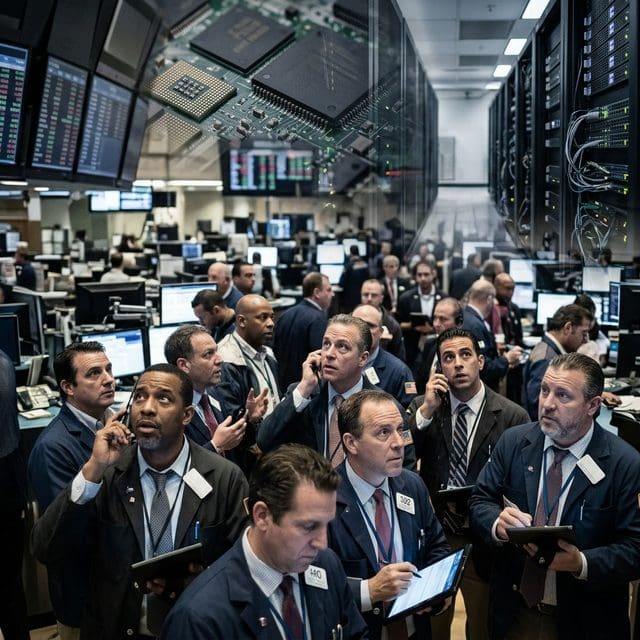
US stocks surged Friday as investors returned to technology and AI shares, while higher Treasury yields and mixed signals from oil showed the rebound was not a clear all-market shift.
US stocks ended Friday, November 27, sharply higher as investors bought technology and AI shares that had been battered during a volatile week. The S&P 500 gained 1.7% and the Nasdaq-100 rose 2.7%. Technology led sectors with a 2.8% advance, followed by communication services at 2.1%. Health care and utilities each added just 0.3%.
The session’s clearest story was a return of demand for AI-linked names. Sandisk climbed roughly 16%, while Western Digital and Seagate each rose more than 7%, and Micron advanced 7.6%, according to Investopedia’s coverage. Those gains point to strength in storage and semiconductor shares, companies tied to the infrastructure needed to build and operate data centers.
Anthropic also rebounded. The AI company’s shares rose 10.98% to $91.88, StockTitan reported, recovering above the $83 price at which it went public in November. That turn came after the stock had slipped below its IPO price, a reminder that a strong trading day does not settle questions about an AI company’s value or its path to profitable growth.
Nvidia remained central to the market’s AI debate, though Friday’s provided reporting does not establish its closing move. The company had reinstated Jensen Huang as chief executive and board chair on November 23, following his resignation amid a scandal, according to the supplied reports. The leadership reversal and Anthropic’s post-IPO decline helped frame a week in which investors weighed enthusiasm for AI against uncertainty about the returns on enormous spending.
The rally was not a simple signal that investors had become less concerned about risk. The 10-year Treasury yield rose to 4.94%, according to the supplied session coverage. Bond prices move in the opposite direction from yields; the rise indicates that Treasuries were less in demand as a haven during the stock rebound. It also matters for the market’s valuation debate: higher borrowing costs can make future earnings less valuable today, particularly for growth companies whose expected profits lie further in the future.
The available material does not identify a single Friday economic release, Federal Reserve announcement or company earnings report as the trigger for the move. Nor does it establish that the market had reached a new consensus about interest rates. The contrast between rising shares and yields instead suggests a session-specific shift toward riskier assets, not proof that inflation or monetary policy concerns had disappeared.
Currency and commodity trading offered a less uniform picture. The dollar was described as broadly steady in the supplied reports. Oil signals were mixed: the coverage cited a modest decline in crude prices, while the fresh session information indicates different moves for West Texas Intermediate and Brent. With no verified figures for both benchmarks in the material, the direction of one contract should not be treated as a complete account of the oil market.
Friday’s gains repaired some damage for AI and technology shares, but they do not resolve the underlying questions. Investors will continue to watch whether data-center spending produces earnings that justify the cost, whether chip and storage demand holds up, and how interest-rate expectations respond to incoming economic evidence. For households and businesses, the same bond yields that shape market valuations also influence borrowing costs across the economy. The next test is whether the rebound broadens beyond a concentrated group of technology names—and whether it can persist when markets again weigh growth, inflation and the price of capital.

Jordan Lee serves as the Senior Correspondent for Wall Street, Finance, and Monetary Systems at Just Right News. Based in the heart of the world’s financial capital, New York City, Lee brings a sharp, principled eye to the complex mechanisms that drive the global economy. His reporting is defined by a commitment to fiscal responsibility, the defense of the free market, and a deep-seated belief that a transparent monetary system is the bedrock of a free society.
Raised in Portland, Oregon, Lee’s perspective was forged in a city that has undergone significant cultural and economic shifts. His upbringing in the Pacific Northwest instilled in him a profound appreciation for the industriousness of small business owners and the importance of local economic stability. Watching the evolution of his hometown’s landscape sparked an early interest in how federal fiscal policy and large-scale financial trends eventually trickle down to the average citizen. This background provides him with a unique vantage point; he understands the growing disconnect between the policy-making elite and the reality of Main Street, a theme that frequently resonates throughout his work.
Now operating from his base in New York City, Lee bridges the gap between the high-stakes trading floors of Manhattan and the households of everyday Americans. He views the financial sector not merely as a collection of numbers and tickers, but as a vital engine of American prosperity that requires constant vigilance and accountability. His reporting often highlights the dangers of centralized financial control and the necessity of maintaining a system that rewards merit, risk-taking, and innovation.
As the creator and lead of the featured series, “The Invisible Economy,” Lee pulls back the curtain on the often-opaque world of monetary systems. He specializes in translating the dense jargon of central banking and international finance into actionable insights for the Just Right News audience. His work explores the “invisible” forces—such as inflationary pressures, regulatory creep, and the expansion of the administrative state—that erode the purchasing power of American families. By focusing on these systemic issues, Lee empowers readers to understand the hidden forces shaping their financial independence.
Lee’s journalistic philosophy is rooted in a steadfast commitment to traditional American values. As an Asian American professional who has navigated the competitive corridors of the financial world, he is a vocal advocate for meritocracy and the preservation of the American Dream. He believes that a stable currency and a predictable regulatory environment are essential for national sovereignty and individual liberty. His reporting frequently warns against the risks of government overreach in the private sector, arguing that the most effective solutions to economic challenges arise from competition and individual enterprise rather than bureaucratic mandates.
At Just Right News, Jordan Lee remains dedicated to providing a clear-eyed defense of the taxpayer. Whether he is analyzing market volatility or investigating the long-term implications of national debt, his mission is to provide the truth about where the money is going and what it means for the future of the country. Through his rigorous analysis and principled stance, Lee has become a trusted voice for those who value a strong, sovereign, and fiscally sound America.