

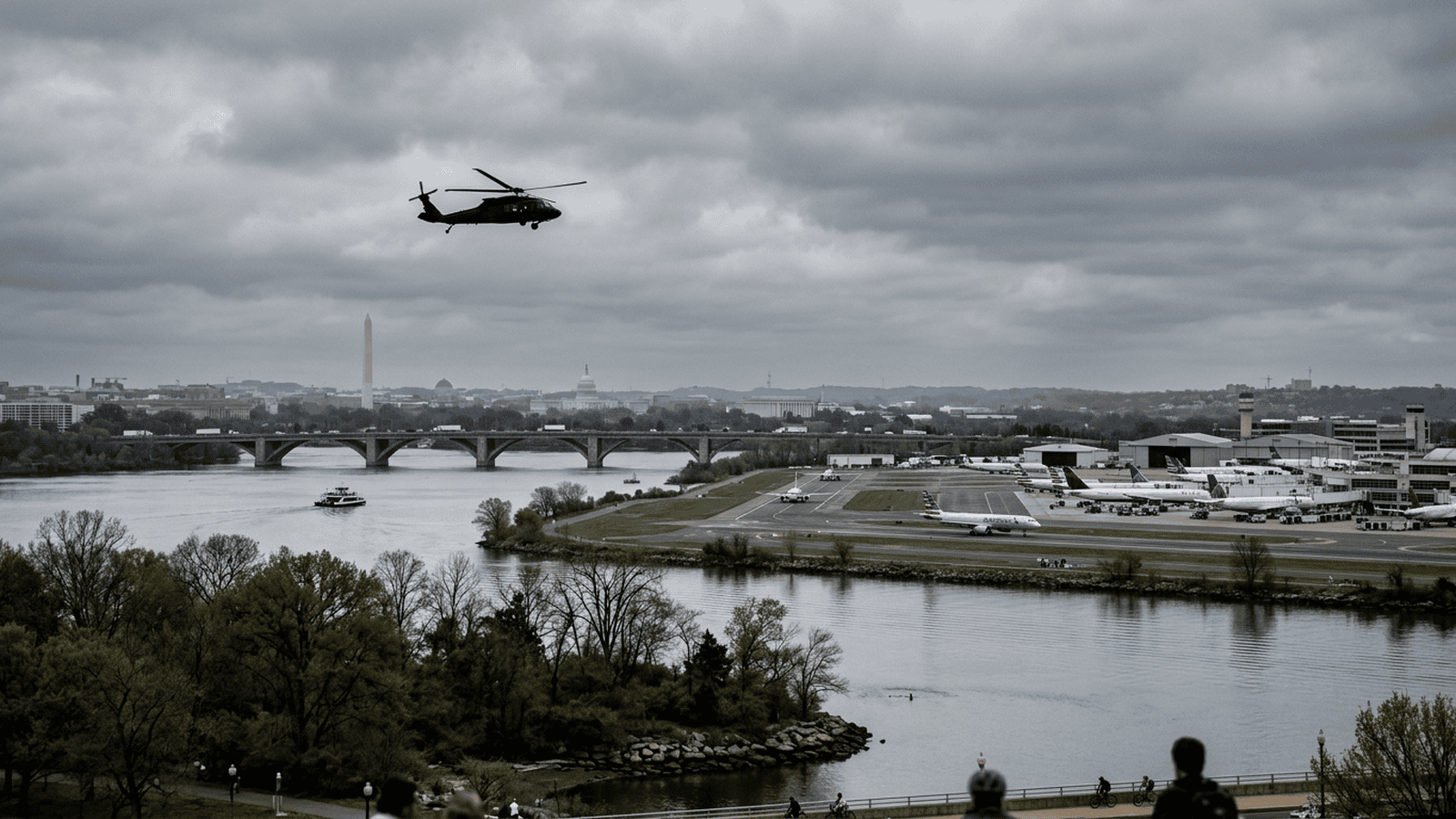
The Army is planning to resume helicopter training near Reagan National Airport, but it has not announced a timeline and the FAA says it has received no formal request. FAA approval is required before flights can restart. The training was suspended in May 2025 after two passenger jets aborted landings when a Blackhawk came too close, following a January 2025 collision that killed 67 people. The NTSB later reported years of unheeded warnings and other ignored dangers. Senators Maria Cantwell and Ted Cruz are working on legislation requiring aircraft to display and audibly announce nearby traffic, with Cruz saying he aims to pass it before January. The account does not specify proposed flight conditions, costs, or a completed safety assessment.
TLDR: The Army has signaled plans to resume training flights near Reagan National, but the FAA says it has no formal request and must approve any restart. The timing, flight conditions, safety assessment, and potential costs remain unspecified as lawmakers pursue aircraft-alert legislation.
The Army is planning to resume helicopter training flights near Ronald Reagan Washington National Airport, less than two years after a midair collision killed 67 people, including three Army pilots. The possible return has drawn attention because the airport’s airspace has seen both a fatal crash and a separate close call involving a Blackhawk helicopter. The Federal Aviation Administration says military training flights cannot restart without its approval.
The available account does not give the Army’s official reason for seeking to resume training or state its schedule. It also does not describe a change in the Army’s training needs or explain why it is seeking a return now. National Transportation Safety Board Chair Jennifer Homendy said flights could resume as early as Tuesday, Dec. 1, but the Army has not announced a timeline. The FAA said it has not received a formal request. That leaves the request, its rationale and any operating conditions unresolved.
The agency suspended training flights in the crowded airspace in May 2025. The move followed an incident in which two passenger jets had to abort their landings after a Blackhawk came too close to the airport. At the time, Transportation Secretary Sean Duffy blamed helicopter traffic on the Pentagon and said there should be no unnecessary training in congested airspace filled with civilians. His comments addressed the risks of the location, but the account does not say whether the Army has changed its plans in response.
That close call came four months after an Army helicopter on a training mission collided with an American Airlines passenger jet approaching DCA in January 2025. Everyone aboard both aircraft died. The NTSB’s yearlong review found that warnings about helicopter traffic near the airport had gone unheeded for years, along with other dangers that the board said had been ignored before the collision. The review adds context to the debate, but the available account does not detail each warning or identify any new flight plan.
Those findings make the FAA’s role central to any restart. The agency has not approved a return, and its statement says it has not received the formal request needed to consider one. The record provided does not describe proposed flight routes, training schedules, new limits or a completed safety assessment. It also does not say whether the Army has addressed the warnings identified by the NTSB. Without those details, the public account does not establish how a restart would differ from the flights that were suspended.
Sen. Maria Cantwell, a Democrat from Washington, said the FAA should not authorize flights until critical safety measures are in place and a thorough safety risk assessment is complete. That position reflects a concern about restarting activity in crowded airspace before safety questions have been resolved. The account does not establish whether the Army or FAA has completed such an assessment or what measures might be required. It also does not say whether Cantwell’s conditions have been formally adopted by the FAA.
Cantwell and Sen. Ted Cruz, a Texas Republican, have been working together on legislation after the collision. The effort would add aircraft safety features that alert pilots to nearby aircraft. Cruz said last week that House and Senate negotiators had reached a deal in principle on a requirement for a feature that displays nearby air traffic and provides visual and audible alerts. He said he intends to pass it before the new Congress is sworn in in January. The account does not say that the proposed requirement is already law or that the features are in place on aircraft near DCA. Any legislative action would be separate from the FAA’s review of an Army request.
The practical effects remain partly unknown. No fees, forms beyond the FAA’s required formal request, enforcement terms, flight limits or compliance deadlines are specified in the account. The Army has not stated when it would seek to restart flights, and the FAA has not received the request that would begin its approval process. The directly affected parties include Army training operations, the FAA, passenger airlines and travelers using the airport. The available information does not quantify any costs or delays, or say whether airlines or travelers would face changes if flights resume.
A possible date for resumption is not the same as authorization. The FAA’s approval remains necessary before training can restart, while lawmakers continue work on the proposed aircraft-alert requirement. The next steps are submission and review of the Army’s request, any FAA decision and further action on the legislation. Those steps will establish what conditions apply. The available account does not support a guarantee about the outcome or the safety measures that may be required.

Susan Carter serves as a Senior Correspondent for Just Right News, where she leads the network’s comprehensive coverage of Health, Medicine, and Public Policy. With a career dedicated to dissecting the complexities of the American healthcare system, Susan brings a principled perspective to the most pressing debates of the day. Her reporting is characterized by a commitment to individual liberty, fiscal responsibility, and a healthy skepticism of government overreach, making her a vital voice for audiences seeking clarity in an increasingly regulated landscape.
Raised in Minneapolis, Minnesota, Susan’s professional outlook is deeply informed by the values of the American heartland. Growing up in the Twin Cities, she witnessed firsthand the importance of community-driven solutions and the resilience of the individual. This Midwestern foundation instilled in her a firm belief that the best answers to public policy challenges often come from local innovation and personal responsibility rather than top-down federal mandates. Her background allows her to translate complex legislative jargon into stories that resonate with families who value common sense and local autonomy.
Now based in Baltimore, Maryland, Susan operates from a unique vantage point at the intersection of medical innovation and urban policy. Living and working in a city renowned for its world-class medical institutions and significant public health challenges, she has a front-row seat to the realities of the modern healthcare landscape. Her proximity to these hubs of research and policy allows her to scrutinize how government intervention affects the quality of care and the freedom of medical professionals. In Baltimore, she sees the tangible results of policy decisions, using the city as a lens through which to examine the broader national health debate and the impact of federal spending on local communities.
As the lead for the acclaimed feature series “The Cost of Care,” Susan dives deep into the economic realities facing patients and providers alike. Her work focuses on the necessity of price transparency, the benefits of market competition, and the preservation of the sacred doctor-patient relationship. She is a staunch advocate for the idea that a well-informed public is the best defense against bureaucratic inefficiency. Through this series, she has exposed the hidden drivers of rising medical expenses, always seeking to empower the individual consumer over the massive institution.
Susan’s reporting on public policy is characterized by a commitment to rigorous inquiry and a focus on constitutional limits. Whether she is analyzing new pharmaceutical regulations, investigating the impact of federal health mandates, or exploring the future of medical technology, her goal remains the same: to provide Just Right News audiences with the facts they need to navigate a complex world. By blending her Midwestern sensibilities with the insights gained from her base in Maryland, Susan Carter has become a trusted authority for those who believe that personal freedom and public health are inextricably linked. Her work continues to challenge the status quo, advocating for a system that respects the taxpayer and prioritizes the patient.