

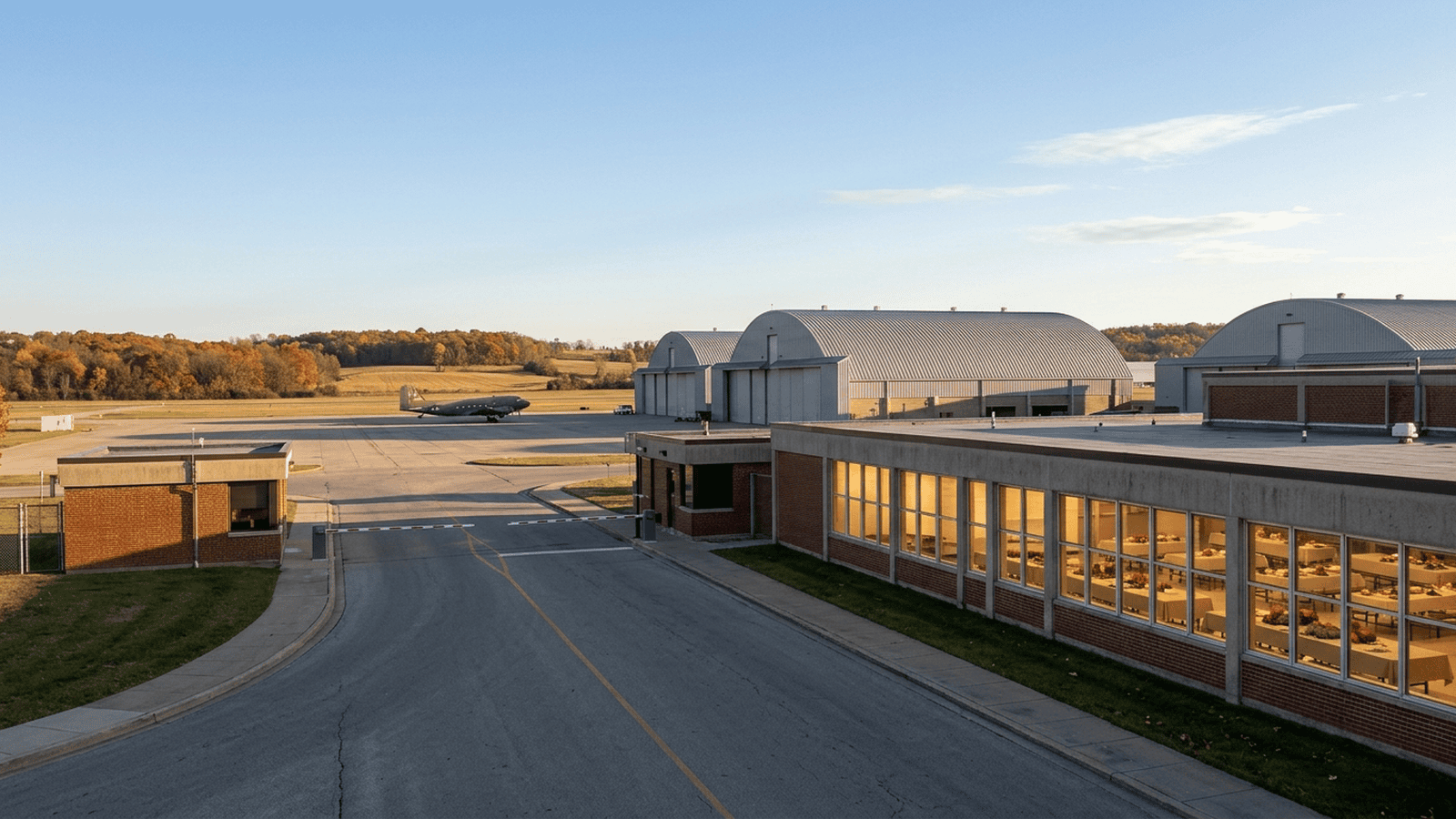
Vice President JD Vance, second lady Usha Vance and their children plan to visit Wright-Patterson Air Force Base on Wednesday, serve Thanksgiving food to troops and join them for lunch. The trip coincides with Ohio lawmakers’ effort to place the proposed U.S. Space Academy near the base’s technologically advanced complex. Sen. Bernie Moreno’s letter, signed by Sen. Jon Husted and all 15 of Ohio’s U.S. representatives, compares the proposed institution’s intended role with West Point and Annapolis. The account does not say that the administration has selected Wright-Patterson, connect the visit to a siting decision or provide a timetable, costs, construction details or oversight plan. The meal is planned; the academy’s location remains unresolved.
TLDR: Vance’s planned Thanksgiving visit to Wright-Patterson comes as Ohio’s congressional delegation urges the administration to place the proposed Space Academy near the base. The account confirms the visit and advocacy, but reports no final site decision, cost estimate or timetable.
Vice President JD Vance and his family are scheduled to visit Wright-Patterson Air Force Base in Ohio on Wednesday, where they plan to serve a Thanksgiving meal to troops and join them for lunch. The visit brings a national spotlight to a base that Ohio’s congressional delegation is promoting as a possible home for the U.S. Space Academy. The academy remains a proposal in the available account, not a confirmed administration decision.
The stated rationale for locating the academy near Wright-Patterson is the base’s technologically advanced complex and the goal of creating a prominent institution for the Space Force. Sen. Bernie Moreno described the ambition by comparing it with the service academies associated with the Army and Navy. That is a clear case for considering the site, though the material does not report a selection or explain the administration’s decision process.
Vance, second lady Usha Vance and their four children plan to spend Thanksgiving in Ohio, according to the vice president’s office. The base is in southwest Ohio, about 60 miles from the family’s home in Cincinnati and close to where Vance was born. The visit has a direct holiday purpose: serving a meal and sharing lunch with service members.
The timing also places the visit alongside a recent effort by Ohio’s elected representatives to influence a federal siting decision. Moreno led the delegation’s push for the Trump administration to place the proposed U.S. Space Academy near Wright-Patterson. The letter backing that effort was signed by Republican Sen. Jon Husted and all 15 of Ohio’s U.S. representatives, according to the account.
That support makes the proposal politically visible, but it does not settle the question of where the academy will go. The source material does not describe a formal review, a final decision, a schedule for choosing a site or the criteria the administration will use. It also does not say that Vance’s visit is connected to a decision about the academy. Keeping those events distinct is necessary to understand what is known and what remains unresolved.
Moreno’s comparison gives the proposal its central argument. In his letter, he wrote that Wright Field should hold for the Space Force a place like West Point for the Army and Annapolis for the Navy. The comparison signals a vision for an institution with a strong connection to the military branch it would serve. The material does not provide further details about the academy’s proposed programs, size, facilities or operation.
For the base, the concrete development context in the account is its existing technologically advanced complex. That feature is the stated reason Ohio’s delegation singled out Wright-Patterson. No construction plan, infrastructure assessment or estimate of added public expense is included. There is also no information about land use, local services or any effect on nearby residents and businesses, so those issues cannot yet be assessed from the available facts.
The immediate practical impact is limited to the planned Wednesday visit and meal with troops. The account identifies no new fees, forms, compliance rules, enforcement measures or deadlines tied to the Space Academy proposal. It does not say what costs a location decision could bring or which agencies would be responsible for development. Those details remain part of the plan only in the broad sense that a proposal has been advanced; the source does not confirm that planning has begun.
The delegation’s letter is an act of advocacy, not a binding order. The administration’s next step, if it takes one, would be to consider the proposed site, but the excerpt offers no timetable or description of oversight. For now, Vance’s planned Thanksgiving visit is confirmed as an event in Ohio, while Wright-Patterson’s academy role remains a request from the state’s congressional delegation. Any later decision and its costs, schedule and review process will need to be judged on the details made public. Those necessary steps are not described in the available account, and no expert assurance about the outcome is provided.
The two developments therefore carry different levels of certainty. The family’s visit and the meal are scheduled events, while the academy is still an idea backed by Ohio lawmakers. A delegation can make a case for a site, but its letter alone does not establish that federal officials have chosen it. Nor does the visit itself show that the administration has reached a conclusion.
For readers following the proposal, the key unanswered points are practical as well as political. The account does not identify other locations under consideration or say whether officials have begun comparing sites. It provides no details about how a choice would be announced or what public information would accompany it. Until those facts are available, the case for Wright-Patterson rests on the delegation’s stated rationale, and the effects of a possible academy cannot be measured.

Deborah Cole serves as a Senior Correspondent for Just Right News, where she spearheads the network’s coverage of Housing, Infrastructure, and Mobility. With a career defined by a commitment to rigorous reporting and a focus on the fundamental pillars of American community life, Deborah brings a principled perspective to the complex issues that dictate how and where we live. Her work is grounded in the belief that sound policy, fiscal responsibility, and respect for private property are the essential foundations of a prosperous society.
Originally from Boston, Massachusetts, Deborah’s upbringing in one of the nation’s oldest and most historically significant cities deeply influenced her professional trajectory. Growing up amidst the architectural legacy and dense urban planning of New England, she developed an early appreciation for the importance of durable infrastructure and the role of local tradition in shaping neighborhoods. Her perspective is informed by the classic American values of her hometown—hard work, community cohesion, and a healthy skepticism of top-down bureaucratic mandates that often overlook the unique needs of individual citizens.
Today, Deborah operates from her base in Austin, Texas, a city that serves as a primary laboratory for her reporting. Austin’s rapid expansion and its status as a hub for innovation and migration provide her with a front-row seat to the most pressing challenges in modern infrastructure and housing. From the Lone Star State, she chronicles the tensions between rapid growth and the preservation of the American Dream, often highlighting how market-driven solutions and deregulation can address the housing shortages that plague many of the country’s metropolitan areas.
At Just Right News, Deborah is perhaps best known for her signature feature series, “Where We Live.” Through this platform, she explores the intersection of public policy and private life, moving beyond mere statistics to tell the stories of families, small business owners, and local developers. Her reporting frequently highlights the importance of mobility—not just in terms of transportation and transit, but as a vehicle for economic opportunity and social stability. She remains a staunch advocate for the taxpayer, consistently scrutinizing government spending on large-scale projects and advocating for transparency in how infrastructure dollars are allocated.
Deborah’s beat is more than just a collection of policy topics; it is an investigation into the physical and legal structures that allow families to flourish. Whether she is reporting on the impact of zoning laws on suburban development or the necessity of maintaining the nation’s highway systems, her work is characterized by a dedication to the facts and a respect for the constitutional principles that protect the rights of homeowners.
As a Senior Correspondent, Deborah Cole continues to be a vital voice for Just Right News, providing the audience with the clarity and context needed to navigate an ever-changing landscape. Her reporting ensures that the values of individual liberty and local sovereignty remain at the forefront of the national conversation regarding the future of our cities and towns. Through her tireless efforts, she remains committed to informing the public on the issues that hit closest to home.