

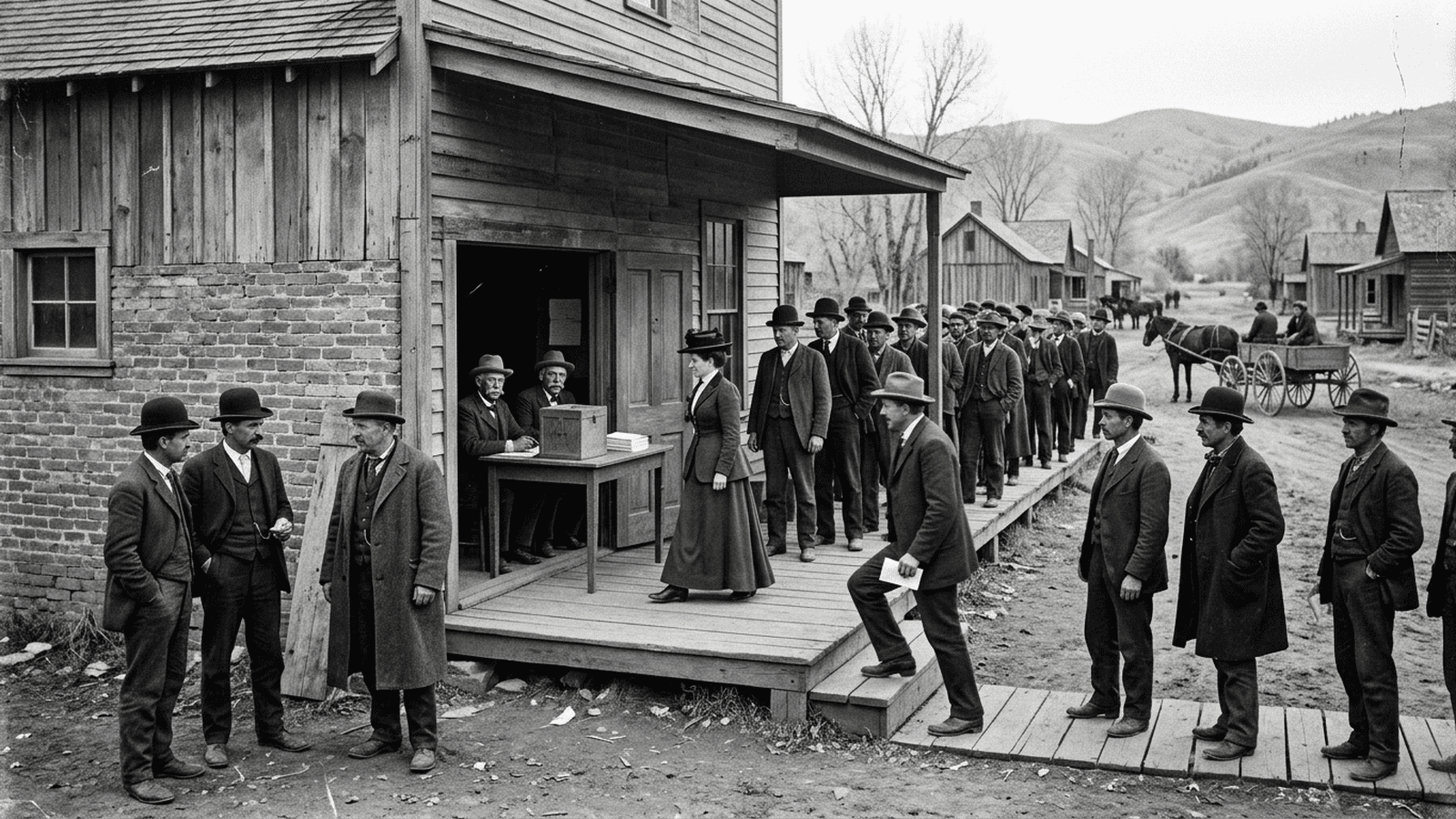
Idaho’s 1903 direct-primary law moved party nominations toward a system in which voters, rather than convention delegates alone, had a formal role. The United States reform formed part of a wider Progressive Era effort to make party politics more accountable, while leaving continuing debates over access, influence, and election administration.
TLDR: Idaho’s 1903 direct-primary law made voter participation a formal part of party nominations, challenging the convention system that had given delegates and party organizations substantial influence. The measure reflected broader Progressive Era reform, but did not eliminate party power or settle questions about access, campaign influence, and election rules.
In 1903, Idaho lawmakers approved a direct-primary system that shifted a consequential party decision from convention delegates to voters. The change belonged to a wider Progressive Era argument over political power: should party leaders and local organizations choose nominees, or should party members do so at the ballot box? Idaho’s law made the state part of an expanding western effort to open nomination contests to direct participation, though its design and reach remained matters of political debate. It also made nomination procedures a subject of public election law, not only internal party practice.
Before direct primaries, party conventions commonly selected candidates for office. Delegates gathered to negotiate slates, and the influence of party organizations could shape who reached the general-election ballot. Critics argued that this system concentrated power among insiders and made nominations vulnerable to bargaining. Supporters of reform saw a primary election as a way for ordinary party voters to register preferences directly, rather than relying on delegates whose choices might not reflect them.
Idaho’s 1903 measure established a legal route for parties to nominate candidates through primary voting. The law’s significance lay in that institutional change, not in an overnight disappearance of party influence. Political organizations still mobilized supporters, promoted candidates, and mattered in elections. A primary changed the formal decision-maker, but participation depended on voters knowing when and how to take part, and on candidates building support across their parties. State rules also had to define how the contest would be conducted, making election administration part of the reform’s practical impact.
The reform emerged in a state where political questions were closely connected to rapid settlement, mining, agriculture, and the growing reach of government. Idaho entered the Union in 1890, and its new state institutions were still taking shape. Across the West, reformers questioned whether party conventions and corporate interests had too much control over public life. Direct nomination offered a practical response: place a defined part of the political process before eligible voters, under rules set by state law. The approach promised a more visible route to nominations, though it could not by itself equalize voters’ resources or influence.
The measure also illustrated the limits of election reform. A primary could alter how nominees were selected without guaranteeing equal influence for every voter or ending organized political pressure. Campaign resources, local loyalties, and access to information continued to affect contests. Nor did direct nomination settle disagreements about party membership, ballot administration, or the proper role of party leaders. Those questions accompanied the broader transition from convention-centered politics to more voter-facing systems. In that sense, a new voting mechanism shifted political competition rather than removing it.
Idaho’s action formed part of a national pattern rather than an isolated innovation. Other states adopted or expanded primary systems during the early twentieth century, and reformers debated how much authority those elections should transfer from conventions. The details varied: states set different rules for participation, nomination thresholds, and election administration. Idaho’s 1903 law is therefore best understood as one step in a sustained reworking of how political parties connected voters to candidates. The varied state approaches meant there was no single national model, and debates over the balance between party choice and voter access continued.
The lasting consequence was a stronger expectation that party nominations could be decided through elections established by public law. Direct primaries did not remove party organizations from politics, but they changed the arena in which nominations were contested and made voter participation a formal part of that choice. Subsequent state reforms continued to adjust primary rules and election oversight, reflecting the same unresolved balance between party organization, open participation, and accountable administration.

Sophie Carter serves as a Staff Writer for Just Right News, where she anchors the outlet’s critical coverage of Elections, Influence, and Democracy Infrastructure. In an era where the mechanics of voting and the flow of political capital are under constant scrutiny, Sophie provides a steady, principled voice dedicated to the preservation of American institutional integrity and the rule of law.
Raised in Charlotte, North Carolina, Sophie’s perspective was forged in a community that balances rapid modern growth with a deep respect for tradition and civic duty. Growing up in the Queen City, she witnessed firsthand how a robust local culture depends on the trust between the citizen and the state. This upbringing instilled in her a foundational belief that the right to vote is a sacred trust—one that must be protected from both administrative overreach and the encroaching influence of special interest groups. Her reporting reflects these North Carolina roots, emphasizing the importance of community-led governance and the preservation of the individual’s voice in the face of nationalized political movements.
Now based in Atlanta, Georgia, Sophie operates from the heart of one of the nation’s most pivotal and contested political landscapes. Her location allows her to report from the front lines of the debate over election security, legislative reform, and the modernization of voting systems. For Sophie, the “infrastructure” of democracy is not merely a matter of machines and ballots; it is the collection of laws, people, and transparent processes required to maintain public confidence. Her work often highlights the necessity of clear, enforceable standards that ensure every legal vote is counted fairly and that the machinery of our republic remains accountable to the taxpayers who fund it.
Central to her work at Just Right News is her acclaimed feature series, “The Price of a Vote.” Through this ongoing project, Sophie explores the complex web of influence that shapes modern campaigns and policy decisions. She delves into how high-level lobbying, non-governmental organizations, and shifting bureaucratic regulations impact the weight of an individual citizen’s ballot. By examining the financial and structural pressures placed on the electoral process, she provides readers with a comprehensive look at the forces vying for control over the American political system.
Sophie’s approach to journalism is rooted in a commitment to the constitutional framework. She views her role as a watchdog for the voter, ensuring that the systems meant to serve the public remain transparent and free from corruption. Whether she is analyzing the implementation of new voting technologies or investigating the influence of outside money on state-level policy, her work is characterized by a rigorous adherence to facts and a refusal to succumb to the sensationalism that often plagues modern political reporting.
At Just Right News, Sophie Carter continues to be a vital resource for readers who value clarity, conviction, and a defense of traditional American values. Her deep ties to the Southeast and her specialized focus on the mechanics of our republic make her an essential voice in the ongoing conversation about the future of American self-governance. Through her reporting, she remains dedicated to the idea that a secure and honest electoral system is the bedrock of a free and prosperous society.