

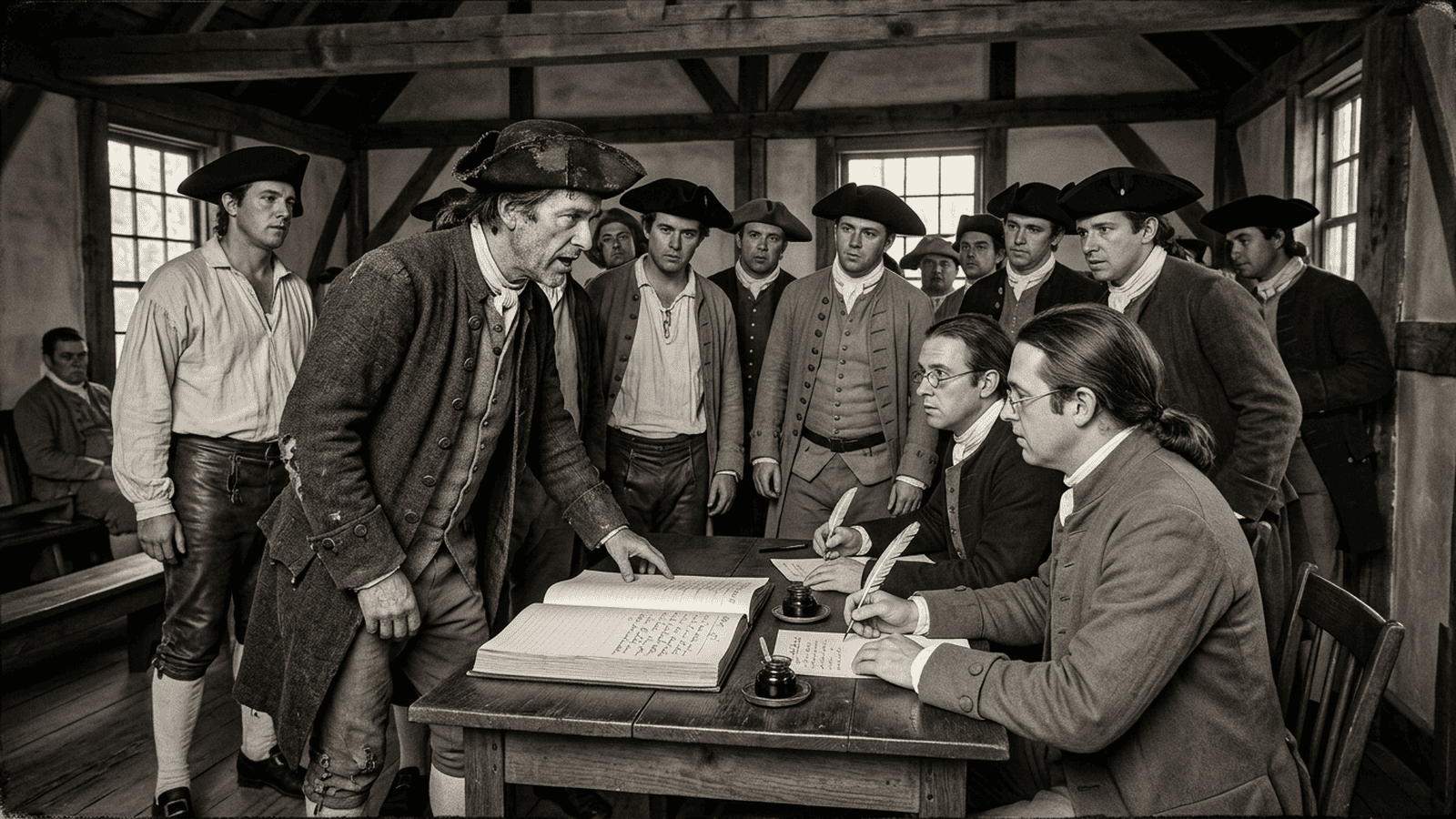
Virginia’s 1785 election law regulated a public, viva voce voting system in which qualified voters announced their choices for officials to record. The practice offered visibility but exposed voters to social and economic pressure, illustrating the limits of early U.S. election procedures and the restricted electorate.
TLDR: Virginia’s 1785 law regulated elections conducted through viva voce voting: eligible men spoke their choices aloud, and officials recorded them. Public voting made choices observable but could expose voters to pressure. The system operated within a restricted electorate and preceded later reforms favoring secret ballots and broader suffrage.
In 1785, Virginia lawmakers formalized a voting practice that made elections public performances as well as contests for office. Under the state’s viva voce system, a qualified voter announced his choices aloud before election officials, who recorded them. The method reflected an era when voting was commonly understood as a public civic act, not a private mark on a ballot. Officials had to hear each declaration and enter it accurately, making the poll book central to a count that could be disputed.
The law belonged to the unsettled political landscape that followed independence. Virginia had broken with Britain and adopted a state constitution in 1776, but its institutions still carried habits inherited from colonial government. Elections for the House of Delegates and other offices depended on local officials, county arrangements and statutes that could be revised as the new republic took shape. The 1785 measure set rules for conducting elections and recording votes within that system. County officers therefore shaped the practical process, from determining eligibility at the poll to preserving its written record for review.
The electorate was sharply restricted. Voting was generally limited to free white men who met property qualifications, excluding women, enslaved people and most free Black residents. Property tests tied political participation to economic standing, rather than simply to residence or adult status. Within that narrow electorate, however, a voice vote made each participant’s preference visible to neighbors, candidates, landlords, employers and local power brokers. A voter did not simply cast a choice; he declared it in a setting where others could hear and remember.
Supporters of public voting could regard it as a check on fraud. An announced choice could be entered into the poll record, and observers could monitor the process more directly than they could a concealed ballot. Public voting also fit republican arguments that citizens should openly account for their political judgments. Yet visibility carried costs. Social pressure, intimidation or dependence on a powerful local figure could influence what a voter said, particularly in communities where economic and political relationships overlapped. Where livelihoods depended on local patrons, a public declaration could make dissent costly even without an explicit threat.
Virginia’s system did not emerge in isolation. Viva voce voting was widespread in the early United States, and many states continued the practice well into the nineteenth century. Elections were often held at courthouses or other public places, with officials and spectators close to the voter. The procedure made participation legible to the community, but it did not provide the privacy that later reformers would treat as essential to an independent choice.
The 1785 statute should not be mistaken for universal suffrage or a modern secret-ballot reform. It regulated elections within a society whose political membership remained bounded by race, sex and property. Nor did one law eliminate local disputes over eligibility, election administration or the influence of prominent Virginians. Its importance lies in showing how a young state defined the mechanics of representation while its democratic language coexisted with extensive exclusions.
Over the following decades, arguments about electoral fairness increasingly turned on whether voters could make choices without coercion. The Australian ballot movement of the late nineteenth century helped popularize state-printed, secret ballots, while changes in suffrage gradually widened the electorate through constitutional amendments and federal laws. Those later developments did not erase Virginia’s earlier public-voting tradition; they marked a change in what reformers considered a fair election. The 1785 law offers a clear early example of election administration as a political choice: recording votes could promote transparency, while public exposure could leave voters vulnerable to pressure.

Sophie Carter serves as a Staff Writer for Just Right News, where she anchors the outlet’s critical coverage of Elections, Influence, and Democracy Infrastructure. In an era where the mechanics of voting and the flow of political capital are under constant scrutiny, Sophie provides a steady, principled voice dedicated to the preservation of American institutional integrity and the rule of law.
Raised in Charlotte, North Carolina, Sophie’s perspective was forged in a community that balances rapid modern growth with a deep respect for tradition and civic duty. Growing up in the Queen City, she witnessed firsthand how a robust local culture depends on the trust between the citizen and the state. This upbringing instilled in her a foundational belief that the right to vote is a sacred trust—one that must be protected from both administrative overreach and the encroaching influence of special interest groups. Her reporting reflects these North Carolina roots, emphasizing the importance of community-led governance and the preservation of the individual’s voice in the face of nationalized political movements.
Now based in Atlanta, Georgia, Sophie operates from the heart of one of the nation’s most pivotal and contested political landscapes. Her location allows her to report from the front lines of the debate over election security, legislative reform, and the modernization of voting systems. For Sophie, the “infrastructure” of democracy is not merely a matter of machines and ballots; it is the collection of laws, people, and transparent processes required to maintain public confidence. Her work often highlights the necessity of clear, enforceable standards that ensure every legal vote is counted fairly and that the machinery of our republic remains accountable to the taxpayers who fund it.
Central to her work at Just Right News is her acclaimed feature series, “The Price of a Vote.” Through this ongoing project, Sophie explores the complex web of influence that shapes modern campaigns and policy decisions. She delves into how high-level lobbying, non-governmental organizations, and shifting bureaucratic regulations impact the weight of an individual citizen’s ballot. By examining the financial and structural pressures placed on the electoral process, she provides readers with a comprehensive look at the forces vying for control over the American political system.
Sophie’s approach to journalism is rooted in a commitment to the constitutional framework. She views her role as a watchdog for the voter, ensuring that the systems meant to serve the public remain transparent and free from corruption. Whether she is analyzing the implementation of new voting technologies or investigating the influence of outside money on state-level policy, her work is characterized by a rigorous adherence to facts and a refusal to succumb to the sensationalism that often plagues modern political reporting.
At Just Right News, Sophie Carter continues to be a vital resource for readers who value clarity, conviction, and a defense of traditional American values. Her deep ties to the Southeast and her specialized focus on the mechanics of our republic make her an essential voice in the ongoing conversation about the future of American self-governance. Through her reporting, she remains dedicated to the idea that a secure and honest electoral system is the bedrock of a free and prosperous society.