

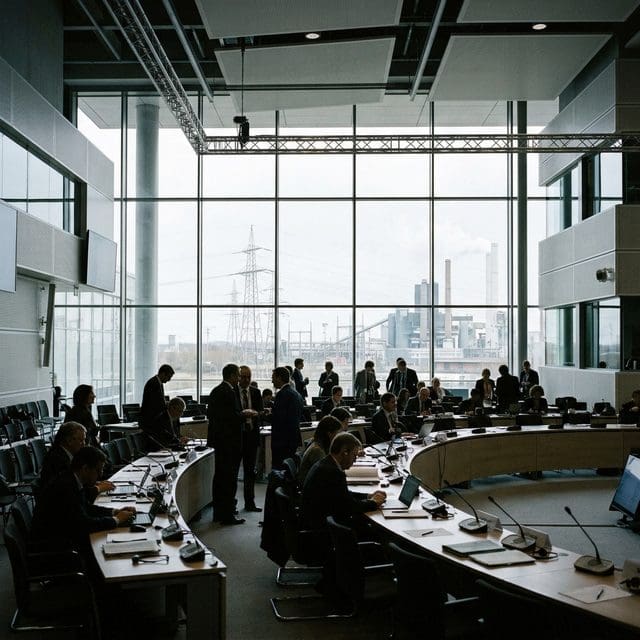
Climate negotiations left fossil fuels, emissions cuts and finance unresolved as market signals and industrial policy highlighted the economic tradeoffs of reliable, lower-emissions energy.
COP31’s closing agenda offered no easy formula for reconciling emissions cuts with energy security and investment costs. Separate decisions on just transition and adaptation advanced, but no new collective adaptation-finance target was adopted, according to a November 23 analysis by law firm Eversheds Sutherland. Disputes over fossil fuels, climate finance and emissions cuts remained unresolved.
The impasse leaves governments facing a familiar challenge: turning climate commitments into policies that attract capital, maintain reliable supplies and distribute costs. The meeting’s unresolved issues do not erase existing obligations, but they underscore how difficult it is to agree on who pays for the transition and how quickly fossil-fuel use should change. The available reporting does not estimate the economic cost of the deadlock.
Energy markets were responding to nearer-term supply and demand signals. Investing.com reported Monday that natural gas prices fell as milder heating-degree-day readings weakened the outlook for heating demand. The source material gives no verified price or size of the decline.
A separate Investing.com report said oil fell as its geopolitical premium faded, while stocks, gold and copper rebounded. No verified benchmark prices or trading figures were provided. The reports point to the range of forces that shape fuel costs: weather, supply, geopolitics and financial sentiment. Those factors affect household and industrial costs regardless of long-run emissions targets.
In the United Kingdom, Jürgen Maier, chair of Great British Energy, was appointed the government’s Northern Economy and Reindustrialisation Commissioner on November 23, Politico reported. He is to be based at No. 10 North and report to Business and Trade Secretary Jonathan Reynolds. The appointment links energy policy to regional industrial ambitions, though the announcement does not specify projects, funding or changes to Great British Energy’s mandate.
The connection matters because energy infrastructure is both a reliability requirement and an input to economic development. New generation and grid capacity can support industry, but projects carry financing, construction and operating costs. The available information does not establish how Maier’s appointment will affect those tradeoffs.
Company news offered a limited view of investor interest in the sector. Eagle Nuclear Energy said it will join the Russell Microcap Index after the U.S. market closes December 11, as part of the 2026 Russell reconstitution. Index inclusion may increase a company’s visibility among investors, but it does not demonstrate that a nuclear project is financed, permitted or ready to supply power.
Bloom Energy’s shares showed how sentiment around energy-related businesses can shift. Trefis said the stock fell 15.3% on November 20 amid a broader sell-off in AI and data-center infrastructure stocks, with no company announcement, earnings report or filing identified as the trigger. A Seeking Alpha headline on November 23, by contrast, described Bloom as leading industrial stocks higher during an AI rally. The reports cover different sessions and suggest that investor pricing may track the wider technology trade as well as company fundamentals.
BlackRock Energy and Resources Trust declared a dividend of $0.0973 per share, according to Seeking Alpha. That fund-level distribution does not establish the sector’s future returns or energy costs.
Taken together, the developments offer no single verdict on the energy transition. Climate talks remain divided over finance and fossil fuels; markets react to weather and geopolitics; and governments are tying energy to industrial policy. Each approach faces a practical test: delivering dependable supply and emissions progress at costs households and businesses can sustain.

Mark Davis serves as the Senior Correspondent for Energy, Climate, and Resource Economics at Just Right News. In an era where the conversation around the environment is often dominated by alarmism and top-down mandates, Mark provides a vital, market-oriented perspective on the complex forces shaping our world. As the lead voice behind the acclaimed feature series “Power and the Planet,” he explores the intersection of environmental policy, global energy markets, and the fundamental economic principles that sustain modern civilization.
Mark’s pragmatic approach to resource management was forged in the high desert of his hometown, Albuquerque, New Mexico. Growing up in a region defined by both its breathtaking natural beauty and its rugged, resource-dependent landscape, he developed an early appreciation for the delicate balance between conservation and utilization. New Mexico’s unique position as a hub for both traditional energy production and cutting-edge scientific research provided Mark with a front-row seat to the evolution of the American energy sector. This upbringing instilled in him a deep-seated belief that true environmental stewardship is inseparable from economic prosperity and technological innovation.
Now based in Boulder, Colorado, Mark operates from the heart of the nation’s climate research community. While Boulder is often seen as a bastion of environmental idealism, Mark utilizes his post to provide a necessary counterweight, grounded in the realities of resource economics. He understands that energy policy does not exist in a vacuum; it has tangible consequences for the American taxpayer, the stability of the national power grid, and the strength of the domestic manufacturing sector. By reporting from the front lines of the climate debate, he is able to challenge prevailing narratives with hard data and a commitment to the principles of the free market.
Throughout his tenure at Just Right News, Mark has distinguished himself by focusing on the “Resource Economics” aspect of his beat. He frequently highlights the hidden costs of rapid energy transitions and advocates for an “all-of-the-above” energy strategy that prioritizes American energy independence. His work often shines a light on the geopolitical implications of resource scarcity, arguing that a secure nation must first be an energy-secure nation. Whether he is analyzing the impact of federal land-use regulations or investigating the supply chains required for new technologies, Mark remains focused on how policy decisions affect the lives and livelihoods of everyday citizens.
In “Power and the Planet,” Mark continues to bridge the gap between complex scientific concepts and the economic realities facing the country. He rejects the false choice between a healthy environment and a thriving economy, instead seeking out solutions that leverage American ingenuity and private-sector competition. For Mark, reporting on the climate is not about following the latest trends, but about ensuring that the conversation remains tethered to the foundational values of liberty, property rights, and fiscal responsibility. His contributions ensure that Just Right News readers receive a comprehensive, clear-eyed view of the challenges and opportunities defining the future of our planet.