

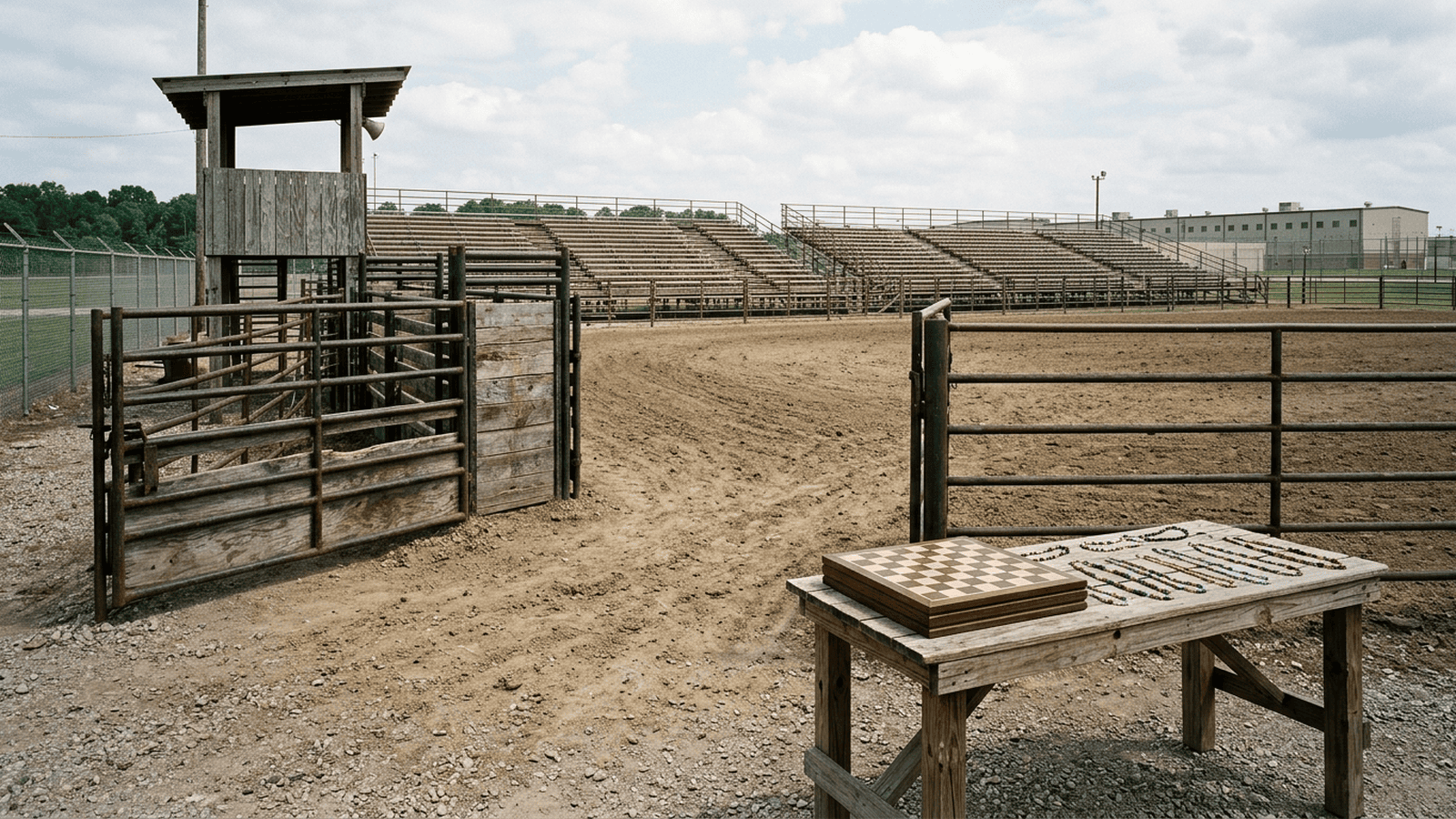
The Angola Prison Rodeo gives some incarcerated men a chance to compete, sell handmade goods, earn money, and spend time with visiting family. Around 1,000 men at Louisiana State Penitentiary earn privileges through good behavior, including the option to participate. The event runs during one weekend in April and on Sundays in October, and participants describe it as a source of purpose and accomplishment. Riders keep their winnings, while craftspeople pay 11 percent of sales to the prison; earnings are not assured, and some sellers make no sales. The available account does not describe a new policy, formal rationale, or announced oversight process.
TLDR: At Angola, eligible incarcerated men can ride in a prison rodeo or sell crafts to visitors, with participation described as an earned privilege. Riders keep prize money, while craftspeople pay 11 percent of sales to the prison, and some make no sales.
At Louisiana State Penitentiary, the Angola Prison Rodeo offers some incarcerated men a rare chance to compete before thousands of spectators. Riders climb onto wild horses and bulls. Others sell handmade goods, meet with family members, or spend the day working at their tables. The annual event takes place during one weekend in April and on Sundays in October.
The account does not describe a new government policy or provide an official policy rationale. It does explain the purpose participants find in the rodeo: a demanding activity that can create a sense of accomplishment and give structure to life in prison. Participation is described as an option earned through good behavior, not an obligation imposed on inmates.
Around 1,000 incarcerated men at the prison, described as the country’s largest maximum-security prison, earn access to various privileges through good behavior. The rodeo is one of those options. Kevin “Country” Gildhouse and Travis “Buckethead” Johnson are among the men who compete, though both are serving life sentences without parole. Their stories show how a few hours of competition can stand apart from the conditions of the rest of the year.
Gildhouse was sentenced to life without parole at 19 after he was convicted of killing a cab driver during a botched robbery. He recalls fearing the prison when he first arrived nearly two decades ago. He also described a childhood spent in foster care and moving through about 72 homes. The rodeo does not change his sentence, but he says the competition gives him a temporary break from the identity of an inmate.
In his view, riders choose to take part and compete alongside other men. John Corley, editor of the award-winning prison magazine The Angolite, describes the event as a way to give incarcerated men purpose. For men with no real prospect of release, he said, having something to do and a chance to accomplish something can make a difference in how they endure. That is a participant’s explanation, not a formal statement of prison policy.
Johnson, the reigning rodeo champion, grew up in rural Louisiana and later became addicted to drugs after his family moved to Thibodaux, about 55 miles southwest of New Orleans. He has two first-degree murder convictions dating back almost three decades. The account says he does not feel able to talk about what happened. He does, however, describe riding as a moment of accomplishment and a way to earn money that does not involve taking from anyone.
At an October rodeo, Johnson took a poker chip worth $500 from between a bull’s horns. He then leapt onto the stands and waved to the crowd. He described the result as a shared achievement, involving both his effort and the spectators’ support. The moment offers a clear example of the event’s appeal to competitors and visitors, but it does not erase the serious convictions or sentences of the men taking part.
Riding is not the only way to participate. Kenny “300” Palmer, who is also serving life without parole after being convicted of killing a man in a drug deal, chooses not to compete on horseback or on a bull. Instead, he makes chessboards and beaded necklaces to sell to visitors. He said the work gives him room to be creative and a chance to earn money. On the day of the visit described in the account, he made $87.
The rodeo’s practical terms are straightforward in the available account. Riders keep every dollar they win, while craftsmen pay 11 percent of their sales to the prison. Some men work at their tables all day and sell nothing, so earnings are not guaranteed. The account gives no details about forms, fees for spectators, event safety rules, or other compliance procedures; those details are not provided. Directly affected participants include the incarcerated riders and craftspeople, while families can visit and sit with inmates during the event.
The arrangement carries real limits. The rodeo is a temporary privilege for men in prison, not a release from their sentences, and the account notes that critics outside the prison have raised charges of exploitation. It also describes a clear difference in how earnings are treated: riders keep their winnings, while craftspeople pay a share to the prison. Those facts matter alongside the purpose and income participants say they gain. No broader claim about the prison’s finances or the event’s oversight is provided.
The next scheduled opportunities described are the annual April weekend and Sundays in October. No new deadline, policy review, or oversight process is reported, so none can be presented as an announced next step. The available account establishes the event’s schedule, its participation rules as described, and the different treatment of rider winnings and craft sales. Those are the facts available for assessing how the rodeo operates.
Mark Davis serves as the Senior Correspondent for Energy, Climate, and Resource Economics at Just Right News. In an era where the conversation around the environment is often dominated by alarmism and top-down mandates, Mark provides a vital, market-oriented perspective on the complex forces shaping our world. As the lead voice behind the acclaimed feature series “Power and the Planet,” he explores the intersection of environmental policy, global energy markets, and the fundamental economic principles that sustain modern civilization.
Mark’s pragmatic approach to resource management was forged in the high desert of his hometown, Albuquerque, New Mexico. Growing up in a region defined by both its breathtaking natural beauty and its rugged, resource-dependent landscape, he developed an early appreciation for the delicate balance between conservation and utilization. New Mexico’s unique position as a hub for both traditional energy production and cutting-edge scientific research provided Mark with a front-row seat to the evolution of the American energy sector. This upbringing instilled in him a deep-seated belief that true environmental stewardship is inseparable from economic prosperity and technological innovation.
Now based in Boulder, Colorado, Mark operates from the heart of the nation’s climate research community. While Boulder is often seen as a bastion of environmental idealism, Mark utilizes his post to provide a necessary counterweight, grounded in the realities of resource economics. He understands that energy policy does not exist in a vacuum; it has tangible consequences for the American taxpayer, the stability of the national power grid, and the strength of the domestic manufacturing sector. By reporting from the front lines of the climate debate, he is able to challenge prevailing narratives with hard data and a commitment to the principles of the free market.
Throughout his tenure at Just Right News, Mark has distinguished himself by focusing on the “Resource Economics” aspect of his beat. He frequently highlights the hidden costs of rapid energy transitions and advocates for an “all-of-the-above” energy strategy that prioritizes American energy independence. His work often shines a light on the geopolitical implications of resource scarcity, arguing that a secure nation must first be an energy-secure nation. Whether he is analyzing the impact of federal land-use regulations or investigating the supply chains required for new technologies, Mark remains focused on how policy decisions affect the lives and livelihoods of everyday citizens.
In “Power and the Planet,” Mark continues to bridge the gap between complex scientific concepts and the economic realities facing the country. He rejects the false choice between a healthy environment and a thriving economy, instead seeking out solutions that leverage American ingenuity and private-sector competition. For Mark, reporting on the climate is not about following the latest trends, but about ensuring that the conversation remains tethered to the foundational values of liberty, property rights, and fiscal responsibility. His contributions ensure that Just Right News readers receive a comprehensive, clear-eyed view of the challenges and opportunities defining the future of our planet.