

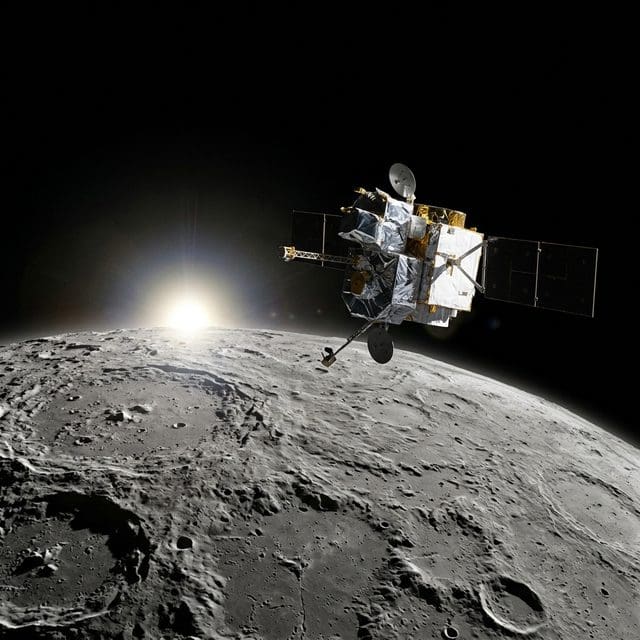
BepiColombo has reached Mercury, but a software issue shortened its insertion burn, prompting mission teams to review the spacecraft’s condition before science operations proceed.
After more than eight years in flight, the BepiColombo spacecraft has reached Mercury. Its arrival marks a major step toward studying the planet closest to the Sun—but the insertion maneuver did not go entirely as planned. A software issue cut short the burn intended to place the spacecraft in orbit.
The European Space Agency said the burn lasted 37 minutes, shorter than planned. As of Nov. 23, the spacecraft was safe and teams were reviewing telemetry: the data it sends back to Earth. ESA has not announced a scientific finding from the arrival or said whether the anomaly will change the mission’s plans.
That distinction matters. Reaching orbit is not the same as beginning a full science campaign. BepiColombo, a joint mission of ESA and Japan’s space agency JAXA, is designed to investigate Mercury up close. Its instruments are intended to help researchers study the planet and the environment around it.
Mercury is a small, rocky world, but its features raise large questions about how planets form and evolve. Scientists are also interested in how the planet sustains a magnetic field despite its size and proximity to the Sun. Measurements collected nearby can provide details that are difficult to obtain from Earth, helping researchers test ideas about the histories of rocky planets—including, with important differences, Earth.
The mission’s significance lies in the measurements it is meant to make, not in any discovery reported with this arrival update. For now, the immediate issue is operational. A burn that ends early can affect a spacecraft’s path and the steps needed to reach its intended configuration. ESA’s statement that the vehicle is safe is reassuring, but does not explain the anomaly’s effects. Reviewing telemetry helps teams determine what happened and whether adjustments are needed. The update does not specify any changes or provide a revised schedule for science observations.
The episode also illustrates the demands of deep-space exploration. Mercury’s location makes a mission there a challenge of navigation and spacecraft operations, as well as endurance. After more than eight years underway, the insertion burn was a critical transition from traveling toward the planet to operating in its vicinity. The software issue is a reminder that exploration depends not only on spacecraft hardware but on the systems that control it.
Recent activity closer to Earth shows another side of spaceflight. SpaceX launched two Falcon 9 rockets from the same California pad just over 32 hours apart on Nov. 20 and 22, setting the company’s fastest same-pad turnaround, according to SpaceX. NASA also reported that a Dragon cargo spacecraft splashed down on Nov. 21 with research material from the International Space Station, including a 3D-bioprinted blood-vessel construct and frozen tumor organoids. These missions have different goals, but both demonstrate how spaceflight supports exploration and research.
BepiColombo’s next chapter depends on the review underway. If the spacecraft proceeds as intended, its instruments could give researchers a much closer look at a planet that remains less familiar than Mars or the Moon. The confirmed news for now is more limited: BepiColombo has reached Mercury, the spacecraft is safe, and teams are assessing a burn that ended early. The science results—and any answer about the anomaly’s consequences—remain to come.

Mason Reed serves as a Staff Writer for Just Right News, where he spearheads the Future Frontiers & Special Projects desk. In an era defined by rapid technological shifts and evolving social landscapes, Mason provides a steady, principled voice, examining the innovations of tomorrow through the lens of traditional American values. His work is most prominently featured in his signature series, “The Next Horizon,” where he explores the intersection of emerging technology, national sovereignty, and the preservation of individual liberty.
A native of San Diego, California, Mason’s worldview was shaped by the unique culture of his hometown. Growing up in a region defined by its strong military presence and its history of maritime industry, he developed a deep-seated respect for the institutions that provide national stability and the entrepreneurial spirit that drives the American economy. This upbringing instilled in him a belief that true progress is not found in discarding the past, but in building upon a foundation of proven principles. His reporting often reflects this San Diego influence, emphasizing the importance of a robust national defense and the necessity of maintaining a competitive edge in the global marketplace.
Now based in San Francisco, Mason operates from the heart of the world’s technological engine. Living and working in the Bay Area provides him with a front-row seat to the advancements—and the ideological challenges—emanating from Silicon Valley. While many in the region embrace a “move fast and break things” mentality, Mason’s reporting serves as a vital counterweight. He offers Just Right News readers a “boots on the ground” perspective, documenting how radical local policies and the concentration of tech power impact the everyday lives of citizens. His proximity to the industry allows him to cut through the marketing jargon of big tech to uncover the real-world implications for privacy, free speech, and the nuclear family.
In his “Future Frontiers” beat, Mason tackles complex subjects ranging from the ethics of artificial intelligence to the burgeoning private space race. He approaches these topics with a healthy skepticism toward centralized bureaucracy, championing instead the decentralized innovations that empower individuals. Through “The Next Horizon,” he highlights the pioneers and thinkers who are working to ensure that the future remains a place where human dignity and constitutional rights are protected. He believes that the rapid pace of change requires more than just technical expertise; it requires a moral compass rooted in the Western tradition.
Throughout his tenure at Just Right News, Mason has remained committed to the idea that the future is something to be shaped, not merely accepted. His writing is characterized by a rigorous defense of American exceptionalism and a belief that the country’s best days lie ahead, provided it remains true to its founding ideals. Whether he is investigating the impact of automation on the American workforce or profiling the next generation of aerospace engineers, Mason Reed ensures that his readers are equipped with the insights they need to navigate a changing world with confidence and clarity.