

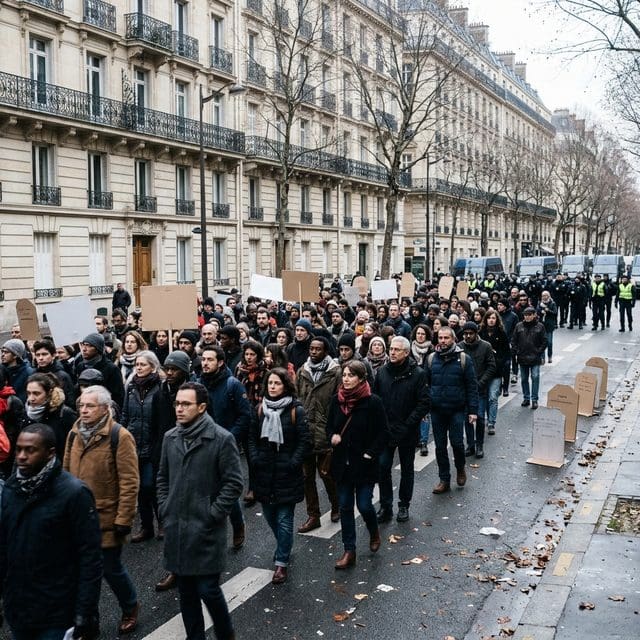
Demonstrations entered a sixth weekend as French protesters demanded better services and relief from living costs, though estimates differed sharply over turnout.
Protests over living costs, inequality and public services continued across France for a sixth consecutive weekend on Saturday, drawing students, union members, activists and Yellow Vest supporters into demonstrations that have grown beyond their initial focus on schools.
The rallies put demands for education, healthcare and social protection in the streets. But the available reporting offers no new household-income or poverty figures to measure how those pressures are affecting French families. Nor does it identify a specific change to welfare benefits or other safety-net programs. The demonstrations show the political salience of public services; they do not, by themselves, establish how many households are falling behind or whether government support is reaching them.
Crowd estimates differed substantially. France’s Interior Ministry counted 82,500 demonstrators nationwide, including 21,500 in Paris. Organisers put the total at 150,000, with 45,000 in the capital, Al Jazeera reported on November 21 and 22. The organisers’ estimate was nearly twice the ministry’s nationwide count and more than twice its Paris figure, illustrating how sharply the sides differ on the size of the mobilization.
The ministry characterized turnout as declining, comparing its estimate of 82,500 with 106,000 the previous weekend. That comparison uses the ministry’s figures, not the organisers’ totals. The competing estimates make the scale and direction of the latest rallies difficult to pin down, even as both accounts indicate that demonstrations took place across the country.
The movement began in mid-September, when high-school students called for improved learning conditions. Its demands have since widened to include better education, healthcare, social protection and other public services, according to AFP and RFI. The shift from a school-focused protest to a wider set of social and economic demands helps explain why unions, activists and Yellow Vest supporters joined students in the streets.
On Saturday, protesters staged mock gravestones representing what they described as the “death” of public services, including education and social security, AFP reported. The display offered a stark political message, but the available accounts do not supply service-access measures, spending data or details of proposed benefit changes. They therefore cannot establish whether public provision has weakened, which groups are most affected, or how the protest movement’s broader claims translate into specific policy proposals.
Police moved to disperse crowds during the demonstrations, and reports described sporadic clashes and accusations of police violence. A separate report citing the Interior Ministry said 144 people were arrested nationwide; that figure did not appear in Al Jazeera’s main report. The arrest count should be distinguished from the allegations about police conduct: the material reports those accusations but does not establish findings about them.
Organisers and activists called for further protests in the coming weeks. The demonstrations carry added political significance with France’s presidential election scheduled for next year, Al Jazeera reported. The available reporting does not establish how the rallies may affect the campaign, which candidates could benefit, or whether the movement’s different participants share a single political program.
For readers tracking poverty and economic mobility, the central question remains unanswered by the available coverage: which households are losing ground, and whether public programs are cushioning that decline. The reports document grievances over living costs and public services, but do not provide poverty rates, income trends, benefit enrollment figures or comparisons across household groups. Crowd counts can indicate the reach of a protest, not the number of people experiencing hardship or the effectiveness of the safety net.
The demonstrations make clear that living costs and public services are contested issues in France. Assessing their effect on poverty or the adequacy of social protection will require evidence beyond turnout estimates, symbolic displays and protest demands.

James Foster serves as the Senior Correspondent for Inequality and the Social Safety Net at Just Right News, where he brings a principled and nuanced perspective to the most pressing economic challenges facing the nation. With a career dedicated to exploring the intersection of policy and personal responsibility, Foster has become a leading voice in documenting how government programs and economic shifts impact the American family. His reporting is characterized by a commitment to the “human element,” moving beyond cold statistics to highlight the stories of resilience, work, and community that define the modern American experience.
Foster’s perspective is deeply rooted in his upbringing in Birmingham, Alabama. Growing up in a city with a rich industrial heritage and a history of economic transformation, he witnessed firsthand the importance of the dignity of work and the strength of local institutions. In Birmingham, he saw how the most effective safety nets were often those woven by neighbors, faith-based organizations, and local civic groups. This background instilled in him a lifelong skepticism of “one-size-fits-all” solutions from distant bureaucracies, favoring instead the localized, community-driven support systems that he frequently champions in his writing.
Now based in Atlanta, Georgia, Foster operates from one of the most dynamic and rapidly evolving metropolitan hubs in the South. His location provides a front-row seat to the stark contrasts of the modern economy. From the gleaming towers of Atlanta’s financial districts to the struggling neighborhoods on the city’s periphery, Foster finds the stories that illustrate the complexities of upward mobility. His reporting from the Sun Belt serves as a microcosm for the national debate on poverty, highlighting how inflation, housing costs, and labor market shifts affect the working class in real-time.
As the lead for the acclaimed feature series “America’s Balancing Act,” Foster explores the delicate tension between providing a necessary hand up and fostering long-term independence. The series has become a cornerstone of Just Right News, offering a deep dive into the unintended consequences of social welfare policies. Foster’s work often focuses on the “cliff effect” and other systemic hurdles that can inadvertently discourage employment, arguing that true compassion is measured by how many people are empowered to leave the safety net, rather than how many are added to it.
Throughout his tenure, Foster has remained dedicated to the mission of Just Right News, providing a clear-eyed, conservative analysis of social issues. He believes that a free society thrives when individuals are empowered and the private sector is allowed to innovate. Whether he is interviewing small business owners about the challenges of a changing workforce or documenting the success of private charitable initiatives, Foster’s goal is to provide readers with the truth about the state of the American Dream. His work serves as a vital reminder that while the challenges of inequality are great, the solutions are often found in the strength of the American spirit and the preservation of traditional values.