

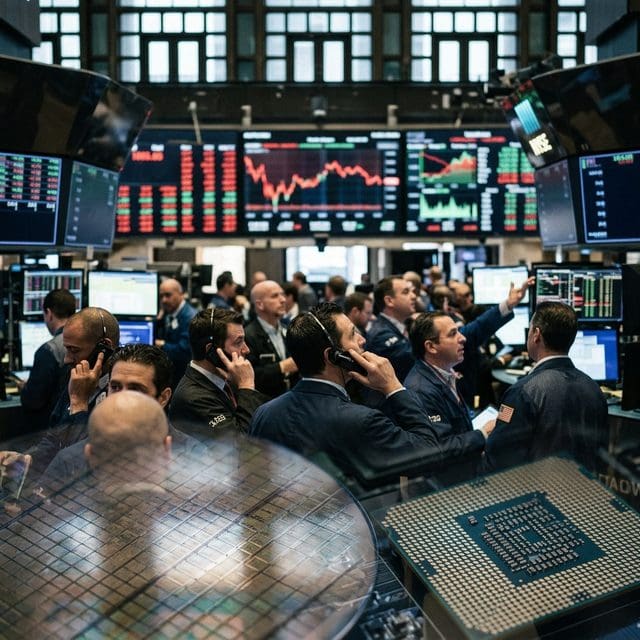
U.S. stock futures bounced after a steep weekly decline, while weak copper and renewed scrutiny of Nvidia showed that confidence in the AI trade and broader risk appetite remained unsettled.
U.S. stock futures rebounded after last week’s sharp selloff, but signs of caution remained across markets. Bloomberg reported Nasdaq-100 futures up more than 3% and S&P 500 futures up 2.9%, a move that interrupted a seven-session losing streak for the S&P 500. The report attributed the bounce to strategists who argued that the decline had created a buying opportunity—not to a fresh economic release or a change in Federal Reserve policy.
The rebound followed a broad retreat. In Friday’s session, the S&P 500 fell 3.5% and the Nasdaq-100 dropped 5.5%. Technology was the weakest sector, down 7.2%, while industrials fell 3.0%. Consumer staples rose 0.7%, and health care edged down just 0.1%, a defensive pattern consistent with investors reducing exposure to riskier areas.
The week’s damage was especially severe in semiconductors. MarketWatch reported that chip stocks lost $2.3 trillion in market value during the week ending November 20, and that a semiconductor index recorded its worst weekly performance in 25 years. The Nasdaq had its worst week since 2020; the Dow and S&P 500 entered correction territory. Those losses put the Monday futures rally in perspective: a sharp bounce can follow forced selling or bargain hunting without proving that the underlying concerns have passed.
Nvidia, a central driver of the AI trade, rose 8.3% in premarket trading, according to Bloomberg, trimming part of a 23% fall the previous week. But the company also faces a separate policy risk. Yahoo Finance reported November 23 that Treasury Secretary Scott Bessent was seeking answers about Nvidia’s semiconductor sales to China and its compliance oversight. The report said CEO Jensen Huang and the company’s general counsel were expected to appear before Congress in early December. The available material does not establish that this scrutiny caused the prior week’s decline, but it adds uncertainty around a company whose business is closely tied to advanced chips and U.S.-China trade controls.
Other markets offered a mixed picture. Treasuries fell, led by shorter maturities, Bloomberg said, meaning bond prices moved lower and yields higher. The report gave no yield levels or explanation linking the move to inflation expectations, Fed decisions or new data. The dollar was little changed, offering no clear signal of a major shift in currency demand. Brent crude dipped below $91 a barrel. Gold rose above $3,600 an ounce, while copper stayed near its lowest level since March. Bloomberg described copper’s weakness as a sign that risk appetite remained fragile, even as equity futures climbed.
The supplied reports provide limited detail on current earnings, economic releases or the Fed’s next decision, so they do not support a firm account of those forces behind the market moves. Investors were awaiting the November personal consumption expenditures inflation report on Wednesday, Reuters reported. That measure is closely watched because inflation can influence expectations for interest rates; the available material does not provide a verified probability for a December rate move.
The near-term test is whether futures gains carry into regular trading and broaden beyond a handful of battered technology names. Friday’s sector split and the scale of semiconductor losses show how concentrated the recent pressure has been. A durable improvement in market confidence would require more than a premarket rebound: investors will look for evidence in inflation data, Fed signals and company results, while Nvidia’s China-related scrutiny remains a distinct risk for the AI supply chain.

Jordan Lee serves as the Senior Correspondent for Wall Street, Finance, and Monetary Systems at Just Right News. Based in the heart of the world’s financial capital, New York City, Lee brings a sharp, principled eye to the complex mechanisms that drive the global economy. His reporting is defined by a commitment to fiscal responsibility, the defense of the free market, and a deep-seated belief that a transparent monetary system is the bedrock of a free society.
Raised in Portland, Oregon, Lee’s perspective was forged in a city that has undergone significant cultural and economic shifts. His upbringing in the Pacific Northwest instilled in him a profound appreciation for the industriousness of small business owners and the importance of local economic stability. Watching the evolution of his hometown’s landscape sparked an early interest in how federal fiscal policy and large-scale financial trends eventually trickle down to the average citizen. This background provides him with a unique vantage point; he understands the growing disconnect between the policy-making elite and the reality of Main Street, a theme that frequently resonates throughout his work.
Now operating from his base in New York City, Lee bridges the gap between the high-stakes trading floors of Manhattan and the households of everyday Americans. He views the financial sector not merely as a collection of numbers and tickers, but as a vital engine of American prosperity that requires constant vigilance and accountability. His reporting often highlights the dangers of centralized financial control and the necessity of maintaining a system that rewards merit, risk-taking, and innovation.
As the creator and lead of the featured series, “The Invisible Economy,” Lee pulls back the curtain on the often-opaque world of monetary systems. He specializes in translating the dense jargon of central banking and international finance into actionable insights for the Just Right News audience. His work explores the “invisible” forces—such as inflationary pressures, regulatory creep, and the expansion of the administrative state—that erode the purchasing power of American families. By focusing on these systemic issues, Lee empowers readers to understand the hidden forces shaping their financial independence.
Lee’s journalistic philosophy is rooted in a steadfast commitment to traditional American values. As an Asian American professional who has navigated the competitive corridors of the financial world, he is a vocal advocate for meritocracy and the preservation of the American Dream. He believes that a stable currency and a predictable regulatory environment are essential for national sovereignty and individual liberty. His reporting frequently warns against the risks of government overreach in the private sector, arguing that the most effective solutions to economic challenges arise from competition and individual enterprise rather than bureaucratic mandates.
At Just Right News, Jordan Lee remains dedicated to providing a clear-eyed defense of the taxpayer. Whether he is analyzing market volatility or investigating the long-term implications of national debt, his mission is to provide the truth about where the money is going and what it means for the future of the country. Through his rigorous analysis and principled stance, Lee has become a trusted voice for those who value a strong, sovereign, and fiscally sound America.