

Delta and FAA disruptions highlight infrastructure vulnerabilities, but available reports identify no new food-safety or water-contamination incident.
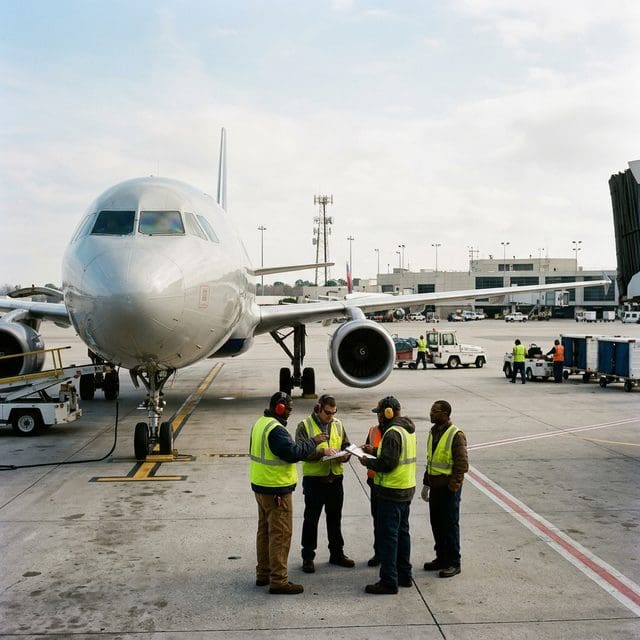
A failure in Delta Air Lines’ automated weight-and-balance system delayed flights bound for Atlanta on Nov. 22, highlighting the operational risks of systems that underpin everyday commerce. The disruption came amid separate air-traffic and technology outages. Available reports, however, identified no new food-safety, water-contamination or agricultural emergency.
The Delta system calculates aircraft weight and balance before departure. The Federal Aviation Administration first issued a ground stop, then changed it to a ground delay for flights to Atlanta. Delta used manual workarounds, and the FAA said the problem was not in its air-traffic systems. Delays averaged nearly an hour.
Reports gave different counts: one cited 364 delayed flights at Hartsfield-Jackson Atlanta International Airport; another counted 1,010 Delta flights, about 30% of scheduled flights, delayed as of 11:30 a.m. The figures use different reported measures and cannot be reconciled from the available information. Both indicate a substantial disruption at a busy travel hub.
The incident followed a separate nationwide FAA ground stop. As of Nov. 22, investigators had not identified its specific cause. The FAA paused installation of new Juniper telecommunications routers while examining how a network function that was supposed to be disabled became active. The failure destabilized 17 of the agency’s 22 en-route air-traffic-control centers.
The FAA had recently expanded its SMART cloud platform nationwide. It combines 200 data streams, but its developer said SMART did not cause the ground stop. Officials instead focused on aging communications infrastructure and the transition from copper to fiber. The router review is ongoing, and the specific technical failure remains unidentified in the available material.
Microsoft attributed a separate global Microsoft 365 outage affecting Outlook, Exchange Online, Teams and Copilot to a latent defect introduced in a July update, increased load after a Teams failover and reduced server capacity. The company said customer impact ended at 11:10 a.m. Eastern on Nov. 13. More than 80% of networking gateway servers were reported unresponsive. Microsoft’s account points to interacting causes, rather than one isolated failure.
Director of National Intelligence Jay Clayton said Americans should expect “a great deal of investment” in system upgrades and cybersecurity, while warning of “bumps in the road.” He cited outages involving Microsoft, airlines, financial institutions and the FAA. His remarks underscore the disruption that can accompany modernization, but the reporting gives no upgrade timetable or cost estimate and does not establish that any particular upgrade will improve reliability.
For food and water oversight, the findings are limited. The supplied reports include no new drinking-water measurements, food recall, contamination notice or documented farm or crop impact tied to the outages. They also identify no EPA or food-safety regulatory action prompted by the incidents. A claim that the failures compromised consumers’ food or water would go beyond the evidence.
Reliable transport and communications matter to businesses moving goods, including agricultural and food companies. But no specific disruption to those sectors is documented here. The distinction matters: an operational failure deserves scrutiny and a clear account of what went wrong, but it is not itself proof of environmental contamination. On the information available, the case is for transparent infrastructure reviews—not alarm about the safety of food or water.

Eric Nolan serves as the Senior Correspondent for Food, Water, and Environmental Health at Just Right News, where he brings a principled, common-sense perspective to the most fundamental issues facing the American public. With a career dedicated to uncovering the truth behind the policies that govern our natural resources, Eric has become a trusted voice for readers who value traditional stewardship over bureaucratic overreach. His reporting is defined by a commitment to the idea that true environmentalism is rooted in the protection of the American family and the preservation of the nation’s agricultural heritage.
Raised in Fresno, California, Eric’s worldview was shaped in the heart of the San Joaquin Valley. Growing up in one of the world’s most productive agricultural hubs, he witnessed firsthand the vital connection between the land, the water, and the dinner table. In Fresno, he saw the resilience of farmers and the devastating impact that distant, top-down regulations can have on local communities. This upbringing instilled in him a deep respect for the producers who feed the country and a lifelong skepticism toward the alarmist narratives often pushed by mainstream media. For Eric, environmental health is not an abstract political talking point; it is a matter of ensuring that the people who work the land have the freedom and the resources to do so effectively.
Now based in Eugene, Oregon, Eric operates from a unique vantage point in the Pacific Northwest. Living in a region often defined by intense environmental debate, he provides a necessary counter-narrative to the prevailing trends of the area. From his base in Eugene, he monitors the shifting tides of federal and state policies, ensuring that the voices of rural citizens and property owners are not drowned out by urban activism. His reporting often bridges the gap between the rugged realities of the outdoors and the legislative halls where decisions are made, offering a grounded perspective that prioritizes local sovereignty and practical solutions.
As the lead for the acclaimed feature series “Earth on the Table,” Eric explores the intricate journey of the American food supply. He tackles critical issues such as water rights, soil health, and food security through a lens of national stability and individual liberty. He believes that a healthy environment and a thriving economy are not mutually exclusive, but rather two sides of the same coin of national prosperity. His work consistently highlights how innovation and private-sector ingenuity are the most effective tools for ensuring clean water and a safe food supply, rather than the expansion of the administrative state.
At Just Right News, Eric’s reporting serves as a vital resource for those who seek accountability and transparency. Whether he is investigating the impact of federal land management on local economies or examining the safety of the national food infrastructure, his work remains anchored in the values of heritage and hard work. Eric Nolan continues to be a leading voice in environmental journalism, championing the belief that the best way to protect our natural resources is to empower the people who live and work closest to them.