

Ryan Chaw’s path from one student rental to 12 properties shows how room-by-room leasing can generate income—and the savings, family support and local demand behind his experience.
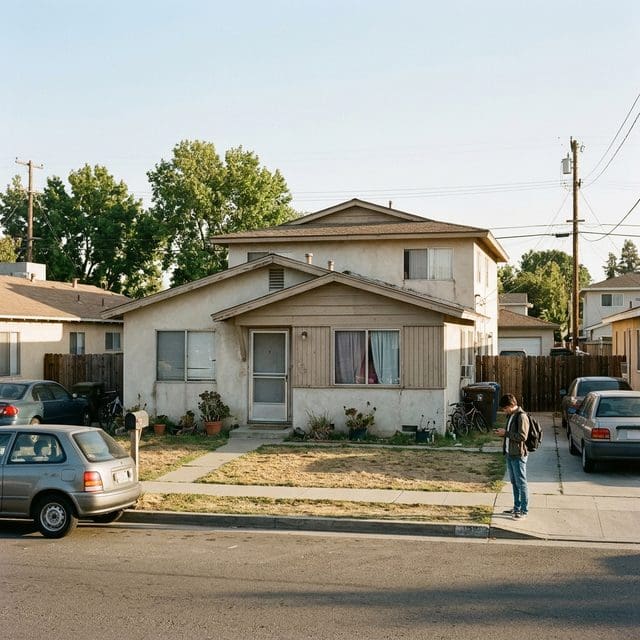
Ryan Chaw’s first rental was a three-bedroom house near the University of the Pacific in Stockton. He rented it by the room to students and later added a fourth bedroom. The approach helped him build a property portfolio, but his story also points to the capital, family support and local demand behind a frequently promoted route to real estate income.
Business Insider reported Nov. 22 that Chaw, 34, owns 12 properties: four in Stockton, one in Sacramento and seven in Ohio. He told the publication that rents in his first house rose from about $630 per room to roughly $720. The mortgage was about $2,000 a month.
Chaw bought the house for $262,000 and put $100,000 down, according to Business Insider. He used a 10-year mortgage and said he paid it off in five years. For his second property, he put 10% down and bought it as a second home. During his first five years of investing, he lived with his parents rent-free and bought roughly one property a year. His first five homes were near the university.
That arrangement is central to understanding the example. Living without rent can free up money for saving or another purchase, but it is not an option for every prospective investor. A large down payment can also be difficult to assemble for households already covering housing costs. Chaw’s experience describes one path, not evidence that a typical renter can quickly move from saving to owning multiple homes.
Room-by-room leasing can bring in more total rent than a single lease, while letting tenants pay for a room rather than an entire home. It also means managing multiple tenants and maintaining the property. Business Insider’s account is not a study of average returns or a guarantee that the model works elsewhere. The reported rent and mortgage figures do not establish the full cost of ownership, including repairs, property taxes and vacancies.
Chaw told Business Insider that he sold his first home for $437,500 and put the proceeds into Ohio. One Ohio duplex cost $367,000 and generates about $4,000 a month in cash flow, he said. After roughly eight years, he said rental income reached about $10,000 a month, enabling him to resign from his pharmacist job in August 2023. He now wants to own 100 properties.
The account comes amid a difficult market for would-be buyers. U.S. home sales reached a record low as mortgage rates remained near 7%, according to the supplied reporting; real-estate agents said buyers had gained negotiating leverage. That leverage does not remove financing costs or the challenge of saving for a down payment. Chaw’s first purchase, with $100,000 down, illustrates how access to capital can shape who is positioned to buy and invest.
For households facing high housing costs, the story is not a direct affordability fix. Rental income for an owner does not automatically mean lower rents for tenants, and the report does not say whether Chaw’s room rentals affected local housing costs. It does show one way existing homes can be leased to people seeking a room rather than an entire house or apartment. Whether that arrangement adds useful options depends on local demand and the quality and terms of the housing.
Chaw’s account offers a detailed example of one investor’s choices, not a basis for assuming most buyers can reproduce them. The outcome depended on savings, financing, family circumstances and a market where room rentals could attract tenants. For people without rent-free family housing or substantial savings, the same starting line may not be available.

Deborah Cole serves as a Senior Correspondent for Just Right News, where she spearheads the network’s coverage of Housing, Infrastructure, and Mobility. With a career defined by a commitment to rigorous reporting and a focus on the fundamental pillars of American community life, Deborah brings a principled perspective to the complex issues that dictate how and where we live. Her work is grounded in the belief that sound policy, fiscal responsibility, and respect for private property are the essential foundations of a prosperous society.
Originally from Boston, Massachusetts, Deborah’s upbringing in one of the nation’s oldest and most historically significant cities deeply influenced her professional trajectory. Growing up amidst the architectural legacy and dense urban planning of New England, she developed an early appreciation for the importance of durable infrastructure and the role of local tradition in shaping neighborhoods. Her perspective is informed by the classic American values of her hometown—hard work, community cohesion, and a healthy skepticism of top-down bureaucratic mandates that often overlook the unique needs of individual citizens.
Today, Deborah operates from her base in Austin, Texas, a city that serves as a primary laboratory for her reporting. Austin’s rapid expansion and its status as a hub for innovation and migration provide her with a front-row seat to the most pressing challenges in modern infrastructure and housing. From the Lone Star State, she chronicles the tensions between rapid growth and the preservation of the American Dream, often highlighting how market-driven solutions and deregulation can address the housing shortages that plague many of the country’s metropolitan areas.
At Just Right News, Deborah is perhaps best known for her signature feature series, “Where We Live.” Through this platform, she explores the intersection of public policy and private life, moving beyond mere statistics to tell the stories of families, small business owners, and local developers. Her reporting frequently highlights the importance of mobility—not just in terms of transportation and transit, but as a vehicle for economic opportunity and social stability. She remains a staunch advocate for the taxpayer, consistently scrutinizing government spending on large-scale projects and advocating for transparency in how infrastructure dollars are allocated.
Deborah’s beat is more than just a collection of policy topics; it is an investigation into the physical and legal structures that allow families to flourish. Whether she is reporting on the impact of zoning laws on suburban development or the necessity of maintaining the nation’s highway systems, her work is characterized by a dedication to the facts and a respect for the constitutional principles that protect the rights of homeowners.
As a Senior Correspondent, Deborah Cole continues to be a vital voice for Just Right News, providing the audience with the clarity and context needed to navigate an ever-changing landscape. Her reporting ensures that the values of individual liberty and local sovereignty remain at the forefront of the national conversation regarding the future of our cities and towns. Through her tireless efforts, she remains committed to informing the public on the issues that hit closest to home.