

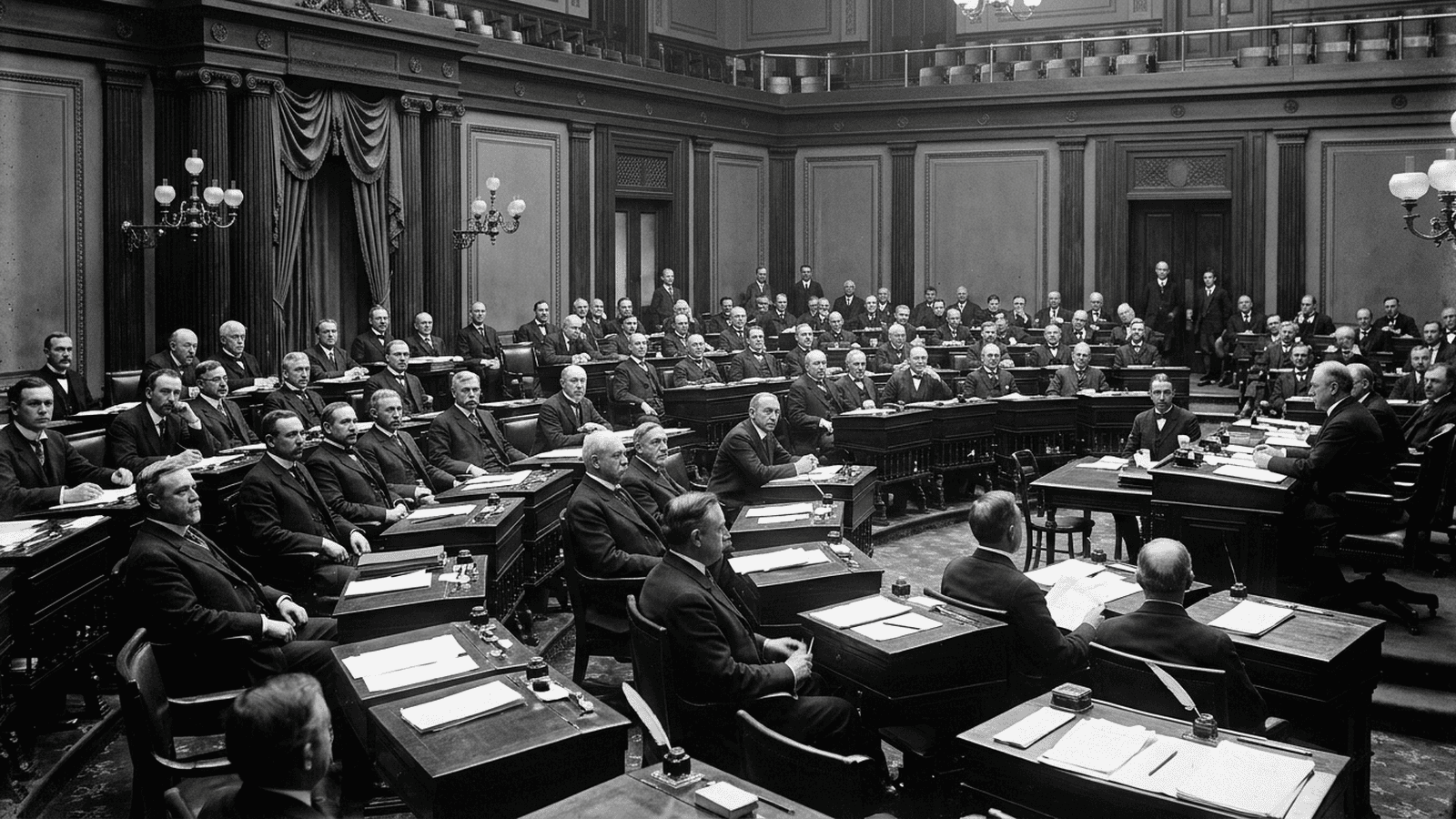
The Lorimer scandal tested whether the U.S. Senate would reverse its own decision after evidence suggested bribery had tainted an Illinois legislative election. In 1912, senators declared William Lorimer’s election void, a controversy that reinforced broader calls for direct election of senators.
TLDR: Illinois Republican William Lorimer won a Senate seat in 1909 amid allegations that state lawmakers had been bribed. The Senate initially seated him, then reconsidered as further testimony and records emerged. In 1912, it declared his election void, highlighting the chamber’s constitutional oversight role and strengthening arguments for direct senatorial elections.
In 1912, the U.S. Senate overturned its earlier decision to seat Illinois Republican William Lorimer, concluding that corruption had tainted his election. The reversal followed accusations, investigations and partisan debate over the Senate’s authority to judge its members’ elections and qualifications. The episode exposed the weakness of a system in which state legislatures, rather than voters, chose U.S. senators—and tested whether the chamber would police its own membership.
Lorimer’s path to Washington began in the Illinois legislature. After a prolonged 1909 contest for the Senate seat, he won enough lawmakers’ support to claim victory. His election drew immediate allegations that legislators had been bribed. State Representative Charles A. White later said he had been paid to vote for Lorimer and described a broader scheme involving other members. Lorimer denied buying votes and maintained that his election was legitimate.
The accusations became a national political issue. A 1910 Illinois legislative investigation failed to establish that Lorimer’s election had been secured by bribery. A special U.S. Senate committee also examined the case. Its initial majority report found insufficient grounds to exclude him, and on March 1, 1910, the Senate voted 46 to 40 to allow Lorimer to take his seat. That decision intensified scrutiny of the evidence and the chamber’s standards.
Investigators revisited testimony and financial records as more accounts of payments emerged. The inquiry focused on whether contributions and cash had been used to influence Illinois legislators. White’s testimony, initially questioned by some senators, gained importance alongside statements from other witnesses. The evidence did not produce a simple account of every payment or participant, but it raised serious doubts about whether Lorimer’s election reflected lawful legislative votes.
The constitutional stakes were unusually direct. Article I gives each house of Congress authority to judge the elections, returns and qualifications of its members. The Senate therefore had to decide not only what had happened in Illinois but also what level of proof and institutional responsibility should govern its own judgment. Supporters of Lorimer warned against overturning a state legislature’s choice on disputed testimony. Opponents argued that the Senate could not credibly tolerate a seat obtained through corrupt means.
In July 1912, a Senate committee recommended that Lorimer be unseated. It concluded that bribery had been used in securing his election and that the election was invalid. On July 13, the full Senate voted 55 to 28 to reverse its 1910 decision and declare Lorimer’s election void. He left the Senate, though the vote did not establish that every allegation made during the investigations was true or that every accused lawmaker had been bribed.
The decision was a rare instance of the Senate revisiting a member’s credentials after initially accepting them. It reflected mounting public pressure for accountability, but also demonstrated how difficult oversight could be when the institution under scrutiny controlled the investigation and final judgment. The proceedings included competing reports, contested witnesses and shifting political alignments, making the outcome a test of both evidence and the Senate’s willingness to act against one of its own.
The Lorimer affair unfolded as reformers were pressing to change how senators were selected. Ratified in 1913, the Seventeenth Amendment established direct popular election of U.S. senators, replacing selection by state legislatures. The amendment had multiple causes and advocates, and the scandal alone did not bring it about. Still, the case strengthened arguments that legislative elections invited corruption and that voters should choose senators themselves. The Senate’s reversal also left a lasting example of its constitutional power—and its responsibility—to examine the legitimacy of its membership.

Sophie Carter serves as a Staff Writer for Just Right News, where she anchors the outlet’s critical coverage of Elections, Influence, and Democracy Infrastructure. In an era where the mechanics of voting and the flow of political capital are under constant scrutiny, Sophie provides a steady, principled voice dedicated to the preservation of American institutional integrity and the rule of law.
Raised in Charlotte, North Carolina, Sophie’s perspective was forged in a community that balances rapid modern growth with a deep respect for tradition and civic duty. Growing up in the Queen City, she witnessed firsthand how a robust local culture depends on the trust between the citizen and the state. This upbringing instilled in her a foundational belief that the right to vote is a sacred trust—one that must be protected from both administrative overreach and the encroaching influence of special interest groups. Her reporting reflects these North Carolina roots, emphasizing the importance of community-led governance and the preservation of the individual’s voice in the face of nationalized political movements.
Now based in Atlanta, Georgia, Sophie operates from the heart of one of the nation’s most pivotal and contested political landscapes. Her location allows her to report from the front lines of the debate over election security, legislative reform, and the modernization of voting systems. For Sophie, the “infrastructure” of democracy is not merely a matter of machines and ballots; it is the collection of laws, people, and transparent processes required to maintain public confidence. Her work often highlights the necessity of clear, enforceable standards that ensure every legal vote is counted fairly and that the machinery of our republic remains accountable to the taxpayers who fund it.
Central to her work at Just Right News is her acclaimed feature series, “The Price of a Vote.” Through this ongoing project, Sophie explores the complex web of influence that shapes modern campaigns and policy decisions. She delves into how high-level lobbying, non-governmental organizations, and shifting bureaucratic regulations impact the weight of an individual citizen’s ballot. By examining the financial and structural pressures placed on the electoral process, she provides readers with a comprehensive look at the forces vying for control over the American political system.
Sophie’s approach to journalism is rooted in a commitment to the constitutional framework. She views her role as a watchdog for the voter, ensuring that the systems meant to serve the public remain transparent and free from corruption. Whether she is analyzing the implementation of new voting technologies or investigating the influence of outside money on state-level policy, her work is characterized by a rigorous adherence to facts and a refusal to succumb to the sensationalism that often plagues modern political reporting.
At Just Right News, Sophie Carter continues to be a vital resource for readers who value clarity, conviction, and a defense of traditional American values. Her deep ties to the Southeast and her specialized focus on the mechanics of our republic make her an essential voice in the ongoing conversation about the future of American self-governance. Through her reporting, she remains dedicated to the idea that a secure and honest electoral system is the bedrock of a free and prosperous society.