

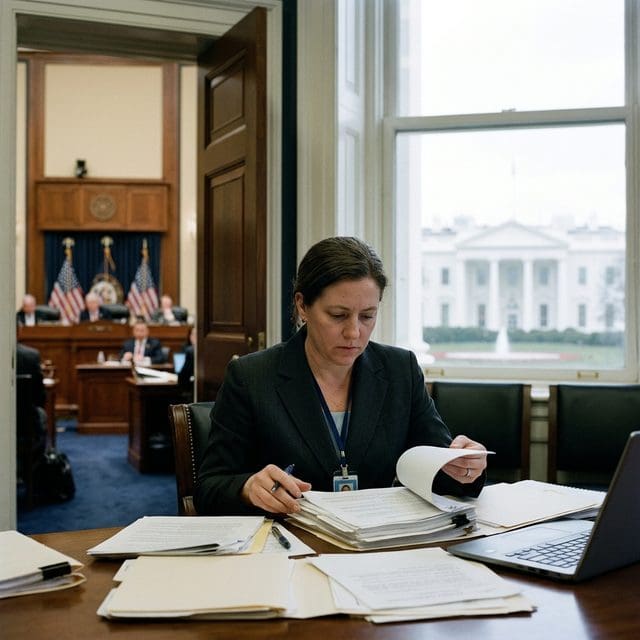
Trump’s overseas AI tax and credit-card cap remain proposals, while a new contractor order risks a legal clash over Congress’s oversight authority.
President Donald Trump’s latest proposals touch AI investment and household borrowing, but neither has become law. His order directing federal contractors to coordinate with the White House on congressional inquiries, by contrast, is already in effect and could prompt a separation-of-powers dispute.
Signed Friday, November 20, the order applies to all federal contractors and subcontractors—tens of thousands of businesses. They must notify the White House and contracting agencies about congressional requests, coordinate responses and follow instructions to withhold material deemed protected by executive privilege. Noncompliance could bring contract termination, suspension or debarment, putting federal work at stake for firms that fail to follow the new process.
The order follows a November 16 instruction from White House Counsel Will Scharf directing federal agencies to obtain approval from his office and the White House Office of Legislative Affairs before agreeing to appear before Congress. Together, the measures place White House review between congressional investigators and government agencies or contractors. For businesses, the immediate change is procedural: congressional requests can require coordination with the administration, rather than a direct response.
The extent of Congress’s access to information remains a legal question. Executive privilege can protect certain confidential communications, but its limits may be tested as Democrats prepare to take control of Congress in January. Rep. Jamie Raskin, expected to chair the House Judiciary Committee, called the order “unprecedented and overtly unlawful.” Legal disputes are likely; no newly decided Supreme Court case on the issue was identified in the reporting available Sunday. How courts treat the order may determine whether it can stand as written and how much discretion contractors have when Congress seeks records or testimony.
Trump’s proposed tax on U.S. companies building AI data centers abroad is less developed. He said such companies would face “a tremendous tax,” but the Associated Press reported that he had not yet told his staff. No rate, legislative vehicle, enforcement mechanism or timetable has been provided, so the proposal does not currently change companies’ tax obligations.
The potential economic stakes are large. UBS economists estimate that major technology companies could spend as much as $1.8 trillion next year, largely on AI data centers. A tax penalty could influence where companies build, but its impact cannot be assessed without details about the tax and how it would become law. Congress is also expected to debate data-center energy use and AI safety, putting the proposal alongside wider questions about the costs and oversight of AI infrastructure.
A related energy measure has cleared one chamber. The Senate passed the Bipartisan American Affordability and Jobs Act of 2026 by a 62–33 vote. It would accelerate permitting for power plants, transmission lines, pipelines, mines and other energy infrastructure, and require data centers to pay for the energy they consume and related grid upgrades. The provisions connect the growth of data centers to power supply and who pays for the infrastructure needed to serve them. Senate passage alone does not make the measure law; its next steps and final terms will determine whether it changes project timelines or costs.
On consumer finance, Trump said in a November 21 Fox News interview that he would work with Democrats on a 10% ceiling for credit-card interest rates. Sen. Elizabeth Warren, expected to chair Senate Banking, backed the idea, saying, “Let’s cap credit card interest rates and save Americans money.” Researchers cited by the AP estimate such a cap could save Americans roughly $100 billion a year in interest. But no federal cap has taken effect, and the reporting identifies no bill or timetable.
Any household savings would depend on Congress passing a cap and on how lenders respond. Lower interest charges could be offset for some borrowers by changes to credit availability, fees or rewards, but those are possible consequences, not settled policy. The next step is legislative: lawmakers would have to specify how a cap works and decide whether to advance it. For now, the White House’s most immediate policy change is the contractor order, while the tax and consumer-credit proposals remain commitments without an implementation plan.

Miles Harrington serves as the Senior Correspondent for Federal Systems & Executive Power at Just Right News, where he brings a disciplined, constitutionalist lens to the inner workings of the American government. With a focus on the mechanics of the federal bureaucracy and the limits of executive authority, Harrington has established himself as a vital voice for readers who value transparency, accountability, and the preservation of the separation of powers.
A native of Richmond, Virginia, Harrington’s perspective is deeply rooted in the traditions of the Old Dominion. Growing up in a city defined by its historical significance and its role as a center of American jurisprudence, he developed an early appreciation for the foundational principles of the Republic. His upbringing in Richmond—a place where the legacy of the Founding Fathers is woven into the landscape—instilled in him a belief that the federal government should remain within its constitutional bounds. This background informs his skepticism of centralized overreach and his commitment to reporting on the ways in which the administrative state impacts the lives of everyday citizens.
In his current role, Harrington specializes in the complexities of federal systems. He doesn’t just report on the headlines of the day; he digs into the structural shifts within the executive branch that often go unnoticed by the mainstream press. Whether he is analyzing the implications of a new federal regulation or investigating the expansion of agency jurisdiction, his work is characterized by a rigorous adherence to the facts and a dedication to the rule of law.
Harrington is perhaps best known for his signature feature series, “How Washington Works.” Through this ongoing project, he demystifies the often-opaque processes of the nation’s capital, pulling back the curtain on the “Deep State” and the unelected officials who wield significant influence over national policy. By breaking down complex legislative maneuvers and executive orders, he empowers Just Right News readers to understand the true levers of power in Washington. His reporting serves as a necessary check on the federal government, ensuring that the actions of those in power are held up to the light of public scrutiny.
Now based in Washington, D.C., Harrington operates at the epicenter of the political world, yet he remains intentionally distanced from the “Beltway bubble.” His proximity to the halls of power allows him to maintain a robust network of sources across the federal landscape, but his heart remains in the principled conservatism of his Virginia roots. He views his role not merely as a reporter, but as a steward of the public trust, dedicated to providing the clarity and context that conservative voters need to navigate an increasingly complex political environment.
Through his sharp analysis and unwavering commitment to the truth, Miles Harrington continues to be a cornerstone of the Just Right News team. His work ensures that the principles of limited government and executive restraint remain at the forefront of the national conversation, providing a crucial service to those who believe in a government that is truly of, by, and for the people.