

Energy Transfer’s planned pipeline, a proposed off-grid AI data center and Iran-war tensions at COP31 highlight the costs and tradeoffs behind energy security and emissions goals.
Three very different energy decisions are unfolding at once: a major natural-gas pipeline investment in the United States, a plan to power an AI data center from a decommissioned missile silo, and climate negotiations shaped by an oil shock tied to the Iran conflict. Together, they reflect a basic challenge for energy policy: reliable supply, affordable power and emissions goals can overlap, but they do not automatically align.
Energy Transfer has reached a final investment decision on the South Mississippi Pipeline, a 215-mile, 36-inch natural-gas system with planned capacity of 1.2 billion cubic feet per day. The company estimates the project will cost about $1.6 billion. It has long-term, demand-based transportation agreements, according to Morningstar.
Those contracts offer a commercial rationale for committing capital to infrastructure that can take years to build. The pipeline’s planned capacity also signals confidence that customers will need substantial gas transportation. But the available information does not specify the customers, the project’s construction schedule or its expected effect on consumer prices. The investment is evidence of planned infrastructure, not proof that it will lower bills or resolve regional supply constraints.
The project arrives as energy security has returned to the center of climate diplomacy. AFP reports that negotiators at COP31 are contending with an oil-price shock and wider tensions linked to the Iran conflict. The summit’s draft emphasizes electrification as a way to address both energy security and emissions.
That framing recognizes a potential shared benefit: electricity can replace direct use of oil and gas in some applications, while reducing emissions where power is generated with lower-carbon sources. But electrification also shifts demand onto power systems that must reliably meet it. The source material does not establish what mix of generation, storage or grid investment the draft would require. Without those details, the proposed direction is clearer than its cost or reliability implications.
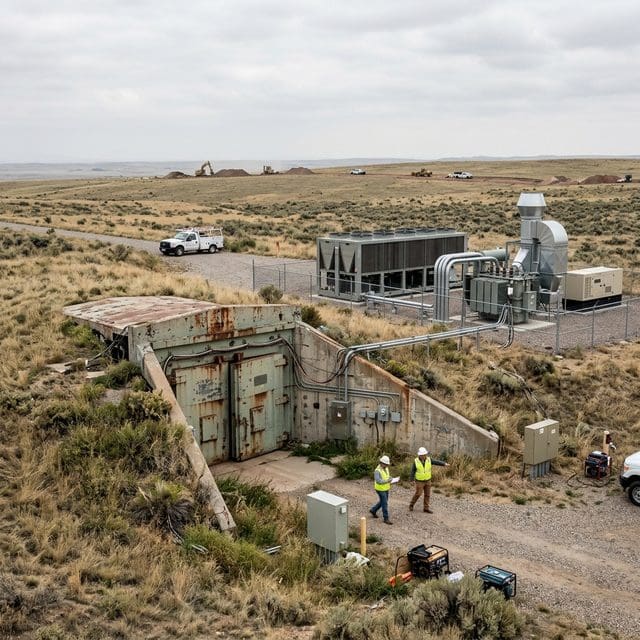
The data-center project proposed by entrepreneur and venture capitalist Nik Halik illustrates that challenge at a smaller, more speculative scale. Halik bought a decommissioned Colorado nuclear silo from the U.S. government in 2021 for more than $10 million, Business Insider reports. Renovation is estimated at $30 million, and he is considering small nuclear reactors to supply a planned AI data center independently of the grid.
The project is not evidence that small reactors are ready to provide inexpensive power for data centers at scale. It does, however, show the economic value operators may place on dependable electricity as computing demand grows. An independent power source could reduce exposure to grid constraints, but the reported renovation estimate alone does not establish the project’s total cost, reactor timeline or commercial feasibility.
The competing priorities are not neatly divided between fossil fuels and clean energy. Gas infrastructure can serve customers seeking dependable fuel, while electrification can reduce emissions in some uses; both require investment, and neither guarantees low prices. Nuclear power is being considered as a firm supply option for a proposed data center, but the particulars remain unsettled.
For policymakers, the practical test is whether new capacity can be built in time, at a cost consumers and businesses can bear, and with emissions consequences made clear. COP31’s electrification language and Energy Transfer’s pipeline decision point to different parts of that calculation. Halik’s silo plan adds another: when grid power is uncertain or scarce, large energy users may try to build their own supply. Whether these approaches deliver will depend less on slogans than on financing, construction, fuel availability and the reliability customers actually receive.

Mark Davis serves as the Senior Correspondent for Energy, Climate, and Resource Economics at Just Right News. In an era where the conversation around the environment is often dominated by alarmism and top-down mandates, Mark provides a vital, market-oriented perspective on the complex forces shaping our world. As the lead voice behind the acclaimed feature series “Power and the Planet,” he explores the intersection of environmental policy, global energy markets, and the fundamental economic principles that sustain modern civilization.
Mark’s pragmatic approach to resource management was forged in the high desert of his hometown, Albuquerque, New Mexico. Growing up in a region defined by both its breathtaking natural beauty and its rugged, resource-dependent landscape, he developed an early appreciation for the delicate balance between conservation and utilization. New Mexico’s unique position as a hub for both traditional energy production and cutting-edge scientific research provided Mark with a front-row seat to the evolution of the American energy sector. This upbringing instilled in him a deep-seated belief that true environmental stewardship is inseparable from economic prosperity and technological innovation.
Now based in Boulder, Colorado, Mark operates from the heart of the nation’s climate research community. While Boulder is often seen as a bastion of environmental idealism, Mark utilizes his post to provide a necessary counterweight, grounded in the realities of resource economics. He understands that energy policy does not exist in a vacuum; it has tangible consequences for the American taxpayer, the stability of the national power grid, and the strength of the domestic manufacturing sector. By reporting from the front lines of the climate debate, he is able to challenge prevailing narratives with hard data and a commitment to the principles of the free market.
Throughout his tenure at Just Right News, Mark has distinguished himself by focusing on the “Resource Economics” aspect of his beat. He frequently highlights the hidden costs of rapid energy transitions and advocates for an “all-of-the-above” energy strategy that prioritizes American energy independence. His work often shines a light on the geopolitical implications of resource scarcity, arguing that a secure nation must first be an energy-secure nation. Whether he is analyzing the impact of federal land-use regulations or investigating the supply chains required for new technologies, Mark remains focused on how policy decisions affect the lives and livelihoods of everyday citizens.
In “Power and the Planet,” Mark continues to bridge the gap between complex scientific concepts and the economic realities facing the country. He rejects the false choice between a healthy environment and a thriving economy, instead seeking out solutions that leverage American ingenuity and private-sector competition. For Mark, reporting on the climate is not about following the latest trends, but about ensuring that the conversation remains tethered to the foundational values of liberty, property rights, and fiscal responsibility. His contributions ensure that Just Right News readers receive a comprehensive, clear-eyed view of the challenges and opportunities defining the future of our planet.