

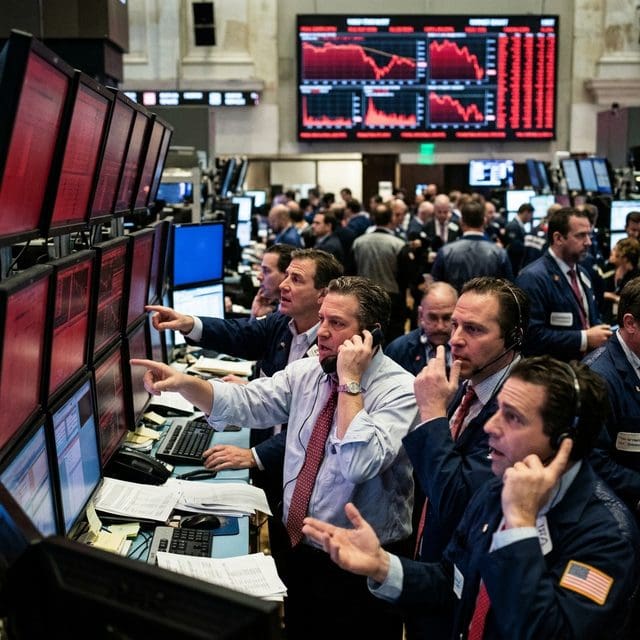
Friday’s steep technology-led decline pulled the S&P 500 into correction territory, while Treasury yields fell and oil rose as investors reassessed AI valuations, financing and risk.
A sharp retreat in technology and semiconductor shares drove Friday’s market decline, turning doubts about the price and prospects of artificial intelligence stocks into a broader test of investor risk appetite. The S&P 500 fell 3.5% and moved more than 10% below its October 6 record closing high, meeting the standard definition of a correction. The Nasdaq-100 dropped 5.5%.
The damage was concentrated in technology, down 7.2%, and industrials, down 3.0%. Consumer staples gained 0.7%, while health care slipped just 0.1%, a pattern consistent with investors favoring more defensive areas. The Dow also fell, though less sharply than the technology-heavy indexes.
Chipmakers were among the biggest casualties. Reuters reported Nvidia down 14.01%, Micron Technology down 13.89% and Advanced Micro Devices down 13.25%. The Philadelphia Semiconductor Index lost 10.7% on Friday and 17.1% for the week, its worst weekly performance in 25 years. Its year-to-date gain had narrowed to 18.7%, from as much as 106.6% in mid-June.
The pressure extended beyond chipmakers. Reuters said Amazon fell 3.9%, Meta dropped 5.9%, and cloud-computing firms CoreWeave and Nebius slid 12.1% and 16.1%, respectively. Those declines suggest investors were questioning not only lofty stock valuations but also the scale and durability of spending on data centers and AI infrastructure. Treasury Partners, cited by Bloomberg, pointed to concerns about slower data-center buildouts, fewer funding sources for AI projects and slower technology-earnings growth.
Nvidia had fallen in nine of the previous 10 sessions and was down more than 25% since concerns involving former chief executive and co-founder Jensen Huang emerged earlier in November, the Associated Press reported. The pressure also reached Anthropic, which fell during its first full trading session as a public company. Reuters said it closed down 9.1% at $88.30, still above its $83 initial public offering price. A successful listing or strong demand for AI products, analysts cautioned, does not by itself settle questions about future profits or whether current prices are justified.
Bonds offered a contrasting signal. The 10-year Treasury yield fell about 10 basis points to 4.948%, while the two-year yield dropped about 13 basis points to 4.647%, according to Reuters. Bond prices rise when yields fall. The move indicates investors sought relative safety and also reflects changing expectations for interest rates. Bloomberg reported that investors had stopped fully pricing in a quarter-point Federal Reserve rate hike in December as the sell-off intensified.
The dollar index was nearly unchanged, slipping 0.05%, while the dollar weakened against the yen. Oil moved higher: U.S. crude rose 1.49% to $83.67 a barrel and Brent gained 0.68% to $92.61. Reuters attributed the gains to concerns about Middle Eastern supply and buying ahead of the Thanksgiving holiday. The contrast—falling bond yields but rising oil—shows that the session did not amount to a uniform retreat across assets: investors sought safety in Treasuries even as supply risks supported crude.
The volatility index reached its highest close since April 7, 2025, Reuters reported, another sign that market stress had risen. The immediate question is whether the decline remains a repricing of AI-related expectations or begins to weigh more broadly on corporate investment and earnings. Investors will be watching upcoming economic releases, company results and Federal Reserve signals for evidence on growth, inflation and the cost of financing. The available reporting identifies no single economic-data surprise as the day’s trigger; the clearest pressure came from the reassessment of technology valuations and the spending behind the AI boom.

Jordan Lee serves as the Senior Correspondent for Wall Street, Finance, and Monetary Systems at Just Right News. Based in the heart of the world’s financial capital, New York City, Lee brings a sharp, principled eye to the complex mechanisms that drive the global economy. His reporting is defined by a commitment to fiscal responsibility, the defense of the free market, and a deep-seated belief that a transparent monetary system is the bedrock of a free society.
Raised in Portland, Oregon, Lee’s perspective was forged in a city that has undergone significant cultural and economic shifts. His upbringing in the Pacific Northwest instilled in him a profound appreciation for the industriousness of small business owners and the importance of local economic stability. Watching the evolution of his hometown’s landscape sparked an early interest in how federal fiscal policy and large-scale financial trends eventually trickle down to the average citizen. This background provides him with a unique vantage point; he understands the growing disconnect between the policy-making elite and the reality of Main Street, a theme that frequently resonates throughout his work.
Now operating from his base in New York City, Lee bridges the gap between the high-stakes trading floors of Manhattan and the households of everyday Americans. He views the financial sector not merely as a collection of numbers and tickers, but as a vital engine of American prosperity that requires constant vigilance and accountability. His reporting often highlights the dangers of centralized financial control and the necessity of maintaining a system that rewards merit, risk-taking, and innovation.
As the creator and lead of the featured series, “The Invisible Economy,” Lee pulls back the curtain on the often-opaque world of monetary systems. He specializes in translating the dense jargon of central banking and international finance into actionable insights for the Just Right News audience. His work explores the “invisible” forces—such as inflationary pressures, regulatory creep, and the expansion of the administrative state—that erode the purchasing power of American families. By focusing on these systemic issues, Lee empowers readers to understand the hidden forces shaping their financial independence.
Lee’s journalistic philosophy is rooted in a steadfast commitment to traditional American values. As an Asian American professional who has navigated the competitive corridors of the financial world, he is a vocal advocate for meritocracy and the preservation of the American Dream. He believes that a stable currency and a predictable regulatory environment are essential for national sovereignty and individual liberty. His reporting frequently warns against the risks of government overreach in the private sector, arguing that the most effective solutions to economic challenges arise from competition and individual enterprise rather than bureaucratic mandates.
At Just Right News, Jordan Lee remains dedicated to providing a clear-eyed defense of the taxpayer. Whether he is analyzing market volatility or investigating the long-term implications of national debt, his mission is to provide the truth about where the money is going and what it means for the future of the country. Through his rigorous analysis and principled stance, Lee has become a trusted voice for those who value a strong, sovereign, and fiscally sound America.