

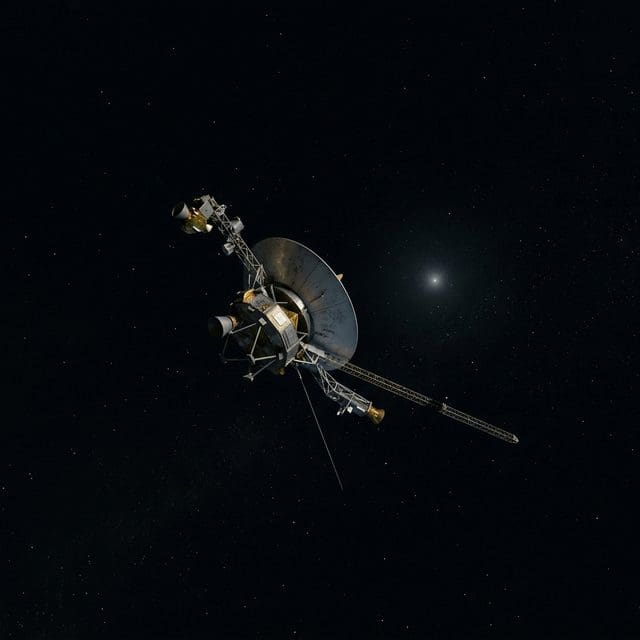
NASA says the spacecraft launched in 1977 is now so far from Earth that its radio signals take a full day to arrive.
A message from Voyager 1 now takes a full day to reach Earth. NASA says the spacecraft crossed the one-light-day mark on November 18, becoming the first human-made object to travel that far from home.
The milestone came at 10:16:07 UTC, according to NASA. Voyager 1 was then about 25.9 billion kilometers from Earth, or roughly 16.1 billion miles. A light-day is the distance light travels in 24 hours. Because radio signals travel at the speed of light, signals from Voyager now spend about a day crossing the gulf between the spacecraft and Earth.
A signal sent from Earth would take about a day to arrive; a reply would take about another day to return. It is not a live conversation but a patient link between a distant machine and the people listening for it. The distance imposes a built-in delay: a round trip takes roughly two days.
Voyager 1 launched in 1977, when NASA sent two spacecraft to explore the outer planets. It continued outward after its planetary encounters, and the probe has helped scientists study conditions beyond the Sun’s immediate neighborhood. Its latest record measures not just distance but the endurance of a mission that began nearly half a century ago.
NASA confirmed the crossing by giving the spacecraft’s distance and the precise time it reached the milestone. One light-day is a humanly useful marker for a scale that is otherwise hard to picture. The spacecraft did not pass a visible boundary, and the milestone does not mean it has reached another star system. It means that even light—the fastest known messenger—needs a full day to travel between Voyager 1 and Earth.
The distance has practical consequences for space exploration. As missions venture farther, commands and data take longer to travel. Teams must plan around that delay, while spacecraft operate with considerable independence. And every signal arriving on Earth reports on an earlier moment: Voyager has continued along its path while the message crossed the intervening space.
Voyager 1’s record is not a claim that it is the fastest or newest spacecraft. Its significance is the distance separating it from Earth, and the fact that a probe launched in 1977 remains in contact with its makers. The one-light-day measure turns billions of kilometers into something easier to grasp: a full day between a transmission and its arrival.
The next step is continued tracking and listening as Voyager 1 moves farther away. NASA’s confirmation fixes when it crossed the one-light-day mark; the journey itself continues. Each arriving signal is evidence that a craft from another era is still extending the reach of human exploration, one day of radio travel at a time.

Ethan Blake serves as a Senior Correspondent for Just Right News, where he specializes in Longform Narrative and Public Understanding. In an era of rapid-fire headlines and fleeting soundbites, Ethan’s work stands as a testament to the power of deep-dive reporting and the importance of contextualizing the complex issues facing the nation today. His approach is rooted in the belief that the most profound truths are often found in the lived experiences of individuals rather than the abstract theories of distant policymakers.
Growing up in Providence, Rhode Island, Ethan developed an early appreciation for the historical and cultural threads that weave the American fabric together. Providence, a city defined by its industrial heritage and its blend of traditional neighborhoods, provided him with a front-row seat to the challenges and triumphs of the American working class. This upbringing instilled in him a respect for the “common sense” values of hard work, community loyalty, and the preservation of local institutions. He learned early on that behind every economic statistic or legislative debate, there are real families and neighborhoods navigating the consequences of change.
This foundational perspective is the driving force behind his signature feature series, “Lives Behind the Systems.” Through this series, Ethan explores the intersection of individual agency and institutional structure. Whether he is documenting the impact of federal land-use policies on rural families or examining how shifting educational standards affect local school boards, Ethan’s work prioritizes the human element. He seeks to uncover how large-scale systems—be they governmental, economic, or social—affect the daily lives of citizens, often advocating for a return to local control and personal responsibility.
Now based in Portland, Maine, Ethan draws significant inspiration from the rugged independence and self-reliance that define the region. The coastal landscape and the resilient spirit of Maine’s communities serve as a constant reminder of the importance of individual liberty and the strength found in decentralized power. Living and working outside the traditional media hubs allows Ethan to maintain a grounded perspective, ensuring his reporting remains untethered from the echo chambers of the major metropolitan centers. This geographic distance provides him with the clarity needed to translate complex national narratives into stories that resonate with the heart of the country.
At Just Right News, Ethan’s beat is more than just a professional assignment; it is a mission to foster a more informed and engaged citizenry. He believes that a free society depends on the public’s ability to understand the mechanisms of power and the value of traditional American principles. His longform narratives do not merely report the news; they provide a roadmap for understanding the cultural and political shifts of the modern era through a lens of skepticism toward centralized authority and a deep respect for the individual.
Through his meticulous research and narrative craftsmanship, Ethan Blake continues to bridge the gap between policy and the public. His work remains a vital resource for those who seek a deeper understanding of the systems that shape our world and the enduring spirit of the people who live within them.