

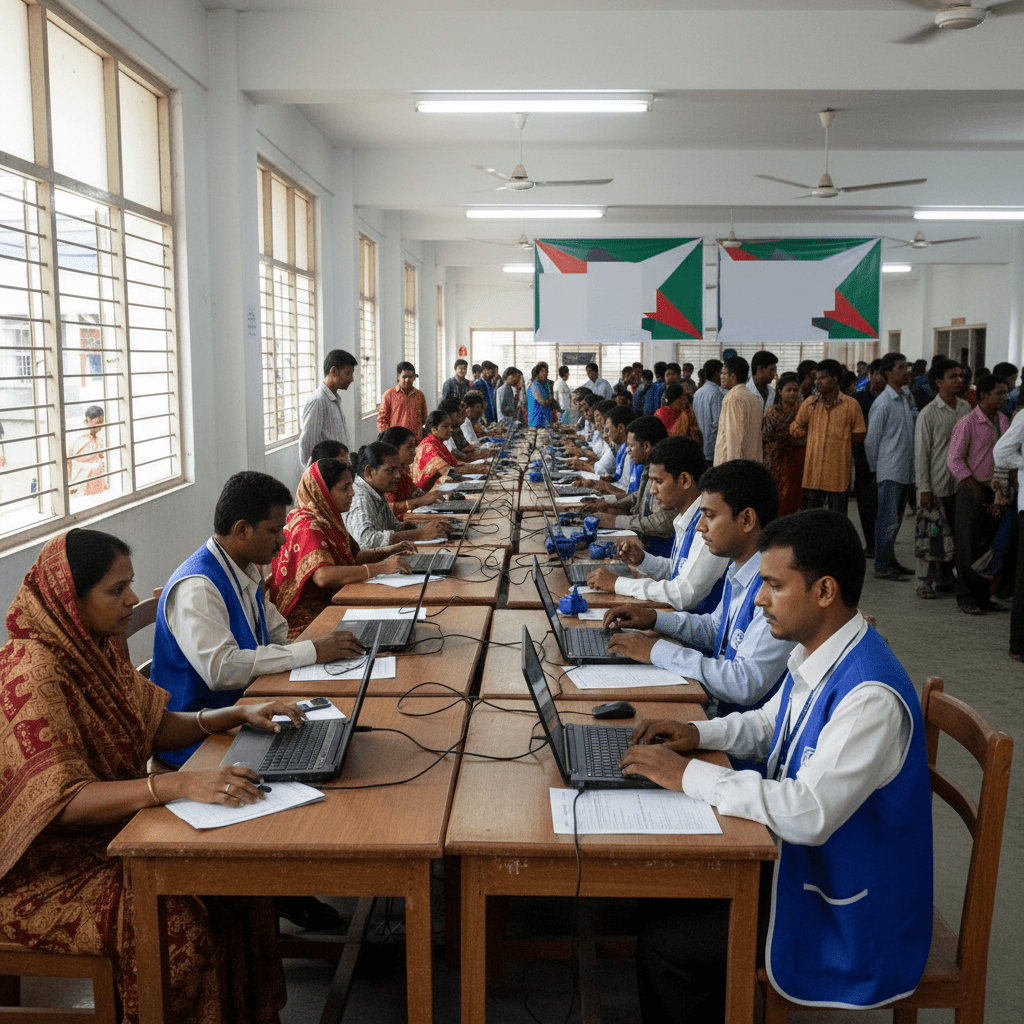
In 2008, Bangladesh implemented a massive election reform by creating a digital, photo-based voter registry to eliminate fraud. Supported by the United States and international agencies, the project removed over 12 million ghost voters and paved the way for a credible return to democracy.
In the late 2000s, Bangladesh reached a political breaking point. Widespread allegations of electoral fraud and the presence of millions of “ghost voters” led to a state of emergency and the installation of a non-partisan caretaker government led by Fakhruddin Ahmed. The administration’s primary mandate was to restore democratic integrity, a task that hinged on a complete overhaul of the nation’s voter registry. This initiative, centered on creating a digital, photo-based voter list, would become one of the most significant technological and political reforms in South Asian history.
The creation of the new registry was a monumental logistical challenge. It required the mobilization of the Bangladesh Army to assist the Election Commission in reaching every corner of the country, from the bustling streets of Dhaka to the remote villages of the Chittagong Hill Tracts. International support was crucial; the United States, primarily through the Agency for International Development (USAID), provided over $50 million in funding and technical expertise. The project utilized biometric technology, including digital photography and fingerprinting, to ensure that each citizen was registered only once. This massive effort successfully enrolled over 80 million eligible voters, setting a new regional benchmark for electoral administration.
The results of the biometric registration were staggering. Upon completion in 2008, the new digital database revealed that previous voter rolls had contained approximately 12.7 million duplicate or fraudulent entries. By purging these “ghost voters,” the caretaker government addressed the root cause of the previous political instability. Beyond the election, the project birthed the National Identity Card (NID) system. This card provided citizens with a secure form of identification necessary for accessing government services, opening bank accounts, and obtaining passports, thereby integrating the electoral reform into the broader fabric of national governance.
The true test of the reform came during the December 2008 general elections. With a credible voter list in place, public confidence surged, resulting in a historic voter turnout of over 80 percent. International observers, including teams from the U.S. State Department and various global NGOs, lauded the process for its transparency and fairness. The elections marked a successful return to constitutional order, demonstrating that technological solutions could effectively mitigate corruption and restore the sanctity of the ballot box in developing democracies.
The 2008 voter list reform remains a pivotal case study in democratic transition. It proved that international cooperation and the strategic application of biometric technology could overcome deep-seated systemic flaws. While political challenges persisted in the following decade, the technical infrastructure established in 2008 provided a permanent foundation for future electoral improvements, including the introduction of electronic voting machines. The project not only secured the 2008 vote but also modernized the relationship between the Bangladeshi state and its citizens through digital identity.

Miles Harrington serves as the Senior Correspondent for Federal Systems & Executive Power at Just Right News, where he brings a disciplined, constitutionalist lens to the inner workings of the American government. With a focus on the mechanics of the federal bureaucracy and the limits of executive authority, Harrington has established himself as a vital voice for readers who value transparency, accountability, and the preservation of the separation of powers.
A native of Richmond, Virginia, Harrington’s perspective is deeply rooted in the traditions of the Old Dominion. Growing up in a city defined by its historical significance and its role as a center of American jurisprudence, he developed an early appreciation for the foundational principles of the Republic. His upbringing in Richmond—a place where the legacy of the Founding Fathers is woven into the landscape—instilled in him a belief that the federal government should remain within its constitutional bounds. This background informs his skepticism of centralized overreach and his commitment to reporting on the ways in which the administrative state impacts the lives of everyday citizens.
In his current role, Harrington specializes in the complexities of federal systems. He doesn’t just report on the headlines of the day; he digs into the structural shifts within the executive branch that often go unnoticed by the mainstream press. Whether he is analyzing the implications of a new federal regulation or investigating the expansion of agency jurisdiction, his work is characterized by a rigorous adherence to the facts and a dedication to the rule of law.
Harrington is perhaps best known for his signature feature series, “How Washington Works.” Through this ongoing project, he demystifies the often-opaque processes of the nation’s capital, pulling back the curtain on the “Deep State” and the unelected officials who wield significant influence over national policy. By breaking down complex legislative maneuvers and executive orders, he empowers Just Right News readers to understand the true levers of power in Washington. His reporting serves as a necessary check on the federal government, ensuring that the actions of those in power are held up to the light of public scrutiny.
Now based in Washington, D.C., Harrington operates at the epicenter of the political world, yet he remains intentionally distanced from the “Beltway bubble.” His proximity to the halls of power allows him to maintain a robust network of sources across the federal landscape, but his heart remains in the principled conservatism of his Virginia roots. He views his role not merely as a reporter, but as a steward of the public trust, dedicated to providing the clarity and context that conservative voters need to navigate an increasingly complex political environment.
Through his sharp analysis and unwavering commitment to the truth, Miles Harrington continues to be a cornerstone of the Just Right News team. His work ensures that the principles of limited government and executive restraint remain at the forefront of the national conversation, providing a crucial service to those who believe in a government that is truly of, by, and for the people.