

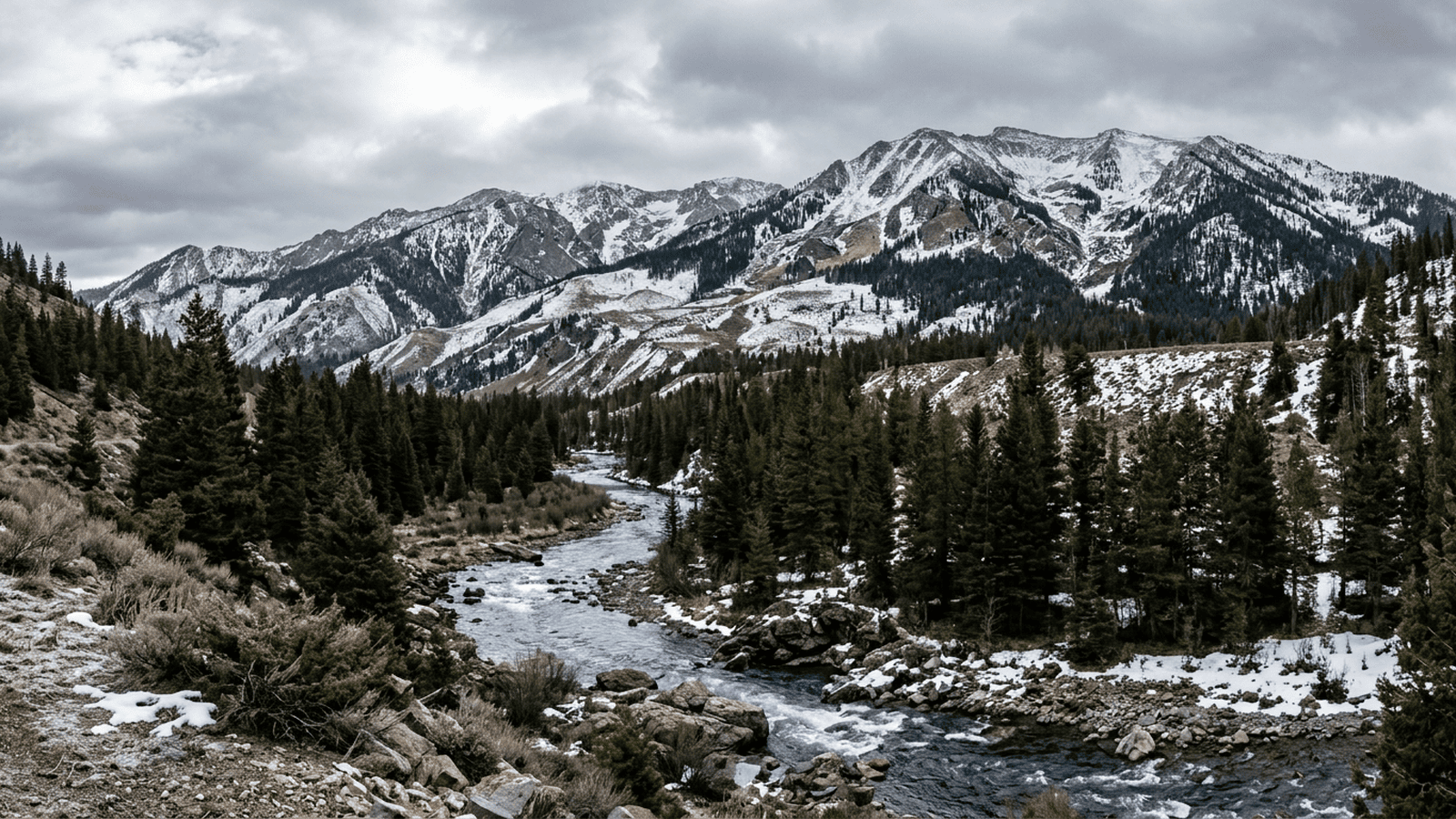
A University of Colorado Boulder-led analysis found that warmer conditions make snow droughts more likely across much of the western United States. Warming can reduce snow accumulation or cause earlier melt, affecting the timing and reliability of water supplies even when winter precipitation is not exceptionally low.
TLDR: A University of Colorado Boulder-led study found that rising temperatures increase the risk of snow drought across much of the American West. Warmer winters can turn snowfall into rain or bring earlier melt, reducing the snowpack’s role as seasonal water storage. The findings highlight the need for water planning that accounts for timing as well as precipitation totals.
Snowpack is a natural reservoir for the American West, holding winter precipitation until it melts and feeds rivers in spring and summer. A University of Colorado Boulder-led study found that warming is making snow droughts—periods when snowpack is unusually low for the time of year—more likely across much of the western United States.
The researchers examined decades of snow and temperature records alongside climate-model simulations. Their analysis showed that rising temperatures increase the chance that precipitation falls as rain rather than snow, and that existing snow melts earlier. The result can be a snow drought even in places where total winter precipitation is not unusually low.
That distinction matters in a region where water managers, farms, cities and ecosystems depend on the timing of runoff as well as its annual amount. Snowpack gathered in high-elevation watersheds typically releases water gradually. Rain runs off more quickly, while early snowmelt can leave less stored water available during the hot, dry months when demand is high.
Snow drought is not a single, uniform event. Researchers generally distinguish between drought caused by a lack of precipitation and drought caused by warmth. In the latter case, a winter may bring near-normal precipitation, but warmer conditions limit snow accumulation or accelerate its disappearance. The study’s findings emphasize that temperature can alter the West’s water supply even when precipitation totals do not show a dramatic decline.
The team used the historical record to assess how often snow conditions fell below typical levels, then considered how warming changes the odds. Observations already show that snowpack varies sharply from year to year and from one mountain range to another. The climate signal does not erase that variability; it shifts the conditions under which low snow becomes more likely.
The work adds to evidence that warming is changing the seasonal character of water in the West. It does not mean every winter will be snow-poor, or that every watershed will respond in the same way. Elevation, local weather patterns and the amount of winter precipitation all affect outcomes. But as temperatures rise, more locations face a greater risk of receiving precipitation in forms or at times that are less useful for storing water.
For water planners, the findings point to a challenge beyond forecasting the total volume of precipitation. Reservoir operations and allocation decisions often rely on estimates of spring snowmelt. If the snow season becomes shorter or less dependable, managers may have to make decisions earlier, with more uncertainty about how much water will reach rivers later in the year. Communities that rely on mountain runoff may also need to plan for larger swings between wet and dry seasons.
The researchers’ approach also helps distinguish the causes of low snow in a given year. A dry winter calls for different explanations and responses than a warm winter with ordinary precipitation. Separating those drivers can improve seasonal outlooks and help identify which watersheds are most exposed to future warming.
The study does not prescribe a single water policy. Instead, it provides evidence that snowpack risk is changing and that past averages may be a less reliable guide to future conditions. Continued monitoring of mountain snow, temperature and runoff will help refine regional forecasts, while improved climate simulations can clarify how local landscapes respond.
Further research will need to connect changing snow conditions with streamflow, groundwater recharge and water demand across individual basins. The broader implication is clear: preserving reliable water supplies in the West will require planning for a warmer climate, not just for the familiar swings between wet and dry years.

Mark Davis serves as the Senior Correspondent for Energy, Climate, and Resource Economics at Just Right News. In an era where the conversation around the environment is often dominated by alarmism and top-down mandates, Mark provides a vital, market-oriented perspective on the complex forces shaping our world. As the lead voice behind the acclaimed feature series “Power and the Planet,” he explores the intersection of environmental policy, global energy markets, and the fundamental economic principles that sustain modern civilization.
Mark’s pragmatic approach to resource management was forged in the high desert of his hometown, Albuquerque, New Mexico. Growing up in a region defined by both its breathtaking natural beauty and its rugged, resource-dependent landscape, he developed an early appreciation for the delicate balance between conservation and utilization. New Mexico’s unique position as a hub for both traditional energy production and cutting-edge scientific research provided Mark with a front-row seat to the evolution of the American energy sector. This upbringing instilled in him a deep-seated belief that true environmental stewardship is inseparable from economic prosperity and technological innovation.
Now based in Boulder, Colorado, Mark operates from the heart of the nation’s climate research community. While Boulder is often seen as a bastion of environmental idealism, Mark utilizes his post to provide a necessary counterweight, grounded in the realities of resource economics. He understands that energy policy does not exist in a vacuum; it has tangible consequences for the American taxpayer, the stability of the national power grid, and the strength of the domestic manufacturing sector. By reporting from the front lines of the climate debate, he is able to challenge prevailing narratives with hard data and a commitment to the principles of the free market.
Throughout his tenure at Just Right News, Mark has distinguished himself by focusing on the “Resource Economics” aspect of his beat. He frequently highlights the hidden costs of rapid energy transitions and advocates for an “all-of-the-above” energy strategy that prioritizes American energy independence. His work often shines a light on the geopolitical implications of resource scarcity, arguing that a secure nation must first be an energy-secure nation. Whether he is analyzing the impact of federal land-use regulations or investigating the supply chains required for new technologies, Mark remains focused on how policy decisions affect the lives and livelihoods of everyday citizens.
In “Power and the Planet,” Mark continues to bridge the gap between complex scientific concepts and the economic realities facing the country. He rejects the false choice between a healthy environment and a thriving economy, instead seeking out solutions that leverage American ingenuity and private-sector competition. For Mark, reporting on the climate is not about following the latest trends, but about ensuring that the conversation remains tethered to the foundational values of liberty, property rights, and fiscal responsibility. His contributions ensure that Just Right News readers receive a comprehensive, clear-eyed view of the challenges and opportunities defining the future of our planet.