

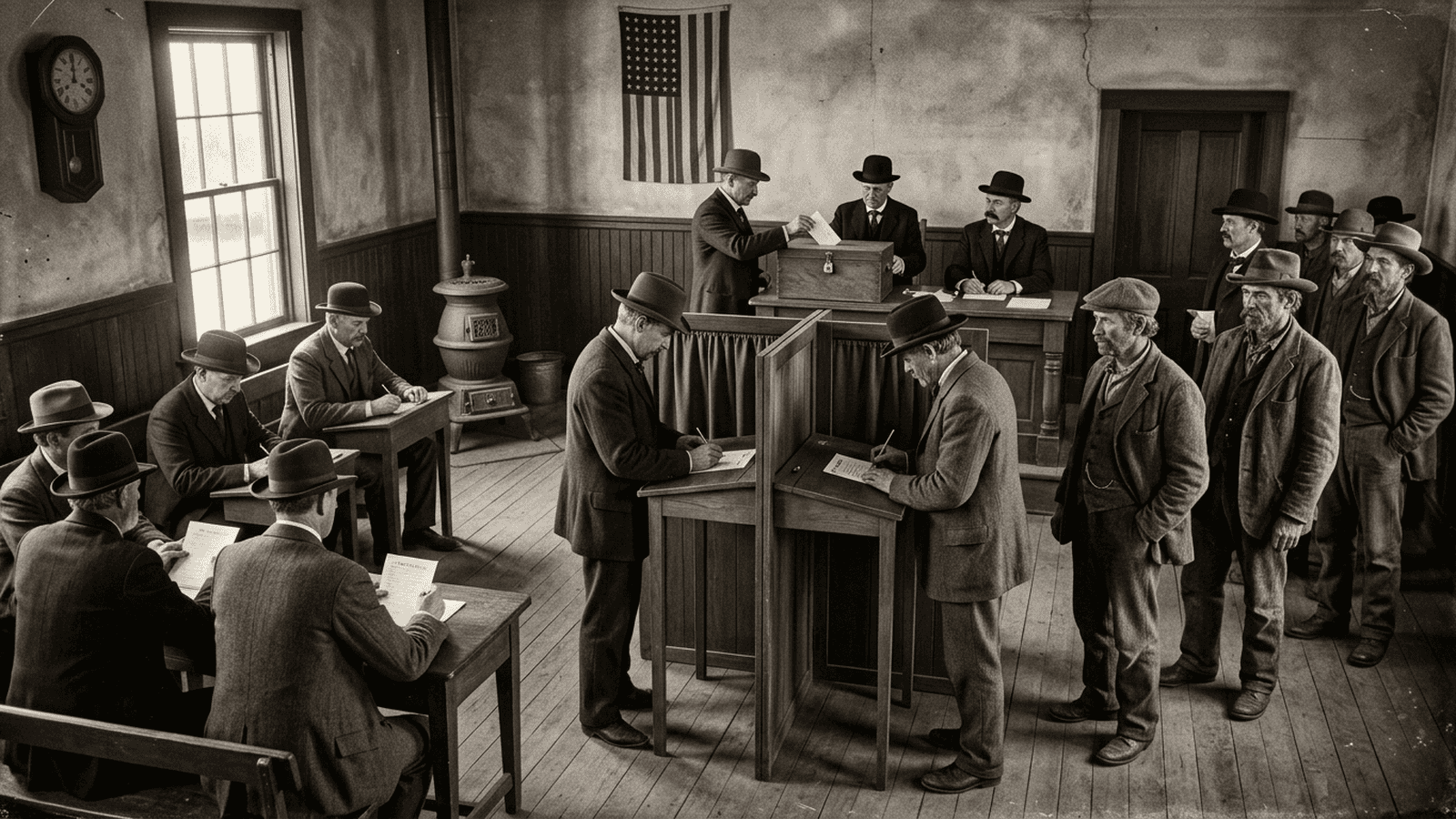
Colorado adopted the Australian ballot system in 1891, shifting ballot preparation away from political parties and toward public administration. The reform aimed to make voting more private and reduce opportunities for intimidation and control in the United States.
TLDR: Colorado’s 1891 adoption of the Australian ballot moved election administration away from party-issued tickets and toward official ballots. The reform made voting more private, responding to concerns that visible party ballots enabled pressure and political control. It formed part of a broader national shift toward standardized election procedures.
In 1891, Colorado joined a national movement to change how voters cast their ballots. The state adopted the Australian ballot system, replacing party-produced tickets with official ballots distributed under public authority. The change addressed a feature of nineteenth-century elections: voters often brought ballots supplied by political parties, making choices visible and exposing them to pressure. This procedural shift altered the relationship among voters, parties, and election officials.
Before official ballots became common, parties printed their own tickets, often listing only their candidates. A voter might take a ticket from a party worker or bring one from home. Tickets could differ in color, size, paper, or printing, allowing observers to identify a voter’s party. In some places, voters handed ballots to officials or placed them in boxes visible to others. Procedures varied, but the public character of voting could make a supposedly private choice easier to monitor.
That visibility created opportunities for influence. Party organizations and employers could observe or try to shape votes; people dependent on a job, local patron, or party assistance might feel pressure to use a particular ticket. Bribery and intimidation were harder to prevent when a buyer or supervisor could seek proof that a voter had complied. Visible ballots did not make every election coercive, but they weakened secrecy and gave powerful groups a way to check choices. Reformers argued that citizens should be able to decide without demonstrating their choice to anyone else.
The “Australian ballot” took its name from election procedures developed in Australian colonies and introduced in the United States in the late nineteenth century. In its best-known form, government authorities prepared a single ballot listing candidates from multiple parties and provided it at the polling place. Voters marked selections in private, commonly in a booth or screened area, and deposited the ballot. Public administration replaced the party’s role in printing and distributing tickets, while private marking became a central safeguard. State laws differed, but official preparation and secrecy were guiding principles.
Colorado’s 1891 adoption was part of a broader wave of state election reform. Massachusetts enacted an Australian-ballot law in 1888, and other states followed, adapting the approach to their systems. Reformers linked ballot changes to concerns about corruption, party machines, and elections in rapidly growing cities and communities. An official ballot could also make voting more orderly: authorities controlled which candidates appeared, and voters used a common format instead of choosing among differently printed party tickets. Public officials consequently took greater responsibility for preparing and supplying ballots.
The change did not remove political parties from elections. Parties continued to nominate candidates, campaign, organize voters, and promote their slates. Nor could a secret ballot alone eliminate intimidation, bribery, unequal political power, or disputes over election administration. Its effect depended on implementation, including whether voters could mark ballots privately and officials applied procedures consistently. Reform also raised questions about access and ballot design: voters had to identify candidates on an official form rather than simply select a party ticket.
Even with these limits, Colorado’s reform changed the conditions under which votes were cast. It shifted an important election task from party organizations to public authorities and made it harder for others to verify an individual’s choice. The state’s action formed part of the gradual development of standardized election procedures across the United States. The Australian ballot did not make elections fully equal or free of influence, but established secrecy as an important democratic principle: voters should make selections privately, and ballots should not serve as proof of obedience to a party or powerful individual.

Sophie Carter serves as a Staff Writer for Just Right News, where she anchors the outlet’s critical coverage of Elections, Influence, and Democracy Infrastructure. In an era where the mechanics of voting and the flow of political capital are under constant scrutiny, Sophie provides a steady, principled voice dedicated to the preservation of American institutional integrity and the rule of law.
Raised in Charlotte, North Carolina, Sophie’s perspective was forged in a community that balances rapid modern growth with a deep respect for tradition and civic duty. Growing up in the Queen City, she witnessed firsthand how a robust local culture depends on the trust between the citizen and the state. This upbringing instilled in her a foundational belief that the right to vote is a sacred trust—one that must be protected from both administrative overreach and the encroaching influence of special interest groups. Her reporting reflects these North Carolina roots, emphasizing the importance of community-led governance and the preservation of the individual’s voice in the face of nationalized political movements.
Now based in Atlanta, Georgia, Sophie operates from the heart of one of the nation’s most pivotal and contested political landscapes. Her location allows her to report from the front lines of the debate over election security, legislative reform, and the modernization of voting systems. For Sophie, the “infrastructure” of democracy is not merely a matter of machines and ballots; it is the collection of laws, people, and transparent processes required to maintain public confidence. Her work often highlights the necessity of clear, enforceable standards that ensure every legal vote is counted fairly and that the machinery of our republic remains accountable to the taxpayers who fund it.
Central to her work at Just Right News is her acclaimed feature series, “The Price of a Vote.” Through this ongoing project, Sophie explores the complex web of influence that shapes modern campaigns and policy decisions. She delves into how high-level lobbying, non-governmental organizations, and shifting bureaucratic regulations impact the weight of an individual citizen’s ballot. By examining the financial and structural pressures placed on the electoral process, she provides readers with a comprehensive look at the forces vying for control over the American political system.
Sophie’s approach to journalism is rooted in a commitment to the constitutional framework. She views her role as a watchdog for the voter, ensuring that the systems meant to serve the public remain transparent and free from corruption. Whether she is analyzing the implementation of new voting technologies or investigating the influence of outside money on state-level policy, her work is characterized by a rigorous adherence to facts and a refusal to succumb to the sensationalism that often plagues modern political reporting.
At Just Right News, Sophie Carter continues to be a vital resource for readers who value clarity, conviction, and a defense of traditional American values. Her deep ties to the Southeast and her specialized focus on the mechanics of our republic make her an essential voice in the ongoing conversation about the future of American self-governance. Through her reporting, she remains dedicated to the idea that a secure and honest electoral system is the bedrock of a free and prosperous society.