

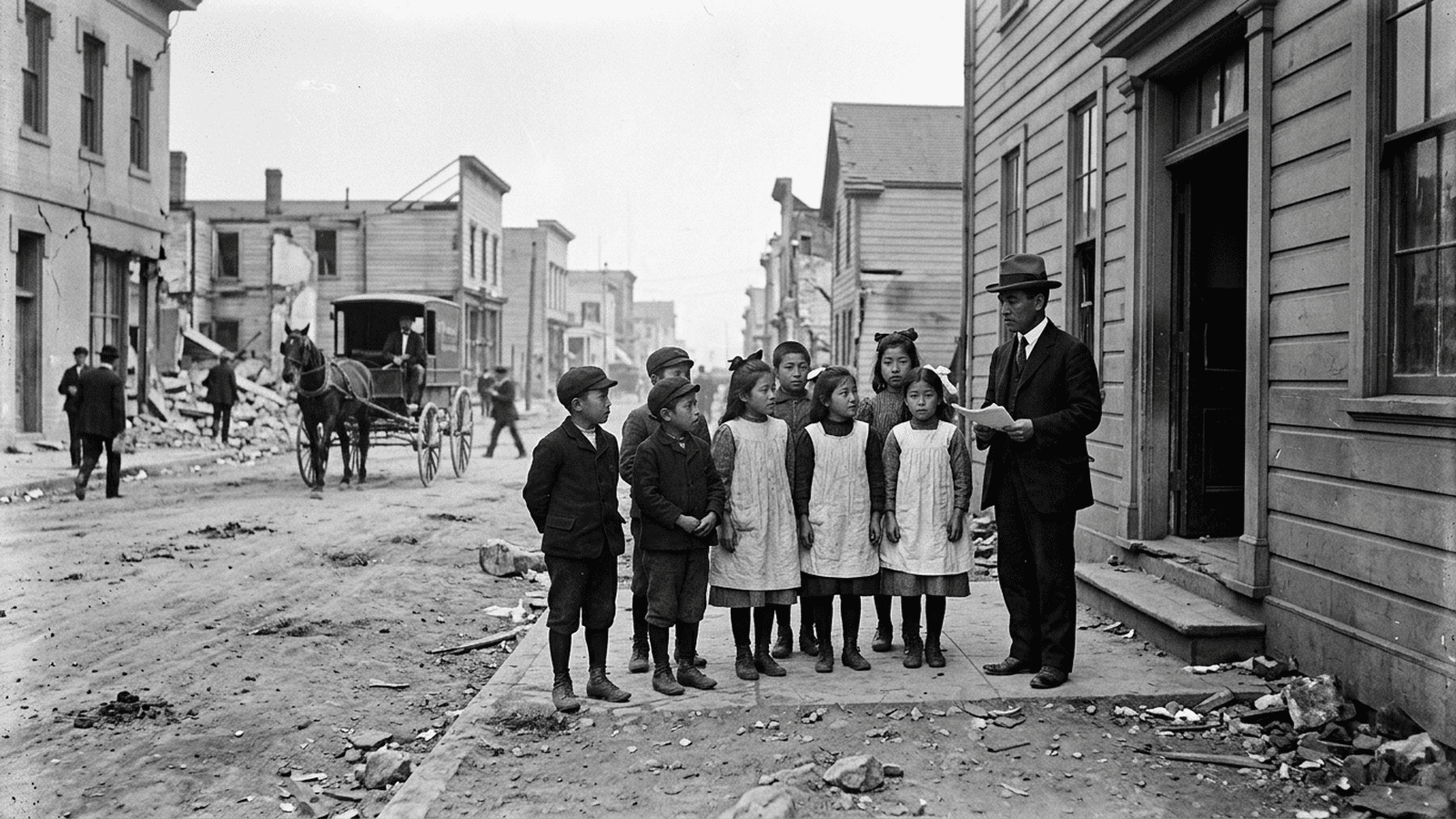
In 1906, San Francisco ordered Japanese and Korean children into a segregated school, prompting protests and a diplomatic dispute with Japan. President Theodore Roosevelt pressed city officials to reverse the policy, which the school board rescinded in March 1907, but the settlement did not end discrimination or create lasting legal protections in the United States.
TLDR: San Francisco’s 1906 order to segregate Japanese and Korean pupils sparked protests and a diplomatic dispute with Japan. President Theodore Roosevelt pressured city officials, and the school board reversed the policy in March 1907. The episode eased immediate tensions but left racial discrimination and the lack of durable civil-rights protections unresolved.
In October 1906, San Francisco’s Board of Education directed Japanese and Korean children to attend a segregated school in Chinatown. The order placed a local school dispute at the center of a national argument about equal treatment, immigration, and the United States’ standing with Japan. It was one of the Progressive Era’s most consequential civil-rights confrontations on the Pacific Coast. Because public schooling was administered locally, the order also raised questions about federal authority.
The board acted after the city’s devastating April earthquake and fire had displaced families and disrupted public services. Officials said Asian pupils should be separated for administrative and educational reasons. Rebuilding strained the school system, but the board made ancestry, rather than individual need, decisive. The order singled out children because of their ancestry. Japanese families and their supporters protested that the policy denied equal access to public education, while Japanese diplomats objected that it insulted their country and its people.
The dispute unfolded against a history of anti-Asian exclusion. Chinese immigrants had faced federal restrictions, and California politics had long featured campaigns against Asian immigration and labor. Japanese immigrants, however, came from a nation the United States recognized as a major power. Japan’s victory over Russia in 1905 had strengthened its international position, making the school order more than a local controversy. Japan’s growing power made officials wary of turning a school dispute into a test of national respect. Newspapers and public officials worried that it could damage relations between the two countries.
President Theodore Roosevelt opposed the segregation order and pressed San Francisco officials to reverse it. He argued that the policy was unjust and risked provoking a diplomatic crisis. Roosevelt feared that public humiliation could intensify anti-American feeling in Japan. The federal government could not simply dictate the city’s school assignments, but Roosevelt used public criticism and negotiations to increase pressure. Japanese officials raised the issue through diplomatic channels, while local leaders faced competing demands from residents, the school board, and Washington.
San Francisco’s school board rescinded the order in March 1907. The reversal ended the immediate segregation crisis, but it did not erase discrimination or establish a broad legal guarantee against it. Families still faced unequal treatment in practice, despite the board’s reversal. The settlement emerged through political and diplomatic bargaining rather than a court ruling. Its limited scope left Japanese American children’s access to schools dependent on local practice and left larger questions of racial equality unresolved.
The school dispute also became part of negotiations over Japanese immigration. In 1907 and 1908, the United States and Japan reached the informal arrangement known as the Gentlemen’s Agreement: Japan restricted passports for laborers seeking to enter the United States, while the United States avoided a formal exclusion law aimed specifically at Japanese people. The agreement’s terms sought to contain conflict without resolving the status of Japanese residents already in America. In 1907, Roosevelt also issued an order restricting entry by Japanese laborers who had traveled to Hawaii, Canada, or Mexico. These measures reduced immediate friction but relied on immigration controls and diplomatic compromise, not equal-rights protections.
The episode showed how a city policy could reach beyond local government, drawing the White House and a foreign government into a fight over children’s treatment. Community leaders used the episode to make unequal treatment publicly visible. It also exposed the limits of Progressive reform: political pressure could reverse a discriminatory order, yet lasting protection required stronger legal and institutional safeguards. Later debates over Asian exclusion and civil rights would continue to test those unresolved boundaries in the United States.

Lila Hayes serves as a Staff Writer for Just Right News, where she anchors the “Courts, Law, and Constitutional Order” beat. Her work is defined by a steadfast commitment to the foundational principles of the American republic and a rigorous defense of the legal frameworks that ensure national stability. As a primary voice for the outlet, she provides readers with a clear-eyed analysis of the judiciary, focusing on the importance of originalism and the preservation of the separation of powers.
Lila’s perspective was forged in the American heartland. Raised in St. Louis, Missouri, she grew up in a Hispanic household where the values of hard work, faith, and respect for the law were paramount. Her upbringing instilled in her a deep appreciation for the American Dream and the legal protections that make it possible. This Missouri background remains a cornerstone of her reporting, providing a grounded, common-sense counter-narrative to the often-insular legal circles of the coastal elite. She understands that the decisions made in high-court chambers have real-world consequences for families and small business owners across the country.
At Just Right News, Lila has become widely recognized for her signature feature series, “The Rulebook of Power.” In this ongoing project, she delves into the mechanics of the federal government, examining how administrative overreach and judicial activism can threaten the delicate balance of the Constitution. She approaches her beat with the tenacity of a veteran journalist and the precision of a legal scholar, consistently advocating for a judiciary that interprets the law as written rather than legislating from the bench. For Lila, the Constitution is not a “living” document subject to the whims of modern social trends; it is a fixed standard that ensures the government remains the servant of the people, not their master.
Now based in Philadelphia, Pennsylvania, Lila finds herself at the very epicenter of American constitutional history. Living and working in the city where the Founders drafted the documents she defends daily provides a constant source of inspiration. The historic halls and landmarks of Philadelphia serve as a daily reminder of the high stakes involved in her reporting. Her presence in the city allows her to bridge the gap between the historical intent of the law and its contemporary application, ensuring that the legacy of the Founding Fathers remains central to the national conversation.
Throughout her career, Lila has remained dedicated to the idea that a free society requires an informed citizenry and a transparent legal system. Her reporting is more than just a collection of headlines; it is a defense of the constitutional order that has sustained the nation for over two centuries. By focusing on the “Rulebook of Power,” she ensures that her readers understand not just what is happening in the courtrooms, but why those decisions matter for the future of American liberty. Lila Hayes continues to be a vital voice for those who believe that the law should be a shield for the citizen and a constraint on the state.