

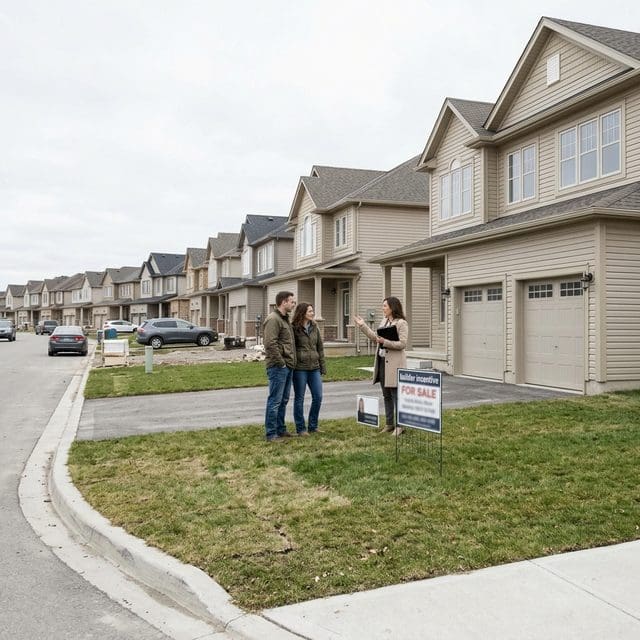
Elevated new-home inventory and builder price cuts may give some buyers room to negotiate, while financing costs and the gap between new and existing-home supply complicate the outlook.
A large supply of new homes is giving buyers more options than the existing-home market, but inventory alone does not make a house affordable. Recent data point to a housing market where builders are trying to draw in customers with lower prices, even as the cost of building and financing a home remains a hurdle.
The U.S. Census Bureau estimated an 8.4-month supply of new homes in September, compared with a 5.1-month supply of existing homes in October, according to Real Estate News on Nov. 17. The figures cover different months and housing categories, so they are not a direct, same-period comparison. Still, they indicate that newly built homes were more plentiful relative to sales than existing homes.
New construction also made up a smaller share of homes listed for sale. Realtor.com data cited by Real Estate News showed newly built homes represented 16.7% of all listings in the third quarter, down from 17.2% a year earlier. That share suggests builders are not simply flooding the overall listing pool, despite the elevated supply measured for new homes.
MarketWatch reported Nov. 17 that nearly half of home builders were cutting prices and offering lower mortgage rates as they struggled to find buyers. The report also said builders were facing rising construction costs, which can constrain how far they can reduce prices. Those incentives may help some buyers, but they are not a substitute for sustained, broad access to homes at prices households can carry.
The distinction between new and existing homes matters because a buyer’s options depend on more than the headline number of houses available. A new home might come with a builder-funded rate incentive, while a comparable existing home may not. Realtor.com data reported by Real Estate News put average third-quarter mortgage rates for new-home purchases at 5.01% when adjustable-rate mortgages and other loan programs were included, versus 6.15% for existing-home transactions. The comparison reflects different financing programs, not necessarily a like-for-like measure of the cost faced by every buyer.
For households weighing a purchase, a lower introductory or program-specific rate can reduce monthly payments, but the terms and duration matter. Price cuts can likewise improve the math, while incentives may leave the home’s listed price unchanged. The available reports do not quantify how much the builder discounts reduce typical monthly costs or how many buyers qualify for the financing offers.
A separate filing from Angel Oak Mortgage REIT offers a glimpse of the pressures in mortgage finance, though it does not measure conditions for homebuyers directly. For the quarter ended Sept. 30, the company reported a GAAP net loss of $16.7 million, net interest income of $10.2 million and distributable earnings of $6.4 million. Its GAAP book value was $8.97 per share, compared with economic book value of $11.45. Those figures describe one mortgage investment trust, not the broader availability or price of household mortgages.
The latest housing figures offer a mixed picture: more new-home supply relative to sales, a smaller new-build share of listings, and builders using discounts and financing offers to find buyers. Whether that translates into meaningful relief depends on the home’s price, the buyer’s loan terms and the costs that remain after the incentive ends. The reports establish room for negotiation in parts of the market, but not a general affordability turnaround.

Deborah Cole serves as a Senior Correspondent for Just Right News, where she spearheads the network’s coverage of Housing, Infrastructure, and Mobility. With a career defined by a commitment to rigorous reporting and a focus on the fundamental pillars of American community life, Deborah brings a principled perspective to the complex issues that dictate how and where we live. Her work is grounded in the belief that sound policy, fiscal responsibility, and respect for private property are the essential foundations of a prosperous society.
Originally from Boston, Massachusetts, Deborah’s upbringing in one of the nation’s oldest and most historically significant cities deeply influenced her professional trajectory. Growing up amidst the architectural legacy and dense urban planning of New England, she developed an early appreciation for the importance of durable infrastructure and the role of local tradition in shaping neighborhoods. Her perspective is informed by the classic American values of her hometown—hard work, community cohesion, and a healthy skepticism of top-down bureaucratic mandates that often overlook the unique needs of individual citizens.
Today, Deborah operates from her base in Austin, Texas, a city that serves as a primary laboratory for her reporting. Austin’s rapid expansion and its status as a hub for innovation and migration provide her with a front-row seat to the most pressing challenges in modern infrastructure and housing. From the Lone Star State, she chronicles the tensions between rapid growth and the preservation of the American Dream, often highlighting how market-driven solutions and deregulation can address the housing shortages that plague many of the country’s metropolitan areas.
At Just Right News, Deborah is perhaps best known for her signature feature series, “Where We Live.” Through this platform, she explores the intersection of public policy and private life, moving beyond mere statistics to tell the stories of families, small business owners, and local developers. Her reporting frequently highlights the importance of mobility—not just in terms of transportation and transit, but as a vehicle for economic opportunity and social stability. She remains a staunch advocate for the taxpayer, consistently scrutinizing government spending on large-scale projects and advocating for transparency in how infrastructure dollars are allocated.
Deborah’s beat is more than just a collection of policy topics; it is an investigation into the physical and legal structures that allow families to flourish. Whether she is reporting on the impact of zoning laws on suburban development or the necessity of maintaining the nation’s highway systems, her work is characterized by a dedication to the facts and a respect for the constitutional principles that protect the rights of homeowners.
As a Senior Correspondent, Deborah Cole continues to be a vital voice for Just Right News, providing the audience with the clarity and context needed to navigate an ever-changing landscape. Her reporting ensures that the values of individual liberty and local sovereignty remain at the forefront of the national conversation regarding the future of our cities and towns. Through her tireless efforts, she remains committed to informing the public on the issues that hit closest to home.