

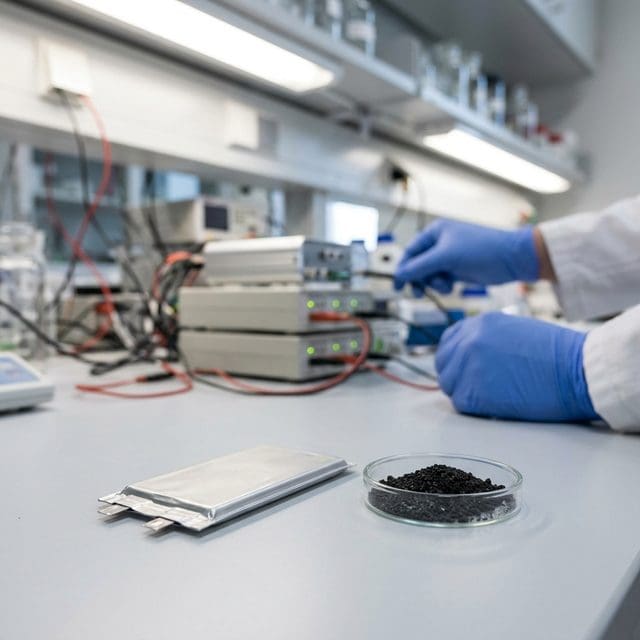
A Chinese research team reports a durable sodium-ion battery cathode, while Swedish researchers are exploring magnets made from local rare-earth mixtures.
Sodium-ion batteries have a basic appeal: sodium is more widely available than lithium, a key ingredient in many batteries. But abundance alone does not make a battery practical. It must store energy reliably, survive repeated charging and discharging, and compete with established alternatives. A Chinese research team has reported results that address part of that challenge with a new cathode material for sodium-ion cells.
The Dalian Institute of Chemical Physics team’s iron–manganese phosphate cathode achieved 97.0 percent first-cycle Coulombic efficiency, a measure of how much of the initial charge is recovered on discharge. It delivered a reversible capacity of 125.7 milliamp-hours per gram. In pouch-cell tests, the battery retained 93.6 percent of its capacity after 1,000 cycles at a charging and discharging rate known as 1C.
Those figures suggest the material can store and return charge efficiently while withstanding repeated use. The team also reported a specific energy of 421.1 watt-hours per kilogram for the cathode’s active material. That number applies to the active cathode material, not the complete battery pack; the finished product must include other materials and components, so its energy density will be lower.
The researchers’ institute has a 100-tonne pilot line, a step beyond producing material only in a laboratory. A pilot line can test whether a process can be scaled, but it is not proof of mass production or commercial success. The reported results also do not establish that sodium-ion batteries can replace lithium-ion batteries in every use.
The commercial market is moving ahead while researchers work on those questions. Wood Mackenzie reported on Nov. 5 that sodium-ion batteries had more than 70 gigawatt-hours of supply agreements. It expects leading manufacturers to reach cell-cost parity with lithium-iron-phosphate batteries by the end of 2026. BYD has 30 gigawatt-hours of planned capacity in China, while CATL is targeting at least 1 gigawatt-hour in shipments by year-end 2026.
The economics remain mixed. Wood Mackenzie estimates sodium-ion storage systems cost $229 per kilowatt-hour upfront, compared with $200 for lithium-iron-phosphate systems. Over a 20-year project life, however, it estimates sodium-ion systems cost 21 percent less to own and operate. Those estimates are not a guarantee for every project, and the upfront premium matters to buyers deciding how to finance a system.
A separate research effort in Sweden points to another way of rethinking battery-related supply chains. Uppsala University researchers are cataloging the full mixtures of rare-earth elements in deposits at Kiruna, Bergslagen and Norra Kärr. Rather than extracting one desired metal at a time, they aim to design magnets around the combinations that are naturally available in those deposits.
The researchers say the approach could reduce processing, waste and pollution, while lowering dependence on China. But the work is a multi-year research effort; no production timetable or quantified estimate of the deposits’ resources has been reported. The potential environmental and supply-chain benefits remain proposals to be tested, not achieved outcomes.
Together, the projects reflect a practical question for the energy transition: can materials and manufacturing be adapted to resources that are more available locally, without sacrificing performance or driving up costs? The new cathode results and the pilot line offer a concrete next step for sodium-ion batteries. The next test is whether those laboratory gains can hold up in larger-scale production and real-world use.

Susan Carter serves as a Senior Correspondent for Just Right News, where she leads the network’s comprehensive coverage of Health, Medicine, and Public Policy. With a career dedicated to dissecting the complexities of the American healthcare system, Susan brings a principled perspective to the most pressing debates of the day. Her reporting is characterized by a commitment to individual liberty, fiscal responsibility, and a healthy skepticism of government overreach, making her a vital voice for audiences seeking clarity in an increasingly regulated landscape.
Raised in Minneapolis, Minnesota, Susan’s professional outlook is deeply informed by the values of the American heartland. Growing up in the Twin Cities, she witnessed firsthand the importance of community-driven solutions and the resilience of the individual. This Midwestern foundation instilled in her a firm belief that the best answers to public policy challenges often come from local innovation and personal responsibility rather than top-down federal mandates. Her background allows her to translate complex legislative jargon into stories that resonate with families who value common sense and local autonomy.
Now based in Baltimore, Maryland, Susan operates from a unique vantage point at the intersection of medical innovation and urban policy. Living and working in a city renowned for its world-class medical institutions and significant public health challenges, she has a front-row seat to the realities of the modern healthcare landscape. Her proximity to these hubs of research and policy allows her to scrutinize how government intervention affects the quality of care and the freedom of medical professionals. In Baltimore, she sees the tangible results of policy decisions, using the city as a lens through which to examine the broader national health debate and the impact of federal spending on local communities.
As the lead for the acclaimed feature series “The Cost of Care,” Susan dives deep into the economic realities facing patients and providers alike. Her work focuses on the necessity of price transparency, the benefits of market competition, and the preservation of the sacred doctor-patient relationship. She is a staunch advocate for the idea that a well-informed public is the best defense against bureaucratic inefficiency. Through this series, she has exposed the hidden drivers of rising medical expenses, always seeking to empower the individual consumer over the massive institution.
Susan’s reporting on public policy is characterized by a commitment to rigorous inquiry and a focus on constitutional limits. Whether she is analyzing new pharmaceutical regulations, investigating the impact of federal health mandates, or exploring the future of medical technology, her goal remains the same: to provide Just Right News audiences with the facts they need to navigate a complex world. By blending her Midwestern sensibilities with the insights gained from her base in Maryland, Susan Carter has become a trusted authority for those who believe that personal freedom and public health are inextricably linked. Her work continues to challenge the status quo, advocating for a system that respects the taxpayer and prioritizes the patient.