

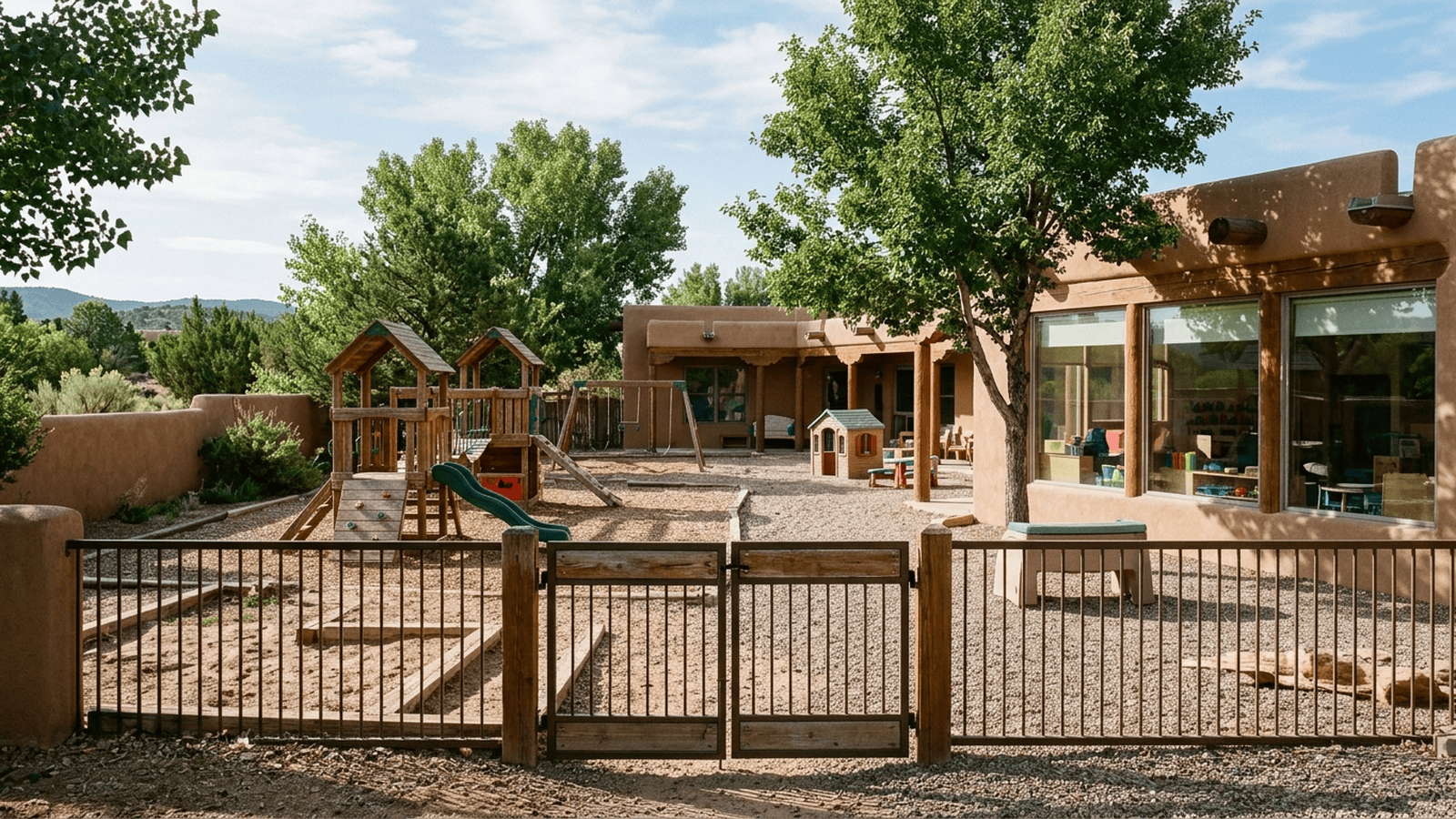
New Mexico’s universal childcare program has made care free for eligible resident families, and about half of the state’s children age five and under are enrolled. Families who secure a place report meaningful benefits, and a cited study found full-time employment among lower-income mothers rose by 23%. Demand still exceeds capacity: Kids Campus in Santa Fe has nearly 700 children on its waitlist, and the state faces shortages of workers and childcare slots. A funding safeguard will require some households earning above $198,000 to pay up to $148.50 a month through the fiscal year. State officials have set a goal of adding 12,000 places, without a specific deadline in the report.
TLDR: New Mexico’s free childcare program has widened access, with about half of children five and under enrolled and reported gains for some families. Long waitlists, worker shortages, and a limited copayment for some higher-income households remain part of the program’s implementation.
New Mexico’s universal childcare program has made care free for eligible families, while demand continues to exceed the number of available places. The state became the first to offer free childcare to every family, regardless of income, a year before the report. Families must live in New Mexico, and adults in the household must be working, looking for work, in school, or unable to work.
The state’s stated rationale is to make childcare available to families across income levels and support early childhood education. New Mexico voters approved dedicating part of the state’s Land Grant Permanent Fund to early childhood education in 2022. The fund includes taxes and royalties from oil and gas production and can provide hundreds of millions of dollars each year for childcare.
For families who secure a place, the program can remove a major household expense. Judyn Martinez’s daughter attends Kids Campus in Santa Fe. Martinez said she is grateful for the program because she otherwise could not have sent her daughter. She described the center as welcoming and said her daughter was learning and growing there.
Access, however, is not automatic. Martinez said it took about a year and a half for her daughter to move off the Kids Campus waitlist. The list now includes nearly 700 children, while the center can serve about 130. Lilia Doyle, also in Santa Fe, said her two-year-old son was on six waitlists. She described being far down some lists and not receiving calls from others.
The statewide figures show both broad reach and a gap. New Mexico has about 67,000 children age five and under, and about half are enrolled in the universal program, according to the state. Some other families use free public programs such as New Mexico PreK and Head Start. The number of children unable to access universal childcare because of limited capacity is not clear. Many children are not enrolled in any free public childcare program.
State officials have acknowledged that the program needs to expand. The main constraints are a shortage of childcare workers and too few available slots. Those shortages are also present elsewhere in the country. Cynthia Osborne, who leads Vanderbilt University’s Prenatal-to-3 Policy Impact Center, said other states will be watching New Mexico to learn how to build the infrastructure needed to provide care at scale. She also noted the challenge of building that system while keeping costs under control.
The program has produced reported benefits for some families. Martinez said the care has made a major difference for her household. The governor, Michelle Lujan Grisham, said parents have told her the program is transformative and described the year as going very well. The excerpt also cites an Arizona State University paper finding that full-time employment among lower-income mothers in New Mexico increased by 23% after universal childcare was enacted. These accounts and findings sit alongside the waitlists, which show that eligibility does not guarantee an immediate place.
The program grew out of earlier childcare subsidies for low-income families and free care for families with the lowest incomes. Families, providers, and grassroots organizers had campaigned to remove income limits. In September 2025, Lujan Grisham announced a plan for free, universal childcare and prekindergarten, scheduled to begin November 1 of that year. The legislature approved the program after its launch, and it became law in March 2026. Any licensed or registered childcare provider in New Mexico may participate. The state offers higher reimbursements to centers that pay higher wages and operate at least 10 hours a day, five days a week.
Funding safeguards have also begun to affect some households. The program provides for adjustments if an economic downturn makes it harder to pay for care. An annual Consumer Price Index increase above 3% triggered one of those safeguards. Families of four with incomes above $198,000 will soon be required to make a copayment, capped at $148.50 a month. The state’s Early Childhood Education and Care Department says the change will affect about 10% of enrolled families and remain in effect through the fiscal year. The excerpt does not specify a start date for the copayments.
In 2025, the department set a goal of creating 12,000 new childcare spots in the program’s first few years, but it did not provide a specific deadline in the report. The source also does not detail new application forms or enforcement procedures. For families, the immediate practical issue remains whether a participating provider has an open place; some continue to wait, and one center offered Doyle’s son a place that would not open until August 2027. Adding places and tracking the copayment change are necessary steps for the program’s implementation. Officials say expansion is needed, and the experience is being watched by policymakers and childcare advocates in other states.

Mason Reed serves as a Staff Writer for Just Right News, where he spearheads the Future Frontiers & Special Projects desk. In an era defined by rapid technological shifts and evolving social landscapes, Mason provides a steady, principled voice, examining the innovations of tomorrow through the lens of traditional American values. His work is most prominently featured in his signature series, “The Next Horizon,” where he explores the intersection of emerging technology, national sovereignty, and the preservation of individual liberty.
A native of San Diego, California, Mason’s worldview was shaped by the unique culture of his hometown. Growing up in a region defined by its strong military presence and its history of maritime industry, he developed a deep-seated respect for the institutions that provide national stability and the entrepreneurial spirit that drives the American economy. This upbringing instilled in him a belief that true progress is not found in discarding the past, but in building upon a foundation of proven principles. His reporting often reflects this San Diego influence, emphasizing the importance of a robust national defense and the necessity of maintaining a competitive edge in the global marketplace.
Now based in San Francisco, Mason operates from the heart of the world’s technological engine. Living and working in the Bay Area provides him with a front-row seat to the advancements—and the ideological challenges—emanating from Silicon Valley. While many in the region embrace a “move fast and break things” mentality, Mason’s reporting serves as a vital counterweight. He offers Just Right News readers a “boots on the ground” perspective, documenting how radical local policies and the concentration of tech power impact the everyday lives of citizens. His proximity to the industry allows him to cut through the marketing jargon of big tech to uncover the real-world implications for privacy, free speech, and the nuclear family.
In his “Future Frontiers” beat, Mason tackles complex subjects ranging from the ethics of artificial intelligence to the burgeoning private space race. He approaches these topics with a healthy skepticism toward centralized bureaucracy, championing instead the decentralized innovations that empower individuals. Through “The Next Horizon,” he highlights the pioneers and thinkers who are working to ensure that the future remains a place where human dignity and constitutional rights are protected. He believes that the rapid pace of change requires more than just technical expertise; it requires a moral compass rooted in the Western tradition.
Throughout his tenure at Just Right News, Mason has remained committed to the idea that the future is something to be shaped, not merely accepted. His writing is characterized by a rigorous defense of American exceptionalism and a belief that the country’s best days lie ahead, provided it remains true to its founding ideals. Whether he is investigating the impact of automation on the American workforce or profiling the next generation of aerospace engineers, Mason Reed ensures that his readers are equipped with the insights they need to navigate a changing world with confidence and clarity.