

Diamondback Energy is reportedly nearing a purchase of Midland Basin drilling assets, but the price, final terms and competitive effects remain uncertain.
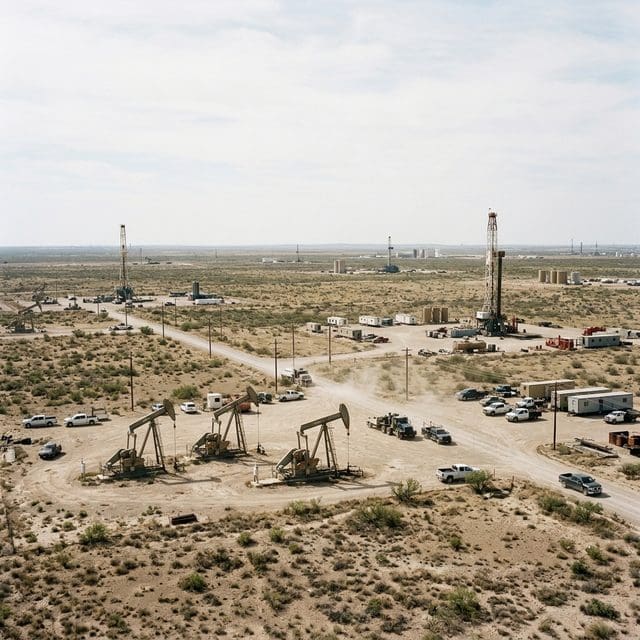
Diamondback Energy is nearing a deal to acquire drilling assets in the Permian Basin, according to a Financial Times headline published November 15. Reuters reported the same day that the proposed seller is Double Eagle V, backed by EnCap Investments, and that its assets are in the Midland portion of the basin.
Reuters said the transaction was not independently verified and could be announced as soon as early the following week. Cash and stock were expected to form the consideration. The Financial Times headline described a roughly $5 billion deal, but the available factual reporting says the figure was not independently verified. It should not be treated as a confirmed price.
That uncertainty matters. A transaction’s value alone cannot show whether competition would suffer, but reliable information about its scope and terms is needed to assess the issue. The reports do not detail the assets’ production, Diamondback’s existing holdings in the area, the number of rival operators or customers’ alternatives. They also identify no Federal Trade Commission or Justice Department review, challenge or approval.
Buying additional drilling acreage could give a producer greater scale. But scale does not, by itself, prove reduced competition—or consumer benefit. Regulators and the public would need to know whether the combined company would control a meaningfully larger share of relevant drilling opportunities, whether rivals could still obtain acreage and services on workable terms, and whether any claimed efficiencies would benefit customers and local businesses.
Reuters separately reported that Diamondback and KKR had agreed the previous week to acquire Five Point Infrastructure’s stake in Deep Blue Midland Basin, a Permian water-infrastructure company. The report did not disclose terms. The available information does not establish that the transaction would restrict rivals’ access to water infrastructure or that it is connected to the proposed Double Eagle V purchase.
The separate deal nevertheless makes infrastructure access a relevant question if Diamondback’s holdings expand. Producers depend on services and infrastructure as well as drilling rights. Whether a company could use ownership to influence rivals’ access or costs depends on facts not included in the reports. Deal activity can warrant scrutiny without proving that competitive harm has occurred.
Other recent headlines provide little evidence about antitrust enforcement. Amanat Acquisition’s quarterly results, Ares Management’s purchase of Claritev shares and a Vistance Networks director’s stock purchase concern earnings or stock transactions, not announced merger reviews or antitrust cases. The Claritev report describes a major shareholder buying shares, not a corporate acquisition. The Vistance report concerns a director’s purchase, while the Amanat headline concerns quarterly results. None demonstrates a broader enforcement trend.
For now, the Diamondback report describes a potential transaction, not a documented antitrust dispute. The reported seller, asset location and possible form of payment provide a starting point, but the unconfirmed valuation, unsettled terms and missing market data prevent a reliable assessment. If the deal is announced, its final scope, the companies’ positions in relevant markets and any agency review will help determine whether it raises a substantive competition concern.

Greg Sanders serves as the Senior Correspondent for Corporate Power and Antitrust at Just Right News, where he brings a principled, conservative perspective to the complex intersection of big business, government regulation, and the American consumer. With a career dedicated to investigative depth and economic clarity, Greg has become a leading voice in examining how the consolidation of industry power impacts the foundational values of the free market and individual liberty.
Raised in Denver, Colorado, Greg’s reporting is deeply informed by the Western spirit of independence and a healthy skepticism of centralized authority. Growing up in the shadows of the Rockies, he witnessed firsthand the importance of local entrepreneurship and the vital role that small-medium enterprises play in sustaining vibrant communities. This upbringing instilled in him a belief that the American Dream is best preserved when the playing field remains level and when competition—rather than backroom deals between corporate lobbyists and federal regulators—dictates success. For Greg, the rugged individualism of his home state serves as a constant reminder that the economy should serve the people, not the other way around.
Now based in Chicago, Illinois, Greg operates from the heart of the nation’s industrial and financial crossroads. His location in the Midwest provides him with a unique vantage point to observe the real-world consequences of corporate overreach. From the boardrooms of the Loop to the manufacturing hubs that define the region, he tracks the movement of capital and the shifting tides of market influence. Chicago’s history as a center of trade and labor offers a rich backdrop for his work, allowing him to bridge the gap between high-level economic theory and the lived experiences of hardworking Americans who feel the squeeze of monopolistic practices.
At Just Right News, Greg’s beat focuses on the “new monopolies” and the rise of “woke” corporate culture. He argues that when corporations become too large, they often abandon their fiduciary duties to shareholders in favor of social engineering and political posturing. His reporting seeks to hold these “Titans” accountable, ensuring that the power of the purse is not used to silence dissent or bypass the democratic process. He is a firm advocate for the idea that true conservatism requires a vigilant defense of competition, preventing any single entity—public or private—from exerting undue control over the lives of citizens.
This mission is most clearly seen in his acclaimed feature series, “The Titans and the Toll.” In this ongoing project, Greg explores the human cost of market consolidation, from the erosion of consumer choice to the decline of local economies. Through rigorous analysis and boots-on-the-ground reporting, he documents how the concentration of power in sectors like tech, agriculture, and finance creates a “toll” paid by the average family.
Greg Sanders remains committed to the idea that a transparent, competitive market is the greatest engine for prosperity ever devised. Through his work at Just Right News, he continues to provide the essential oversight necessary to protect that engine from the encroaching influence of corporate giants and the bureaucratic structures that enable them.