

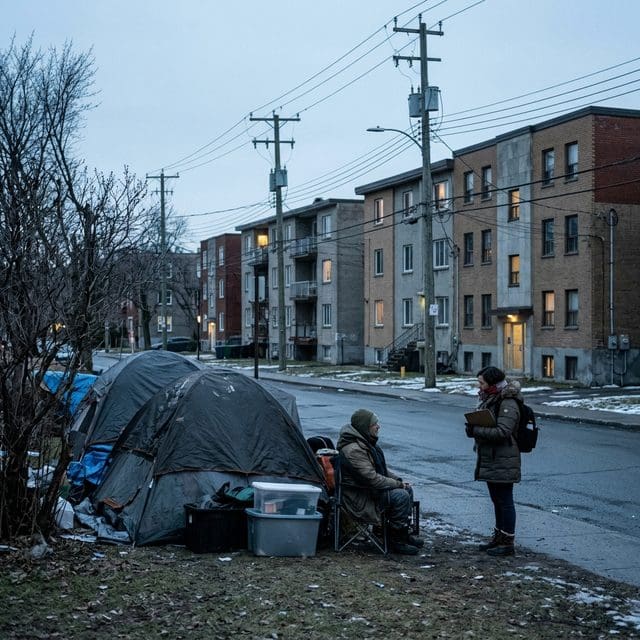
Canada’s proposed housing and health investments draw cautious support from Maggie Helwig, who argues that ending homelessness requires more basic affordable homes than the plan may deliver.
Canada’s federal homelessness plan promises billions for housing and related services, but one of the advocates whose work Prime Minister Mark Carney has cited says the country’s proposed 10-year goal is not ambitious enough to end homelessness.
Maggie Helwig, a writer and Anglican priest whose book on encampments has drawn attention from Carney, described the goal as serious and constructive in an interview with CBC published Nov. 15. But she cautioned that it is “not at a scale which would end homelessness.”
Her central concern is what the plan treats as the problem. Helwig argued that policy should prioritize basic affordable housing rather than frame mental health and addictions as the primary drivers of homelessness. Supportive services can matter, but a housing strategy that does not create enough homes people can afford risks leaving the underlying shortage untouched.
The stakes are substantial. Canada’s 2025 national count found more than 65,000 people homeless on a given night, CBC reported. That was a 59 per cent increase over five years. The share of people counted who were unsheltered, including those living in encampments, rose from 23 per cent to 27 per cent over the same period.
The federal plan includes $10 billion for supportive and transitional housing, $5 billion for integrated housing-health projects and $2 billion for community health infrastructure, according to CBC’s Nov. 14 reporting. It also renews the Canada Housing Benefit and the Reaching Home program. The announced investments span housing and health services, though the figures alone do not establish how many affordable homes will be delivered or how quickly.
That distinction matters to households facing high housing costs and to communities managing visible homelessness. A program can fund services and construction, but its effect depends on whether homes are completed, accessible to people with the greatest need and affordable over time. The available reporting does not specify the number of units the national commitments are expected to produce, so it is not possible to assess the plan’s housing output from the headline dollar amounts alone.
Helwig’s emphasis on basic housing also points to a policy choice: whether homelessness is treated chiefly as a service-delivery challenge or as a shortage of places people can actually live. The plan’s funding for supportive housing and integrated health projects recognizes that some residents need more than a lease. Her critique is that those interventions cannot substitute for a sufficient supply of affordable homes.
The federal government is also renewing existing programs, including the Canada Housing Benefit and Reaching Home. The reporting does not provide verified details on changes to benefit levels or the number of people who will receive assistance. For renters under pressure, renewal may preserve support, but the source material does not show whether it will expand help or close the gap between incomes and housing costs.
The plan’s 10-year horizon gives governments time to build capacity, but it also makes accountability essential. Measures such as completed affordable units, reductions in unsheltered homelessness and sustained access to housing would help show whether public spending is changing conditions, not merely funding activity. Those are tests of outcomes, not claims about targets already set by the plan.
Carney’s government has put substantial sums behind housing and health programs. Helwig’s response offers a sharper measure of success: whether those commitments produce enough basic, affordable housing to move people out of homelessness. On the evidence now reported, the plan’s scale remains an open question.

Deborah Cole serves as a Senior Correspondent for Just Right News, where she spearheads the network’s coverage of Housing, Infrastructure, and Mobility. With a career defined by a commitment to rigorous reporting and a focus on the fundamental pillars of American community life, Deborah brings a principled perspective to the complex issues that dictate how and where we live. Her work is grounded in the belief that sound policy, fiscal responsibility, and respect for private property are the essential foundations of a prosperous society.
Originally from Boston, Massachusetts, Deborah’s upbringing in one of the nation’s oldest and most historically significant cities deeply influenced her professional trajectory. Growing up amidst the architectural legacy and dense urban planning of New England, she developed an early appreciation for the importance of durable infrastructure and the role of local tradition in shaping neighborhoods. Her perspective is informed by the classic American values of her hometown—hard work, community cohesion, and a healthy skepticism of top-down bureaucratic mandates that often overlook the unique needs of individual citizens.
Today, Deborah operates from her base in Austin, Texas, a city that serves as a primary laboratory for her reporting. Austin’s rapid expansion and its status as a hub for innovation and migration provide her with a front-row seat to the most pressing challenges in modern infrastructure and housing. From the Lone Star State, she chronicles the tensions between rapid growth and the preservation of the American Dream, often highlighting how market-driven solutions and deregulation can address the housing shortages that plague many of the country’s metropolitan areas.
At Just Right News, Deborah is perhaps best known for her signature feature series, “Where We Live.” Through this platform, she explores the intersection of public policy and private life, moving beyond mere statistics to tell the stories of families, small business owners, and local developers. Her reporting frequently highlights the importance of mobility—not just in terms of transportation and transit, but as a vehicle for economic opportunity and social stability. She remains a staunch advocate for the taxpayer, consistently scrutinizing government spending on large-scale projects and advocating for transparency in how infrastructure dollars are allocated.
Deborah’s beat is more than just a collection of policy topics; it is an investigation into the physical and legal structures that allow families to flourish. Whether she is reporting on the impact of zoning laws on suburban development or the necessity of maintaining the nation’s highway systems, her work is characterized by a dedication to the facts and a respect for the constitutional principles that protect the rights of homeowners.
As a Senior Correspondent, Deborah Cole continues to be a vital voice for Just Right News, providing the audience with the clarity and context needed to navigate an ever-changing landscape. Her reporting ensures that the values of individual liberty and local sovereignty remain at the forefront of the national conversation regarding the future of our cities and towns. Through her tireless efforts, she remains committed to informing the public on the issues that hit closest to home.