

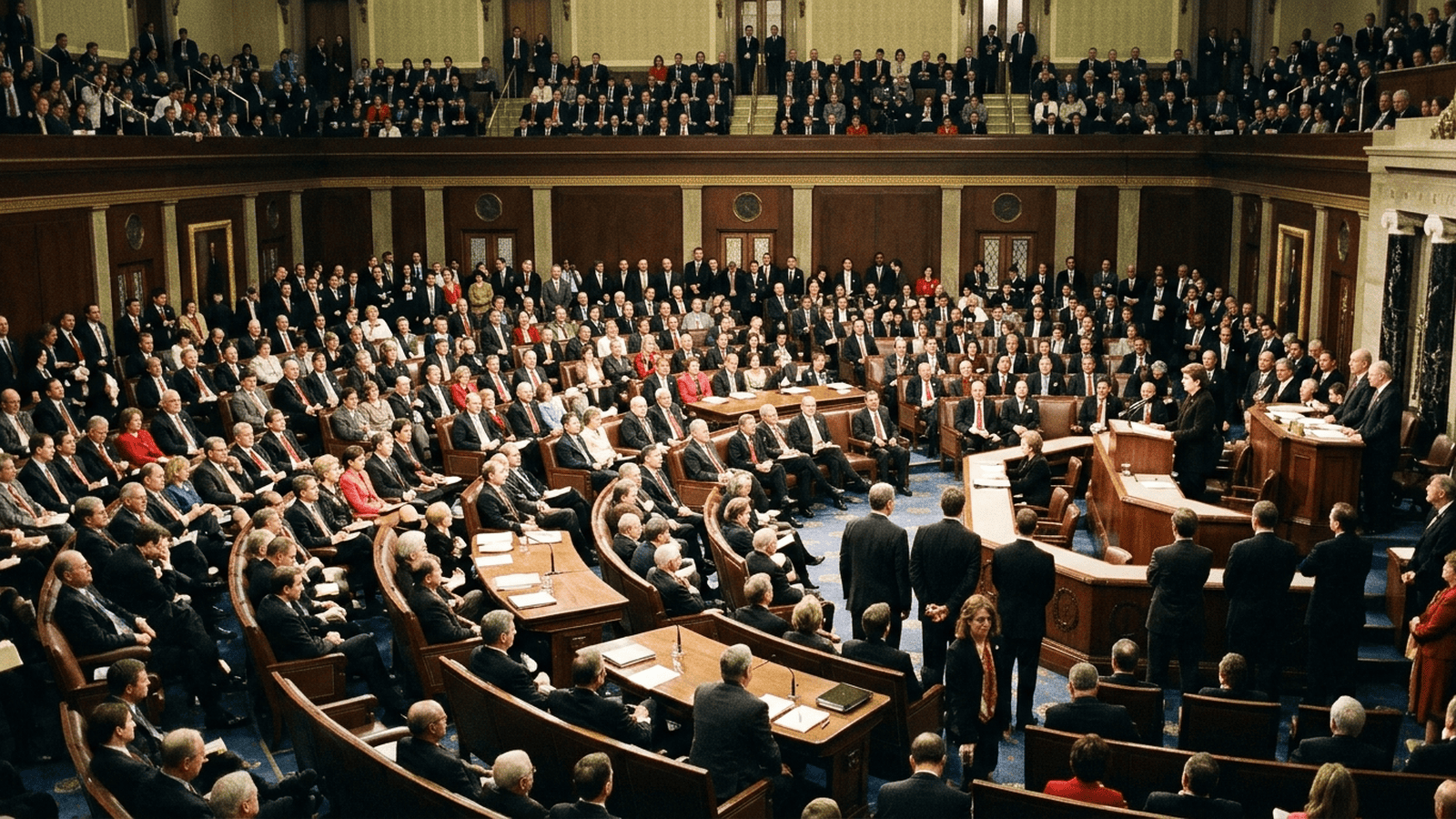
The 2006 midterm elections returned the U.S. House to Democratic control, and on January 4, 2007, Nancy Pelosi became its first woman speaker. The new majority reshaped committee leadership, pursued ethics and domestic legislation, and challenged President George W. Bush over the Iraq war while facing limits in the Senate and the president’s veto power.
TLDR: Democrats won the House in the 2006 midterms and began the 110th Congress in control on January 4, 2007. Nancy Pelosi became the first woman speaker. The majority pursued ethics reforms and domestic legislation, while using House debate and oversight to oppose President Bush’s Iraq troop increase.
When the 110th Congress convened on January 4, 2007, Democrats took control of the U.S. House of Representatives for the first time in 12 years. The shift followed the November 2006 midterm elections, in which voters gave Democrats a House majority and expanded their Senate representation. The change reordered Congress’s leadership, committee system and legislative agenda as President George W. Bush entered the final two years of his administration.
The House contest unfolded amid public discontent over the Iraq war, political scandals and Republican control of Washington. Democrats gained 31 seats, ending a majority that Republicans had held since the 1994 elections. Their new majority stood at 233 seats to the Republicans’ 202. In the Senate, Democrats also gained seats; two independents, Bernie Sanders of Vermont and Joe Lieberman of Connecticut, caucused with them, giving the Democratic caucus effective control.
California Representative Nancy Pelosi, the Democratic leader since 2003, became the first woman elected speaker of the House. Members chose her by a vote of 233 to 202, making her the chamber’s presiding officer and the most powerful figure in its Democratic leadership. Pelosi had helped organize the party’s campaign and had worked to hold together a coalition of members with different priorities, from antiwar voters to more centrist districts.
The transition also featured a contested race for majority leader. Pelosi supported John Murtha of Pennsylvania, a veteran critic of the Iraq war, but Democrats elected Steny Hoyer of Maryland by 149 votes to 86. The result showed that a new majority did not erase divisions within the party. Pelosi and Hoyer subsequently worked together in top leadership roles, while committee assignments and chairmanships shifted to Democrats under the chamber’s rules.
Control of committees gave the new majority substantial power to hold hearings, investigate executive agencies and shape legislation. Because the House sets its own rules and controls appropriations measures, committee chairs could compel testimony and demand records, though disputes over executive privilege often limited access and slowed investigations. Democrats made Iraq a central focus, scheduling debate on a nonbinding resolution opposing Bush’s plan to increase U.S. troop levels. The House approved that measure in February 2007, 246 to 182. It expressed opposition but did not compel the president to change military policy, illustrating the limits of congressional declarations without binding legislation.
The House majority also moved on domestic priorities. In its opening days, it passed a bill to raise the federal minimum wage, a measure that became law in May as part of a broader bill. The chamber approved new ethics rules, including restrictions on gifts and privately funded travel, and pursued measures involving stem-cell research and federal spending. Some proposals became law, while others stalled amid Senate negotiations or presidential opposition.
The transfer was consequential but not an abrupt break in the constitutional balance. Bush retained the veto, Republicans held enough Senate seats to influence legislation, and differences among Democrats complicated efforts to advance a unified program. The new chairs could investigate and legislate, but they could not by themselves end the Iraq war or guarantee that bills would pass both chambers. Congressional oversight became more assertive, especially on war policy and executive conduct.
The 2006 election and the January 2007 organization of the House established a new governing alignment, with Pelosi as speaker and Democrats controlling both chambers. The Senate majority was narrow, and party control would shift again after the 2008 elections. The transition nevertheless helped normalize stronger ethics oversight and demonstrated how midterm voting can rapidly change committee power, chamber leadership and the direction of federal lawmaking.

Miles Harrington serves as the Senior Correspondent for Federal Systems & Executive Power at Just Right News, where he brings a disciplined, constitutionalist lens to the inner workings of the American government. With a focus on the mechanics of the federal bureaucracy and the limits of executive authority, Harrington has established himself as a vital voice for readers who value transparency, accountability, and the preservation of the separation of powers.
A native of Richmond, Virginia, Harrington’s perspective is deeply rooted in the traditions of the Old Dominion. Growing up in a city defined by its historical significance and its role as a center of American jurisprudence, he developed an early appreciation for the foundational principles of the Republic. His upbringing in Richmond—a place where the legacy of the Founding Fathers is woven into the landscape—instilled in him a belief that the federal government should remain within its constitutional bounds. This background informs his skepticism of centralized overreach and his commitment to reporting on the ways in which the administrative state impacts the lives of everyday citizens.
In his current role, Harrington specializes in the complexities of federal systems. He doesn’t just report on the headlines of the day; he digs into the structural shifts within the executive branch that often go unnoticed by the mainstream press. Whether he is analyzing the implications of a new federal regulation or investigating the expansion of agency jurisdiction, his work is characterized by a rigorous adherence to the facts and a dedication to the rule of law.
Harrington is perhaps best known for his signature feature series, “How Washington Works.” Through this ongoing project, he demystifies the often-opaque processes of the nation’s capital, pulling back the curtain on the “Deep State” and the unelected officials who wield significant influence over national policy. By breaking down complex legislative maneuvers and executive orders, he empowers Just Right News readers to understand the true levers of power in Washington. His reporting serves as a necessary check on the federal government, ensuring that the actions of those in power are held up to the light of public scrutiny.
Now based in Washington, D.C., Harrington operates at the epicenter of the political world, yet he remains intentionally distanced from the “Beltway bubble.” His proximity to the halls of power allows him to maintain a robust network of sources across the federal landscape, but his heart remains in the principled conservatism of his Virginia roots. He views his role not merely as a reporter, but as a steward of the public trust, dedicated to providing the clarity and context that conservative voters need to navigate an increasingly complex political environment.
Through his sharp analysis and unwavering commitment to the truth, Miles Harrington continues to be a cornerstone of the Just Right News team. His work ensures that the principles of limited government and executive restraint remain at the forefront of the national conversation, providing a crucial service to those who believe in a government that is truly of, by, and for the people.