

A communications failure that halted U.S. departures has sharpened a fight over FAA spending, while Congress schedules Nvidia-related testimony and a judge blocks a park redevelopment plan.
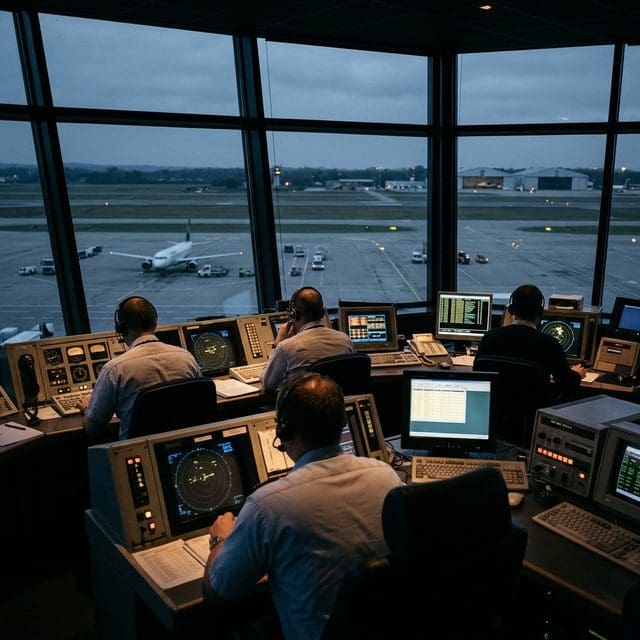
A failure in the communications network used by air-traffic controllers to speak with pilots halted nearly all departing U.S. flights for almost five hours Friday, exposing a vulnerability with immediate consequences for travelers and airlines. The disruption has also intensified a familiar Washington dispute: how much more federal money is needed to modernize infrastructure, and whether agencies have used the money Congress already provided.
Transportation Secretary Sean Duffy has raised his request for air-traffic-control modernization funding from roughly $30 billion to $50 billion. The White House and Transportation Department had earlier sought $30.1 billion for airport and air-traffic infrastructure. Congress approved $12.5 billion for modernization in 2025, and Democrats say the Federal Aviation Administration has yet to spend most previously authorized modernization funds. They have promised an investigation next year.
The outage’s suspected mechanism is more specific than a general technology failure. Reuters, citing two airline officials, reported that the disruption appeared to involve a network handling the critical radio frequencies controllers use to communicate with pilots. Duffy has said the FAA’s legacy system became overloaded during maintenance and modernization work, calling it “an incredibly old air traffic control system.”
For passengers and businesses, the immediate effect is uncertainty over reliable schedules as airlines work through disruption. The FAA said normal schedules might not return until late Sunday, Nov. 15. No verified cancellation or delay totals are available in the material reviewed here, so the scale of the continuing disruption remains unclear.
The funding question is not simply whether modernization is needed. The outage offers a case for replacing vulnerable equipment, but the existing appropriation makes execution and oversight central to the debate. House Speaker Mike Johnson plans to include additional FAA funding in an “aggressive legislative package” during the lame-duck session, according to The New York Times. That proposal would come before lawmakers have resolved Democrats’ questions about the use of prior funds. The available material does not specify the package’s final size or terms.
A separate technology-policy dispute involving Nvidia and China is moving toward congressional scrutiny. Jensen Huang resigned as Nvidia chief executive on Nov. 12 after reports about alleged personal relationships, including one involving a woman accused of spying for China. The controversy also concerns the administration’s handling of suspected diversion of Nvidia chips to China.
Reuters reported that Commerce Secretary Howard Lutnick allegedly stalled Trump-authorized action against companies suspected of diverting the chips. The White House said President Donald Trump maintained “complete confidence” in Lutnick. Lutnick has agreed to testify voluntarily before the Senate Banking Committee on Dec. 10; Huang was asked to appear on Dec. 3, CNBC reported. The hearings could clarify how export-control decisions were made, but the available reports do not establish that the administration granted Nvidia improper treatment.
The consequences extend beyond one company. Controls on advanced chips affect U.S. technology businesses seeking access to foreign markets and policymakers’ effort to limit China’s access to strategically important computing hardware. The testimony dates set a near-term oversight timetable, though no legislative change is yet described.
In Washington, a federal judge blocked the Trump administration from closing East Potomac Park for at least two weeks, The Hill reported Nov. 14. The temporary order pauses the proposed closure for now; the supplied material does not describe the court’s full reasoning or the next hearing date. Together, the FAA fight, export-control scrutiny and park ruling show the different levers shaping policy: appropriations, congressional oversight and judicial review. For taxpayers, the next test is whether officials can explain both what new spending would accomplish and what happened to funds already approved.

Deborah Cole serves as a Senior Correspondent for Just Right News, where she spearheads the network’s coverage of Housing, Infrastructure, and Mobility. With a career defined by a commitment to rigorous reporting and a focus on the fundamental pillars of American community life, Deborah brings a principled perspective to the complex issues that dictate how and where we live. Her work is grounded in the belief that sound policy, fiscal responsibility, and respect for private property are the essential foundations of a prosperous society.
Originally from Boston, Massachusetts, Deborah’s upbringing in one of the nation’s oldest and most historically significant cities deeply influenced her professional trajectory. Growing up amidst the architectural legacy and dense urban planning of New England, she developed an early appreciation for the importance of durable infrastructure and the role of local tradition in shaping neighborhoods. Her perspective is informed by the classic American values of her hometown—hard work, community cohesion, and a healthy skepticism of top-down bureaucratic mandates that often overlook the unique needs of individual citizens.
Today, Deborah operates from her base in Austin, Texas, a city that serves as a primary laboratory for her reporting. Austin’s rapid expansion and its status as a hub for innovation and migration provide her with a front-row seat to the most pressing challenges in modern infrastructure and housing. From the Lone Star State, she chronicles the tensions between rapid growth and the preservation of the American Dream, often highlighting how market-driven solutions and deregulation can address the housing shortages that plague many of the country’s metropolitan areas.
At Just Right News, Deborah is perhaps best known for her signature feature series, “Where We Live.” Through this platform, she explores the intersection of public policy and private life, moving beyond mere statistics to tell the stories of families, small business owners, and local developers. Her reporting frequently highlights the importance of mobility—not just in terms of transportation and transit, but as a vehicle for economic opportunity and social stability. She remains a staunch advocate for the taxpayer, consistently scrutinizing government spending on large-scale projects and advocating for transparency in how infrastructure dollars are allocated.
Deborah’s beat is more than just a collection of policy topics; it is an investigation into the physical and legal structures that allow families to flourish. Whether she is reporting on the impact of zoning laws on suburban development or the necessity of maintaining the nation’s highway systems, her work is characterized by a dedication to the facts and a respect for the constitutional principles that protect the rights of homeowners.
As a Senior Correspondent, Deborah Cole continues to be a vital voice for Just Right News, providing the audience with the clarity and context needed to navigate an ever-changing landscape. Her reporting ensures that the values of individual liberty and local sovereignty remain at the forefront of the national conversation regarding the future of our cities and towns. Through her tireless efforts, she remains committed to informing the public on the issues that hit closest to home.