

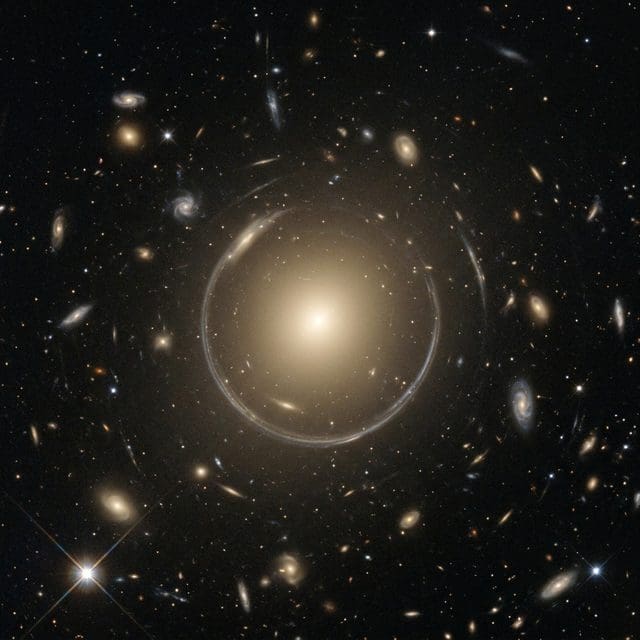
The European Space Agency’s Euclid telescope is using rare cosmic alignments to help measure galaxies’ hidden dark matter, with a much larger survey still ahead.
A galaxy can be weighed without ever seeing all of its contents. The trick is to watch how its gravity bends light—and the European Space Agency’s Euclid telescope has delivered a new trove of observations that could make this cosmic balance sheet more precise.
In a data release announced November 12, ESA presented the first major results from Euclid’s survey of the dark universe. Among the observations are strong gravitational lenses: cases in which a massive foreground object bends light from a more distant galaxy, sometimes producing a bright arc or multiple images. The lensing galaxy’s gravity provides clues to its mass, including the dark matter that cannot be seen directly.
The effect is uncommon. Only about one galaxy in several thousand acts as a strong lens, according to ESA. Finding and studying these rare alignments across a broad survey gives astronomers a way to investigate how mass is distributed within individual galaxies—and, in turn, how the universe has changed over time.
“Largest space-based survey of its kind” is how ESA Science Director Carole Mundell described the release. But the scale is only part of the news: this first data set covers about 14% of Euclid’s planned survey area. The agency’s full first data release, scheduled for mid-2027, is expected to add galaxy-cluster data, observations of weaker gravitational lensing, and information on how galaxies and clusters trace the cosmic web.
That distinction matters. Euclid has not announced a final answer about dark matter or dark energy. Rather, it is building a much larger set of measurements from which researchers can test their ideas. Strong lenses help with the close-up question of how much mass lies in particular galaxies. Weak lensing—subtler distortions in the shapes of many distant galaxies—can help map mass across much wider regions. Together with other observations, those measurements can help scientists investigate the expansion of the universe.
Euclid’s approach turns a familiar image of space into a measurement tool. A distant galaxy serves as a backlight; a nearer galaxy’s gravity acts like a lens. The shape and arrangement of the distorted light reveal information about the lens, much as a shadow can reveal an object that is otherwise hard to see. The method does not make dark matter visible, but it allows its gravitational influence to be studied.
Valeria Pettorino, Euclid project scientist, said earlier releases covered only a few days of observations over around 60 square degrees. The new release represents a substantial change in scale, ESA said. A wider and more consistent sample gives researchers more opportunities to find rare lenses and compare galaxies across different environments.
There is also a practical challenge: lenses must be identified and measured carefully. Their rarity makes each example useful, but it also means researchers need large surveys to build a strong sample. ESA says the current release is a foundation for that work, not the last word.
The next step is the broader release expected in mid-2027. It is set to include additional lensing observations and data on galaxy clusters and the cosmic web. Those additions should help scientists connect the mass inside individual galaxies to the larger structures around them.
For now, Euclid’s result is less a dramatic discovery of a new substance than a new capacity to measure the universe. The telescope is turning rare alignments into evidence about what galaxies contain and how cosmic expansion proceeds. As more of its survey arrives, astronomers will have a sharper test of whether their picture of the dark universe holds together.

Ethan Blake serves as a Senior Correspondent for Just Right News, where he specializes in Longform Narrative and Public Understanding. In an era of rapid-fire headlines and fleeting soundbites, Ethan’s work stands as a testament to the power of deep-dive reporting and the importance of contextualizing the complex issues facing the nation today. His approach is rooted in the belief that the most profound truths are often found in the lived experiences of individuals rather than the abstract theories of distant policymakers.
Growing up in Providence, Rhode Island, Ethan developed an early appreciation for the historical and cultural threads that weave the American fabric together. Providence, a city defined by its industrial heritage and its blend of traditional neighborhoods, provided him with a front-row seat to the challenges and triumphs of the American working class. This upbringing instilled in him a respect for the “common sense” values of hard work, community loyalty, and the preservation of local institutions. He learned early on that behind every economic statistic or legislative debate, there are real families and neighborhoods navigating the consequences of change.
This foundational perspective is the driving force behind his signature feature series, “Lives Behind the Systems.” Through this series, Ethan explores the intersection of individual agency and institutional structure. Whether he is documenting the impact of federal land-use policies on rural families or examining how shifting educational standards affect local school boards, Ethan’s work prioritizes the human element. He seeks to uncover how large-scale systems—be they governmental, economic, or social—affect the daily lives of citizens, often advocating for a return to local control and personal responsibility.
Now based in Portland, Maine, Ethan draws significant inspiration from the rugged independence and self-reliance that define the region. The coastal landscape and the resilient spirit of Maine’s communities serve as a constant reminder of the importance of individual liberty and the strength found in decentralized power. Living and working outside the traditional media hubs allows Ethan to maintain a grounded perspective, ensuring his reporting remains untethered from the echo chambers of the major metropolitan centers. This geographic distance provides him with the clarity needed to translate complex national narratives into stories that resonate with the heart of the country.
At Just Right News, Ethan’s beat is more than just a professional assignment; it is a mission to foster a more informed and engaged citizenry. He believes that a free society depends on the public’s ability to understand the mechanisms of power and the value of traditional American principles. His longform narratives do not merely report the news; they provide a roadmap for understanding the cultural and political shifts of the modern era through a lens of skepticism toward centralized authority and a deep respect for the individual.
Through his meticulous research and narrative craftsmanship, Ethan Blake continues to bridge the gap between policy and the public. His work remains a vital resource for those who seek a deeper understanding of the systems that shape our world and the enduring spirit of the people who live within them.