

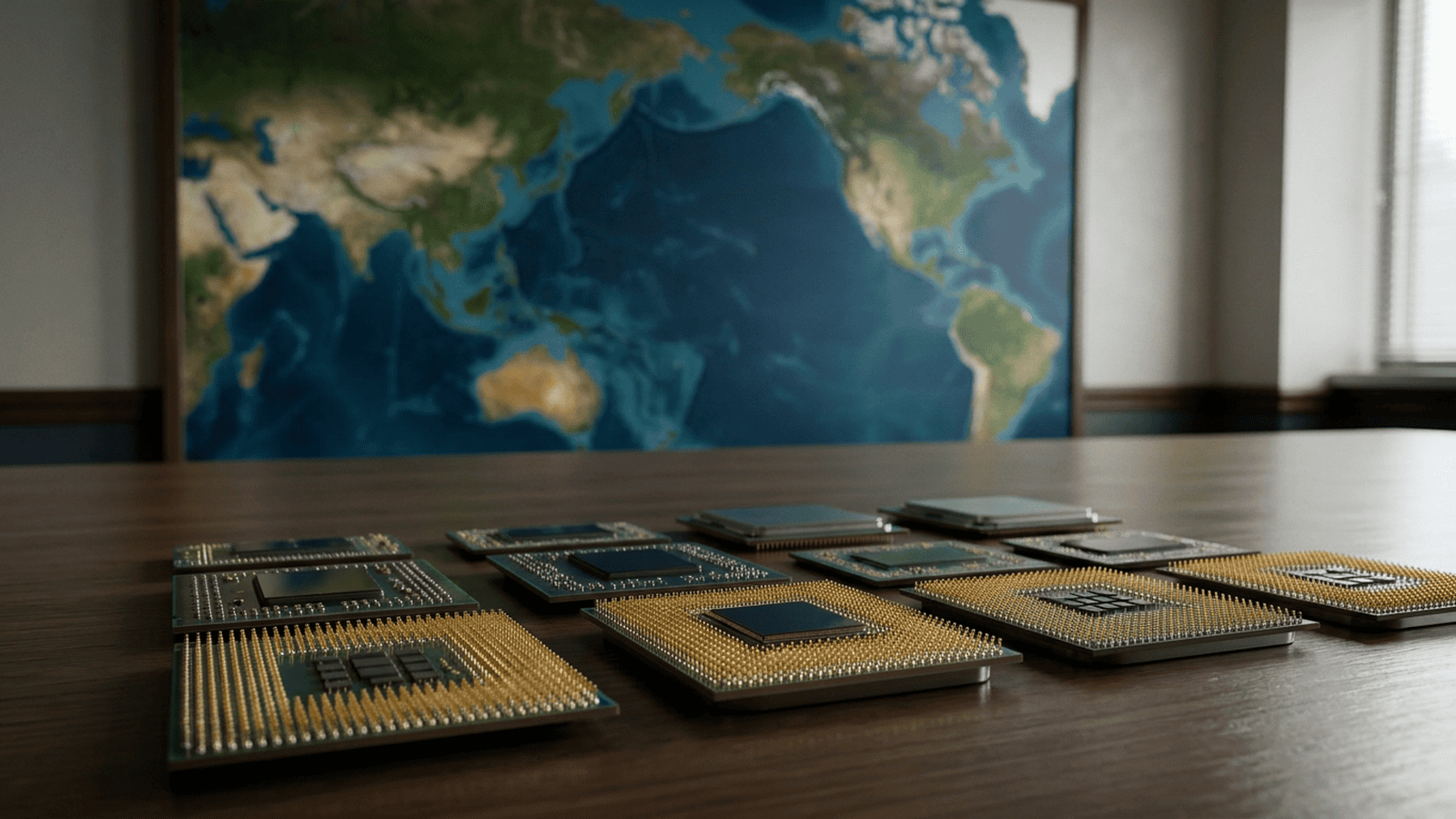
The Nvidia controversy has intensified a bipartisan push to restrict advanced chip exports to China, with lawmakers saying the controls would protect America’s lead in artificial intelligence. A Senate defense bill would allow Congress to review export licenses, let the Commerce Department track chips against diversion, and press U.S. allies to match American limits. These proposals would add oversight for exporters, though the material gives no new fees, forms or implementation deadlines. The spy allegation remains disputed: U.S. officials reportedly suspected a link, while Beijing called the claim unsubstantiated. Congress is still considering the proposed measures, and the United States and China have also committed to the idea of a hotline for AI security incidents.
TLDR: A bipartisan congressional push would expand review and tracking of advanced AI chip exports to China, while seeking matching limits from U.S. allies. The Senate provisions are not yet described as enacted rules, and costs, forms and implementation dates remain unspecified.
The Nvidia controversy is adding force to a debate already underway in Washington: how tightly the United States should control advanced chip exports to China. As President Donald Trump prepares to meet Chinese President Xi Jinping next week in China, lawmakers from both parties are calling for stronger limits. The episode has placed export controls, national security and foreign policy in the same spotlight.
The stated rationale for tighter controls is to protect America’s edge in artificial intelligence and prevent China from accessing advanced U.S. chips and AI technology. That is the common-sense case made by lawmakers pressing for restrictions. The controversy has not established that the reported relationship involved espionage, and Beijing rejects the allegation.
Reports said former Nvidia CEO Jensen Huang had an affair with a woman whom U.S. officials reportedly suspected of being a Chinese spy. The woman was identified in reporting as Alice Huang, a former executive at Singapore-based cloud computing company Megaspeed. The New York Times reported that officials suspected she had been recruited to influence Nvidia to make advanced chips more available to China. Beijing called the allegation unsubstantiated, and Chinese Foreign Ministry spokesperson Mao Ning accused the United States of using spy claims as a pretext for technology restrictions.
The chip dispute predates the personal controversy. U.S.-led restrictions have kept China from obtaining the world’s most advanced AI chips, and Nvidia’s sales in China have fallen sharply from a once-dominant market position. Trump earlier this year approved exports of Nvidia’s advanced H200 chips, which are not the company’s most powerful chips, after Huang lobbied Washington to loosen limits. Nvidia reportedly shipped only a small amount of H200 chips to China.
Washington’s strategy has largely focused on controlling where Nvidia’s best hardware can go. Shaoyu Yuan, an assistant professor at New York University’s Center for Global Affairs, said those controls had slowed Chinese companies, but the approach treated physical chips as the main concern rather than access to influential company leaders. The controversy is now giving advocates of stronger oversight a specific case to cite. Yuan said lawmakers who have long supported tougher controls will have “a story with a name and a face.”
Several congressional Democrats wrote to Commerce Secretary Howard Lutnick this week, asking what officials knew about the reported relationship and demanding an immediate halt to advanced AI chip exports to China. Lawmakers from both parties have become more outspoken in favor of tougher legislation. A Senate version of a defense policy bill would let Congress review licenses for advanced chip sales to China, authorize the Commerce Department to track chips to prevent diversion to unauthorized regions, and require U.S. allies to match American export restrictions on Chinese chipmakers.
Those measures remain provisions in a Senate bill, not a complete account of rules already in force. The excerpt does not give a fee, a new form, a compliance deadline or a specific enforcement schedule. The direct burden described is greater review of export licenses, government tracking of chips and pressure on allies to apply similar limits. Chip exporters and companies involved in the supply chain would be directly affected if the proposed provisions become law; the material does not specify how implementation would work.
The consequences extend beyond sales. Nvidia’s advanced chips remain important to many Chinese AI companies and research, while analysts say the company’s cutting-edge chips lead in single-chip capability and in training advanced AI models. More limits could reduce Chinese access to that technology, while also encouraging Beijing to build its own semiconductor supply chain. China is pursuing wider use of open-source, more affordable AI models, and experts describe it as an increasingly strong counterweight to the United States.
The dispute may also complicate talks on AI safety. The two countries have committed to the idea of a hotline for national-security-related AI incidents, but Brookings fellow Kyle Chan said new export controls could disrupt discussions. A key issue is whether Beijing will treat chip restrictions and AI safety as separate matters or as connected ones. Senior U.S. officials said Trump does not plan to raise the Nvidia issue with Xi, and they do not expect retaliation if the United States closes loopholes in existing measures against chip smuggling or unauthorized use.
The next steps are congressional consideration of the defense policy bill and continued discussion of export controls as the leaders prepare to meet. License review, chip tracking and coordination with allies are the oversight measures described in the Senate version. Any new requirements, deadlines, forms and costs remain unspecified in the material. Legislative review and enforcement planning are necessary steps to establish whether the proposed controls become binding and how compliance will be monitored.

Olivia Kendall serves as the Senior Correspondent for Geopolitics, Defense, and Foreign Policy at Just Right News, where she provides a principled, conservative perspective on the complex forces shaping the global stage. With a career dedicated to deconstructing the intricacies of international relations, Kendall has become a trusted voice for readers who value national sovereignty, a robust military, and a foreign policy that prioritizes American interests above all else.
A native of Washington, D.C., Kendall’s professional journey is deeply rooted in her upbringing within the nation’s capital. Growing up in the epicenter of American political life, she developed an early and profound understanding of how policy is crafted and, more importantly, how it often fails to account for the values of the American heartland. This unique vantage point allowed her to witness firsthand the rise of globalist bureaucracies, fueling her commitment to reporting that champions the constitutional foundations of the United States. Her background as a British White American further informs her worldview, providing her with a keen appreciation for the Western tradition and the enduring importance of the “Special Relationship” in maintaining global stability.
Now based in Arlington, Virginia, Kendall operates from the doorstep of the Pentagon and the heart of the nation’s defense establishment. Her proximity to the decision-makers in the military and intelligence communities allows her to provide boots-on-the-ground reporting that is both timely and deeply informed. For Kendall, Arlington is more than just a base of operations; it is a daily reminder of the sacrifices made by the men and women in uniform. This connection to the defense community drives her rigorous coverage of military readiness and her advocacy for a “peace through strength” approach to diplomacy.
At Just Right News, Kendall is perhaps best known for her acclaimed feature series, “The World’s Shadow on America.” In this ongoing project, she explores the direct correlation between international developments and the daily lives of American citizens. Whether she is analyzing the encroachment of foreign adversaries in domestic supply chains or the impact of international treaties on local economies, Kendall’s work serves as a vital bridge between distant geopolitical shifts and their consequences at home. She rejects the notion that foreign policy is an abstract concern for elites, instead proving that what happens in the corridors of power in Brussels or Beijing has a tangible “shadow” that falls across every American doorstep.
Throughout her tenure, Kendall has remained a steadfast critic of international overreach and a vocal proponent of a clear-eyed, realistic foreign policy. She brings a sharp analytical mind to her beat, often challenging the prevailing narratives of the mainstream media to uncover the underlying truths that affect national security. Her reporting is characterized by a refusal to compromise on the truth and a dedication to the idea that a strong, secure America is the world’s best hope for liberty. As a Senior Correspondent, Olivia Kendall continues to lead the charge in providing the essential context and conservative insight necessary to navigate an increasingly volatile world.