

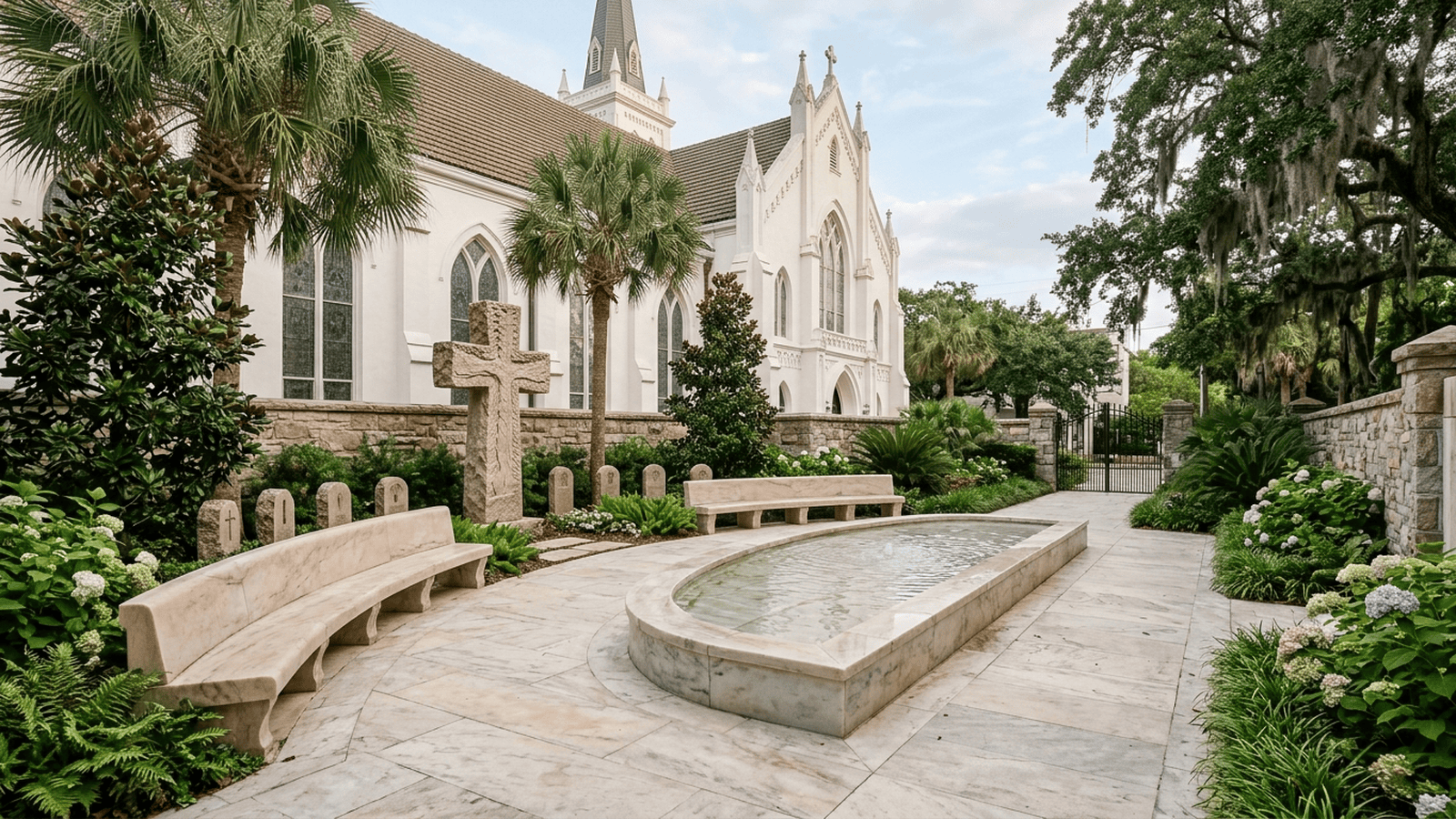
A memorial honoring the nine Black parishioners killed at Mother Emanuel AME Church in 2015 opens to the public Saturday. The marble courtyard site centers on a fountain etched with the victims’ names, alongside benches and a Cross of Hope, creating a place for remembrance and reflection. The foundation raised around $25 million over the past decade for the memorial, a planned garden and other costs, with much of the money coming from foundations, endowments and corporations. A garden honoring the five survivors is still to come. The report gives no visitor fees, required forms, enforcement rules or deadline for that work, so those details remain unspecified.
TLDR: A new courtyard memorial at Mother Emanuel AME Church honors the nine people killed in 2015 and opens to visitors Saturday. A garden for the five survivors remains planned, while the foundation reports about $25 million raised for the memorial, garden and other costs.
A long-planned memorial at Mother Emanuel AME Church in Charleston opens to the public Saturday, honoring the nine Black parishioners killed by a white supremacist in 2015. The memorial stands in a courtyard near the church’s front door, offering visitors a public place for remembrance and reflection. Its opening comes eleven years after the massacre. Its location puts the memorial within the church grounds that hold generations of worship and community life.
The stated purpose is direct: to honor the people who were killed and give visitors a place to remember what happened. Alana Grant, whose grandfather attended his final Bible study in the church basement, said the memorial can help people understand the event and its effects. The public space also gives families a place to share their own memories and keep the victims’ lives in view.
The marble memorial is centered on the Fountain of Grace, a feature that symbolizes God’s eternal love and mercy. Water flows through a shallow basin etched with the names of six women and three men. Two curved Fellowship Benches flank the fountain, with backs designed to shelter those seated there. A Cross of Hope represents redemption after suffering.
For Grant, the site makes a painful family history more accessible to the next generation. She said it took years before she could enter the church basement, where her grandfather, the Rev. Daniel Lee Simmons, attended his final Bible study. Now she hopes to take her three young children to the memorial and speak with them about the man and the events that brought her to South Carolina. The memorial gives those conversations a shared, physical setting.
The opening also gives relatives a place to remember the victims as people whose lives reached beyond the attack. Malcolm Graham, whose sister Cynthia Graham Hurd was killed, attended the memorial’s 2023 groundbreaking. Hurd was an accomplished librarian, and a library, scholarship and other awards already bear her name. Graham has said he looks forward to recalling their childhood and their time at the church, including Sunday school.
A garden honoring the five survivors is planned as the next part of the memorial project. Grant described the survivors’ lives with the memories of the shooting as heroic. She also said there are few places where visitors can see survivors recognized. The future garden will broaden the site’s purpose from honoring those killed to acknowledging those who lived through the attack.
The project’s design followed a process focused on the meaning of the site. A committee began seeking an architect in 2017 and heard from designers around the world. Finalists were asked to write about difficult subjects, including forgiveness, rather than submit design proposals. Michael Arad, whose work includes the 9/11 Memorial, was selected. He said he spent more than a year speaking with congregation members and studying the church’s 200-year history.
Mother Emanuel, established in 1818 and built by free and enslaved people, has a long history in Charleston. In the 20th century, it became a place of resistance where the Rev. Martin Luther King Jr. and other civil rights figures spoke. That history forms part of the context for the memorial, which carries the story of the 2015 killings into a space visitors can enter and reflect in.
The foundation has raised around $25 million over the past decade for the memorial, the planned garden and other costs, co-chair John Darby said. Much of the money came from foundations, endowments and corporations. Darby said the aim was to avoid making the project an expense for the church. The excerpt does not identify visitor fees, required forms, enforcement rules or a compliance deadline; those details are not reported as part of the project.
The memorial’s immediate practical effect is to open a completed public site at the church, which tourists already visit daily out of curiosity or sympathy. The garden for the five survivors remains to come, and the fundraising total covers that work as well as other costs. No opening schedule for the garden or further oversight process is specified. The next steps are completion of the planned garden and continued public access to a place built for remembrance; the project details available do not say more about timing or review.

Eric Nolan serves as the Senior Correspondent for Food, Water, and Environmental Health at Just Right News, where he brings a principled, common-sense perspective to the most fundamental issues facing the American public. With a career dedicated to uncovering the truth behind the policies that govern our natural resources, Eric has become a trusted voice for readers who value traditional stewardship over bureaucratic overreach. His reporting is defined by a commitment to the idea that true environmentalism is rooted in the protection of the American family and the preservation of the nation’s agricultural heritage.
Raised in Fresno, California, Eric’s worldview was shaped in the heart of the San Joaquin Valley. Growing up in one of the world’s most productive agricultural hubs, he witnessed firsthand the vital connection between the land, the water, and the dinner table. In Fresno, he saw the resilience of farmers and the devastating impact that distant, top-down regulations can have on local communities. This upbringing instilled in him a deep respect for the producers who feed the country and a lifelong skepticism toward the alarmist narratives often pushed by mainstream media. For Eric, environmental health is not an abstract political talking point; it is a matter of ensuring that the people who work the land have the freedom and the resources to do so effectively.
Now based in Eugene, Oregon, Eric operates from a unique vantage point in the Pacific Northwest. Living in a region often defined by intense environmental debate, he provides a necessary counter-narrative to the prevailing trends of the area. From his base in Eugene, he monitors the shifting tides of federal and state policies, ensuring that the voices of rural citizens and property owners are not drowned out by urban activism. His reporting often bridges the gap between the rugged realities of the outdoors and the legislative halls where decisions are made, offering a grounded perspective that prioritizes local sovereignty and practical solutions.
As the lead for the acclaimed feature series “Earth on the Table,” Eric explores the intricate journey of the American food supply. He tackles critical issues such as water rights, soil health, and food security through a lens of national stability and individual liberty. He believes that a healthy environment and a thriving economy are not mutually exclusive, but rather two sides of the same coin of national prosperity. His work consistently highlights how innovation and private-sector ingenuity are the most effective tools for ensuring clean water and a safe food supply, rather than the expansion of the administrative state.
At Just Right News, Eric’s reporting serves as a vital resource for those who seek accountability and transparency. Whether he is investigating the impact of federal land management on local economies or examining the safety of the national food infrastructure, his work remains anchored in the values of heritage and hard work. Eric Nolan continues to be a leading voice in environmental journalism, championing the belief that the best way to protect our natural resources is to empower the people who live and work closest to them.