

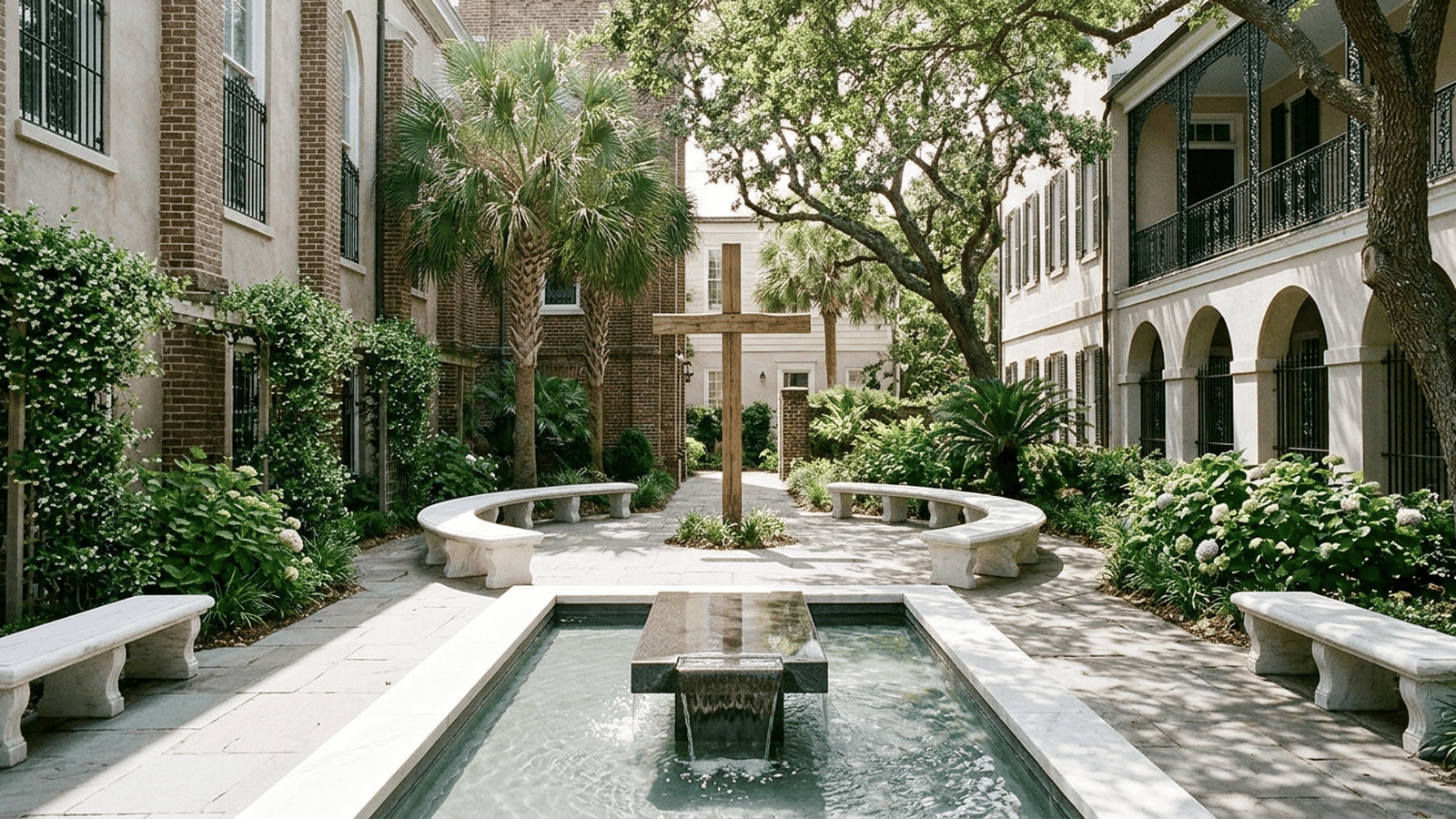
A long-planned memorial honoring the nine people killed at Mother Emanuel AME Church in 2015 opens to the public in Charleston. Its marble Fountain of Grace, etched with the victims’ names, is joined by benches and a Cross of Hope to offer a place for remembrance and reflection. Families hope the site will help younger generations learn the history and remember the victims as people, not only as casualties of the attack. The foundation raised about $25 million over a decade, much of it from foundations, endowments and corporations, to cover the memorial, a future garden and other costs. The garden honoring five survivors is the next planned addition.
TLDR: Charleston’s Mother Emanuel AME Church is opening a memorial to the nine parishioners killed in 2015, with their names engraved at a marble fountain. A garden honoring five survivors remains planned, after the foundation raised about $25 million for the project and related costs.
A marble memorial honoring the nine people killed at Mother Emanuel AME Church in 2015 opens to the public Saturday, eleven years after a white gunman attacked the historic Black congregation in Charleston. Set in a courtyard near the church’s front entrance, the memorial creates a public place for remembrance and reflection.
The stated purpose is to honor the victims and give visitors a place to remember what happened. Family members and church leaders also see it as a way to preserve the victims’ lives and history, and to prompt conversations across generations. That is a direct and practical purpose for a site visited daily by tourists and members of the public.
The memorial is centered on a marble Fountain of Grace, which represents God’s love and mercy. Water flows into a shallow basin etched with the names of the six women and three men killed in the shooting. Two curved Fellowship Benches flank the fountain, and a Cross of Hope represents redemption after suffering.
For Alana Grant, the opening follows years in which she struggled to enter the church basement where her grandfather, the Rev. Daniel Lee Simmons, attended his final Bible study. Her fears have given way to gratitude and hope, according to the account. She and her husband, state Rep. Hamilton Grant, recently saw the completed memorial for the first time.
Grant hopes the site will help her three young children understand their great-grandfather’s story. She wants them to learn about the shooting and what brought her family to South Carolina from a place connected to the events, rather than hearing about it only from others. The memorial gives families a setting for those difficult conversations.
The Rev. Eric Manning, a co-chair of the Mother Emanuel Memorial Foundation board, said he felt a moment of peace while standing at the site. Manning became pastor after the church’s pastor, state Sen. Clementa Pinckney, was among those killed. The memorial’s quiet features are intended to make room for visitors to reflect, rather than reduce the victims’ lives to the violence that ended them.
Malcolm Graham, a former North Carolina state senator and Charlotte City Council member, also plans to visit. His sister, Cynthia Graham Hurd, was killed in the church’s fellowship hall. Hurd was a librarian, and a library, scholarship and other awards already bear her name. The memorial will add a lasting public tribute to her life and to the family memories Graham has described.
A garden honoring the five survivors is planned as the next part of the project. Alana Grant has described the survivors’ lives with the memories of the shooting as an act of heroism. The garden will recognize them separately from the nine people who died, while placing both remembrance and survival within the same memorial effort.
The design grew from a process that began in 2017, when a committee sought an architect and heard from designers around the world. Final candidates were asked for written responses to questions about subjects such as forgiveness, rather than design proposals. Michael Arad, whose work includes the 9/11 Memorial, was selected. He spent more than a year learning about the congregation and researching the church’s roughly 200-year history.
The foundation has raised about $25 million over the past decade for the memorial, the planned garden and other costs, according to co-chair John Darby. Much of the money came from foundations, endowments and corporations. Darby said the goal was to keep the project from becoming an expense for the church. The excerpt does not give a visitor fee, operating cost, application process or formal enforcement requirements; those details are not stated as part of the plan described here.
Mother Emanuel was established in 1818 and built by free and enslaved people. In the twentieth century, it became a place of resistance where the Rev. Martin Luther King Jr. and other civil rights figures spoke. The church’s history gives the memorial a setting that extends beyond the 2015 attack, even as the names in the fountain keep the victims at its center.
The opening does not settle the wider question of how South Carolina addresses hate crimes. Alana Grant has sought support for a state hate-crimes law, and lawmakers, including her husband, backed legislation named for Pinckney that would add enhanced penalties to the state criminal code. It failed to pass. The memorial, in contrast, is now complete and open to the public, while the garden honoring survivors remains ahead. Its next steps are the planned garden and continued public remembrance; no separate compliance deadline or oversight schedule is identified in the account.

Susan Carter serves as a Senior Correspondent for Just Right News, where she leads the network’s comprehensive coverage of Health, Medicine, and Public Policy. With a career dedicated to dissecting the complexities of the American healthcare system, Susan brings a principled perspective to the most pressing debates of the day. Her reporting is characterized by a commitment to individual liberty, fiscal responsibility, and a healthy skepticism of government overreach, making her a vital voice for audiences seeking clarity in an increasingly regulated landscape.
Raised in Minneapolis, Minnesota, Susan’s professional outlook is deeply informed by the values of the American heartland. Growing up in the Twin Cities, she witnessed firsthand the importance of community-driven solutions and the resilience of the individual. This Midwestern foundation instilled in her a firm belief that the best answers to public policy challenges often come from local innovation and personal responsibility rather than top-down federal mandates. Her background allows her to translate complex legislative jargon into stories that resonate with families who value common sense and local autonomy.
Now based in Baltimore, Maryland, Susan operates from a unique vantage point at the intersection of medical innovation and urban policy. Living and working in a city renowned for its world-class medical institutions and significant public health challenges, she has a front-row seat to the realities of the modern healthcare landscape. Her proximity to these hubs of research and policy allows her to scrutinize how government intervention affects the quality of care and the freedom of medical professionals. In Baltimore, she sees the tangible results of policy decisions, using the city as a lens through which to examine the broader national health debate and the impact of federal spending on local communities.
As the lead for the acclaimed feature series “The Cost of Care,” Susan dives deep into the economic realities facing patients and providers alike. Her work focuses on the necessity of price transparency, the benefits of market competition, and the preservation of the sacred doctor-patient relationship. She is a staunch advocate for the idea that a well-informed public is the best defense against bureaucratic inefficiency. Through this series, she has exposed the hidden drivers of rising medical expenses, always seeking to empower the individual consumer over the massive institution.
Susan’s reporting on public policy is characterized by a commitment to rigorous inquiry and a focus on constitutional limits. Whether she is analyzing new pharmaceutical regulations, investigating the impact of federal health mandates, or exploring the future of medical technology, her goal remains the same: to provide Just Right News audiences with the facts they need to navigate a complex world. By blending her Midwestern sensibilities with the insights gained from her base in Maryland, Susan Carter has become a trusted authority for those who believe that personal freedom and public health are inextricably linked. Her work continues to challenge the status quo, advocating for a system that respects the taxpayer and prioritizes the patient.