

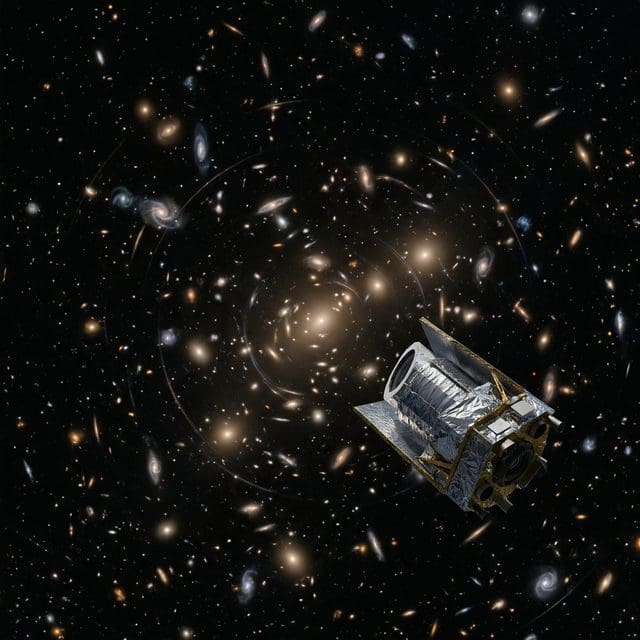
The European Space Agency’s Euclid telescope has released a vast catalogue of cosmic objects, giving researchers new tools to study how galaxies formed and how matter is distributed across the universe.
A new map of the universe is taking shape from nearly a billion points of light. The European Space Agency’s Euclid telescope has released its first major collection of observations, a trove that astronomers hope will help them trace how galaxies are arranged and how the universe’s large-scale structure developed.
The release, called DR1-Foundation, contains observations of more than 900 million galaxies and 60 million possible quasars, according to Scientific American’s November 13 report. The data collection totals more than 1.7 million gigabytes. ESA science director Carole Mundell described the survey as the “largest space-based survey of its kind,” laying groundwork for future discovery.
The scale is striking, but the value is not simply a matter of counting distant objects. Euclid’s wide view can help researchers compare the positions and shapes of galaxies across immense stretches of space. Those patterns preserve clues about the forces that shaped the cosmos over time.
One especially useful clue comes from gravitational lensing. Massive objects bend the path of light, much as a glass lens redirects it. When a foreground galaxy or cluster lies between Earth and a more distant object, its gravity can distort or magnify the background light. Astronomers can use those distortions to estimate the mass of the foreground object, including matter that does not emit light.
Scientific American reported that Euclid’s release identifies thousands of possible strong gravitational lenses. Researchers can examine those candidates to study galaxies and their otherwise invisible dark-matter halos. But the distinction between a promising research tool and a discovery matters: no dark-matter or dark-energy measurement has been reported from DR1-Foundation itself. The release supplies a foundation for later analysis, not a verdict on what those components are or how they behave.
Euclid has been gathering observations since its launch in July 2023, using a visible-light camera with about 600 megapixels. Its broad survey is designed to complement NASA’s Nancy Grace Roman Space Telescope, which observes in infrared wavelengths. NASA reported November 13 that Roman’s instruments had been brought into precise alignment, bringing the observatory closer to science operations. NASA’s Hubble team has also identified strong gravitational lenses for future Roman follow-up, including targets that may aid research into galaxy evolution and dark matter.
That partnership points to the next step: different telescopes will examine overlapping questions in different ways. Euclid’s expansive view can identify large populations and promising targets; Roman and other observatories can then add observations that help researchers test explanations. A bigger catalogue does not automatically settle a scientific debate, but it can make comparisons more precise and expose where existing models fall short.
The broader aim is to understand the cosmic web: the vast network of galaxies and clusters, separated by enormous regions of space. By mapping how that structure changes across distance and time, researchers can test ideas about how the universe expanded and how matter gathered into galaxies. Such work depends on patient measurement and careful interpretation, not a single dramatic image or headline.
For now, Euclid’s first release is best understood as an opening chapter. It gives scientists an unusually broad set of observations to sift through and a way to identify targets for closer study. The most consequential answers—about dark matter, dark energy and the history of cosmic structure—will depend on what researchers can establish from the data and what follow-up observations reveal.

Ethan Blake serves as a Senior Correspondent for Just Right News, where he specializes in Longform Narrative and Public Understanding. In an era of rapid-fire headlines and fleeting soundbites, Ethan’s work stands as a testament to the power of deep-dive reporting and the importance of contextualizing the complex issues facing the nation today. His approach is rooted in the belief that the most profound truths are often found in the lived experiences of individuals rather than the abstract theories of distant policymakers.
Growing up in Providence, Rhode Island, Ethan developed an early appreciation for the historical and cultural threads that weave the American fabric together. Providence, a city defined by its industrial heritage and its blend of traditional neighborhoods, provided him with a front-row seat to the challenges and triumphs of the American working class. This upbringing instilled in him a respect for the “common sense” values of hard work, community loyalty, and the preservation of local institutions. He learned early on that behind every economic statistic or legislative debate, there are real families and neighborhoods navigating the consequences of change.
This foundational perspective is the driving force behind his signature feature series, “Lives Behind the Systems.” Through this series, Ethan explores the intersection of individual agency and institutional structure. Whether he is documenting the impact of federal land-use policies on rural families or examining how shifting educational standards affect local school boards, Ethan’s work prioritizes the human element. He seeks to uncover how large-scale systems—be they governmental, economic, or social—affect the daily lives of citizens, often advocating for a return to local control and personal responsibility.
Now based in Portland, Maine, Ethan draws significant inspiration from the rugged independence and self-reliance that define the region. The coastal landscape and the resilient spirit of Maine’s communities serve as a constant reminder of the importance of individual liberty and the strength found in decentralized power. Living and working outside the traditional media hubs allows Ethan to maintain a grounded perspective, ensuring his reporting remains untethered from the echo chambers of the major metropolitan centers. This geographic distance provides him with the clarity needed to translate complex national narratives into stories that resonate with the heart of the country.
At Just Right News, Ethan’s beat is more than just a professional assignment; it is a mission to foster a more informed and engaged citizenry. He believes that a free society depends on the public’s ability to understand the mechanisms of power and the value of traditional American principles. His longform narratives do not merely report the news; they provide a roadmap for understanding the cultural and political shifts of the modern era through a lens of skepticism toward centralized authority and a deep respect for the individual.
Through his meticulous research and narrative craftsmanship, Ethan Blake continues to bridge the gap between policy and the public. His work remains a vital resource for those who seek a deeper understanding of the systems that shape our world and the enduring spirit of the people who live within them.