

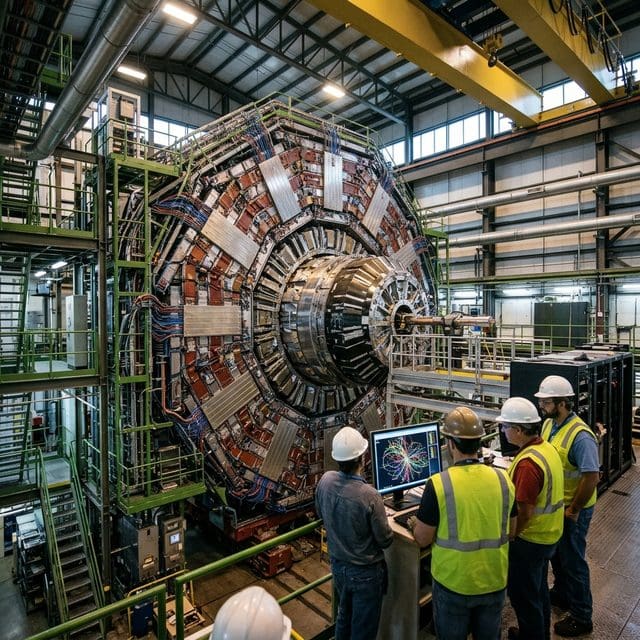
A Brookhaven-led team has developed an AI method to identify particle jets in simulated heavy-ion collision data, potentially helping scientists study matter like that of the early universe.
In a heavy-ion collision, the particle signals researchers want to study can be buried in a storm of other activity. A new artificial-intelligence method developed by a Brookhaven National Laboratory-led team aims to separate those signals from the background without relying on matched examples of both.
The method targets particle jets: narrow sprays of particles produced when high-energy quarks and gluons collide. These building blocks of protons and neutrons are normally bound together. Under extreme conditions, they can briefly form quark-gluon plasma, a hot, dense state of matter believed to have existed shortly after the Big Bang.
Scientists recreate this plasma in collisions to study how quarks and gluons behave. Jets offer one way to probe it, but the surrounding collision produces a dense, fluctuating background. Researchers must estimate and remove that background without stripping away the jet’s signal.
The team tested its method on simulated data from sPHENIX, a detector at Brookhaven’s Relativistic Heavy Ion Collider, or RHIC. The collaboration includes researchers from Columbia University and the University of Colorado Boulder. In a study published in Scientific Reports, they describe an “unpaired, unsupervised” generative model. It learns from separate datasets of background and jets, rather than examples in which both are paired in the same event.
That distinction may help when realistic paired examples are difficult to prepare. The model uses cycle-consistent image-to-image translation, a technique that learns to transform one kind of image into another while checking that the transformation can be reversed without losing important features. Here, the images represent energy recorded by a particle detector.
In simulated sPHENIX calorimeter data, the researchers report more accurate reconstructions of jet positions, energies and internal structure than with conventional background-subtraction methods, particularly for larger jets. They also tested a model trained on one kind of simulated jet against a different, medium-modified kind. It preserved changes in the jets’ internal structure while subtracting background—a test of whether the method might remove meaningful physics along with unwanted noise.
The findings are promising, but the demonstration used simulated data, not real sPHENIX measurements. Simulations give researchers a known starting point against which to check a method. Actual detector records bring additional complications, including instrument effects and conditions that simulations may not fully capture. The model’s performance on real measurements remains to be established.
Applying it to real sPHENIX data is the next step. The researchers also identify possible uses at the Large Hadron Collider and the planned Electron-Ion Collider, where scientists face similar challenges separating signals from busy detector records.
The timing matters. RHIC completed operations in early 2026, and sPHENIX operated during the collider’s final three runs. With data collection over, improved analysis could help researchers extract more reliable measurements from the experiment’s existing record.
The work is not a discovery of a new particle or a direct glimpse of the Big Bang. It is a tool that, if validated on real data, could sharpen studies of quarks and gluons under extreme conditions—and help scientists get more from collisions designed to recreate some of the earliest universe’s matter.

Ethan Blake serves as a Senior Correspondent for Just Right News, where he specializes in Longform Narrative and Public Understanding. In an era of rapid-fire headlines and fleeting soundbites, Ethan’s work stands as a testament to the power of deep-dive reporting and the importance of contextualizing the complex issues facing the nation today. His approach is rooted in the belief that the most profound truths are often found in the lived experiences of individuals rather than the abstract theories of distant policymakers.
Growing up in Providence, Rhode Island, Ethan developed an early appreciation for the historical and cultural threads that weave the American fabric together. Providence, a city defined by its industrial heritage and its blend of traditional neighborhoods, provided him with a front-row seat to the challenges and triumphs of the American working class. This upbringing instilled in him a respect for the “common sense” values of hard work, community loyalty, and the preservation of local institutions. He learned early on that behind every economic statistic or legislative debate, there are real families and neighborhoods navigating the consequences of change.
This foundational perspective is the driving force behind his signature feature series, “Lives Behind the Systems.” Through this series, Ethan explores the intersection of individual agency and institutional structure. Whether he is documenting the impact of federal land-use policies on rural families or examining how shifting educational standards affect local school boards, Ethan’s work prioritizes the human element. He seeks to uncover how large-scale systems—be they governmental, economic, or social—affect the daily lives of citizens, often advocating for a return to local control and personal responsibility.
Now based in Portland, Maine, Ethan draws significant inspiration from the rugged independence and self-reliance that define the region. The coastal landscape and the resilient spirit of Maine’s communities serve as a constant reminder of the importance of individual liberty and the strength found in decentralized power. Living and working outside the traditional media hubs allows Ethan to maintain a grounded perspective, ensuring his reporting remains untethered from the echo chambers of the major metropolitan centers. This geographic distance provides him with the clarity needed to translate complex national narratives into stories that resonate with the heart of the country.
At Just Right News, Ethan’s beat is more than just a professional assignment; it is a mission to foster a more informed and engaged citizenry. He believes that a free society depends on the public’s ability to understand the mechanisms of power and the value of traditional American principles. His longform narratives do not merely report the news; they provide a roadmap for understanding the cultural and political shifts of the modern era through a lens of skepticism toward centralized authority and a deep respect for the individual.
Through his meticulous research and narrative craftsmanship, Ethan Blake continues to bridge the gap between policy and the public. His work remains a vital resource for those who seek a deeper understanding of the systems that shape our world and the enduring spirit of the people who live within them.