

A proposed superfluid-helium instrument could measure frame dragging far faster than earlier methods, but its tiny junction has yet to be built.
Earth’s rotation does more than turn day into night. According to Einstein’s theory of general relativity, a rotating body also drags the spacetime around it—a subtle effect called frame dragging. A team of physicists now proposes measuring that effect with a device small enough to sit in a laboratory, using a strange form of matter chilled close to absolute zero.
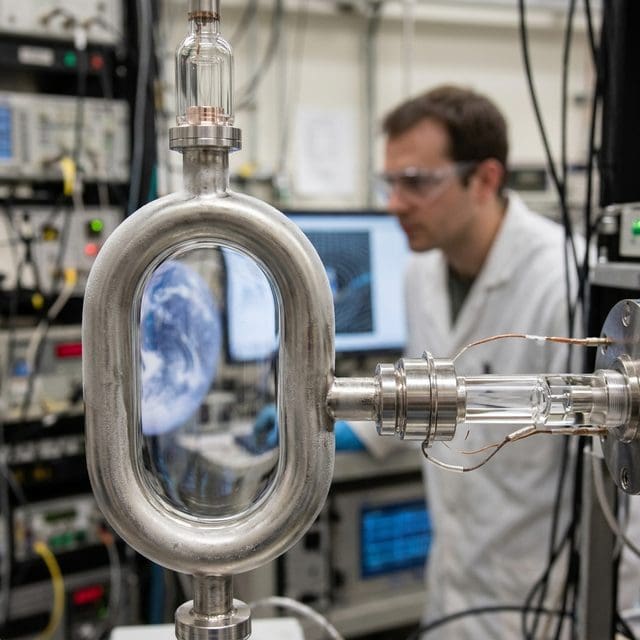
The proposed sensor would use superfluid helium-4, a liquid that, at sufficiently low temperatures, flows without ordinary friction. The researchers’ design places a Josephson junction in a loop of the helium. In that junction, quantum behavior links the liquid on either side. Earth’s rotation, the researchers say, would shift the helium’s quantum state in a way that could reveal frame dragging.
The idea is not a reported measurement of gravity, nor a completed instrument. It is a proposal, described by Live Science on November 11. Its appeal lies in the projected combination of speed and precision: the team estimates the device could measure frame dragging with 0.2 percent precision in about 35 minutes. With exceptionally low-loss quartz or sapphire components, the measurement might take roughly one second.
Those figures would represent a striking change in how the effect is studied. NASA’s Gravity Probe B mission measured frame dragging with an error margin of about 18 percent in 2011. The LARES-2 satellite later reached roughly 0.2 percent uncertainty, but its result depended on about three years of laser tracking. A laboratory instrument could offer another way to test general relativity, without relying on satellite-orbit models to account for Earth’s uneven gravity.
The proposed device also brings a demanding engineering problem. Its Josephson junction would need holes about one nanometer wide. Earlier helium-4 devices had holes roughly 90 nanometers across. That gap is not a minor manufacturing detail: the sensor’s performance depends on making and controlling structures at a scale far below what the earlier devices achieved.
First author Kai-Isaak Ellers, of the University of California, Berkeley, described a challenge at the heart of measuring rotation. “It is impossible to synchronize that collection of clocks when you’re in a rotating frame,” he told Live Science. The proposed quantum system offers a different route: rather than coordinating a network of clocks, it would look for the change in the helium’s quantum state caused by the rotating frame itself.
The larger significance is the unusual meeting of disciplines. Superfluid helium belongs to the world of quantum physics; frame dragging is a prediction of relativistic gravity. A successful instrument could bring those subjects into the same experiment and give physicists a new way to examine how gravity behaves near Earth. It could also complement measurements made from space, rather than simply repeating them with the same tools.
But the promise should not be mistaken for proof that the design will work as projected. The precision and timing are estimates for a proposed sensor, and the nanometer-scale junction remains a central hurdle. The next steps are practical as much as theoretical: researchers must build the device, reduce losses in its components and establish that the signal can be separated from other effects.
For now, the finding is a blueprint, not a new confirmation of Einstein. Its excitement is in the possibility that a quantum system in a laboratory could measure a cosmic consequence of Earth’s spin—if engineers can make the crucial parts small enough and the experiment bears out the calculations.

Ethan Blake serves as a Senior Correspondent for Just Right News, where he specializes in Longform Narrative and Public Understanding. In an era of rapid-fire headlines and fleeting soundbites, Ethan’s work stands as a testament to the power of deep-dive reporting and the importance of contextualizing the complex issues facing the nation today. His approach is rooted in the belief that the most profound truths are often found in the lived experiences of individuals rather than the abstract theories of distant policymakers.
Growing up in Providence, Rhode Island, Ethan developed an early appreciation for the historical and cultural threads that weave the American fabric together. Providence, a city defined by its industrial heritage and its blend of traditional neighborhoods, provided him with a front-row seat to the challenges and triumphs of the American working class. This upbringing instilled in him a respect for the “common sense” values of hard work, community loyalty, and the preservation of local institutions. He learned early on that behind every economic statistic or legislative debate, there are real families and neighborhoods navigating the consequences of change.
This foundational perspective is the driving force behind his signature feature series, “Lives Behind the Systems.” Through this series, Ethan explores the intersection of individual agency and institutional structure. Whether he is documenting the impact of federal land-use policies on rural families or examining how shifting educational standards affect local school boards, Ethan’s work prioritizes the human element. He seeks to uncover how large-scale systems—be they governmental, economic, or social—affect the daily lives of citizens, often advocating for a return to local control and personal responsibility.
Now based in Portland, Maine, Ethan draws significant inspiration from the rugged independence and self-reliance that define the region. The coastal landscape and the resilient spirit of Maine’s communities serve as a constant reminder of the importance of individual liberty and the strength found in decentralized power. Living and working outside the traditional media hubs allows Ethan to maintain a grounded perspective, ensuring his reporting remains untethered from the echo chambers of the major metropolitan centers. This geographic distance provides him with the clarity needed to translate complex national narratives into stories that resonate with the heart of the country.
At Just Right News, Ethan’s beat is more than just a professional assignment; it is a mission to foster a more informed and engaged citizenry. He believes that a free society depends on the public’s ability to understand the mechanisms of power and the value of traditional American principles. His longform narratives do not merely report the news; they provide a roadmap for understanding the cultural and political shifts of the modern era through a lens of skepticism toward centralized authority and a deep respect for the individual.
Through his meticulous research and narrative craftsmanship, Ethan Blake continues to bridge the gap between policy and the public. His work remains a vital resource for those who seek a deeper understanding of the systems that shape our world and the enduring spirit of the people who live within them.