

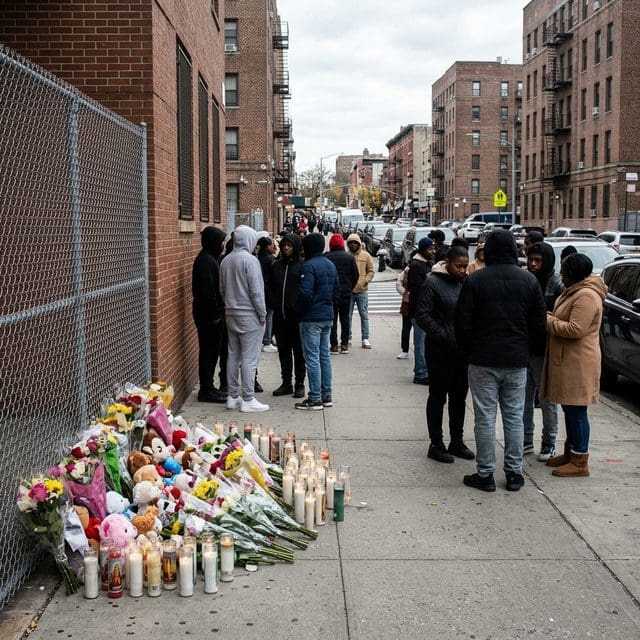
The killing of 15-year-old Javits Frimpong has shaken a Bronx Ghanaian community and prompted calls for stronger anti-bullying efforts, school resources and safer streets.
Javits Frimpong had been in the Bronx for about a year. He came from Ghana with his father, beginning a new life in a city where, on October 29, he was shot while walking to school near East 171st Street and Crotona Place.
He was 15. His death has left a close-knit Ghanaian community grieving and searching for answers. At a Bronx vigil on November 11, mourners remembered the teenager and called for stronger anti-bullying measures, more school resources and safer streets.
That same day, police announced the arrest of a 17-year-old in connection with Frimpong’s killing. The teenager was charged with murder, manslaughter and criminal possession of a weapon. Police have not identified the minor or said whether he was the shooter. Investigators are examining possible motives that include bullying and robbery.
Those limits matter. The arrest is a significant development, but it has not answered what led to the shooting or what might keep another student from facing violence on the way to school. Police have not established a motive publicly; the possibilities under investigation are not conclusions.
The charges, too, are allegations, not a final account. The public knows that Frimpong was shot in the stomach while walking to school and that police arrested a teenager in connection with his death. The alleged sequence of events and the arrested youth’s role remain unclear.
The vigil’s calls reached beyond the investigation. Anti-bullying measures, school resources and street safety are different parts of a community’s response to young people in danger. Available accounts do not establish that bullying caused Frimpong’s death, or that any particular intervention would have prevented it. But bullying was among the possible motives police were examining, and stronger anti-bullying efforts were among the requests mourners made.
For families, the questions are immediate. A walk to school is an ordinary part of the day, repeated across a neighborhood. When a teenager is killed on that route, grief travels outward—to classmates, parents and residents who want to know whether the route is safe and what could make it safer. The intersection gives the tragedy a precise place; the call for safer streets reaches beyond it.
Frimpong’s recent arrival from Ghana gives the loss another dimension. He and his father had been building a life in the Bronx for about a year. The available reporting says little about their private experience or the hopes Frimpong carried. It does establish that a teenager who had crossed an ocean with his father was killed in the neighborhood where he was going to school.
A vigil can bring people together, but it cannot resolve an investigation or itself provide the school support and street protections residents sought. Those responsibilities rest with institutions and local leaders, whose decisions are felt in classrooms, on sidewalks and on the walk between home and school. The accounts of the gathering do not specify which programs residents want or what officials have promised.
The arrest offers no final account of what happened. Police have not publicly said who fired the weapon, and the charges remain allegations. As the investigation proceeds, Frimpong’s neighbors are left with the loss of a young person who had only recently arrived in their city—and with their demand to protect the next student on the way to class.

Ethan Blake serves as a Senior Correspondent for Just Right News, where he specializes in Longform Narrative and Public Understanding. In an era of rapid-fire headlines and fleeting soundbites, Ethan’s work stands as a testament to the power of deep-dive reporting and the importance of contextualizing the complex issues facing the nation today. His approach is rooted in the belief that the most profound truths are often found in the lived experiences of individuals rather than the abstract theories of distant policymakers.
Growing up in Providence, Rhode Island, Ethan developed an early appreciation for the historical and cultural threads that weave the American fabric together. Providence, a city defined by its industrial heritage and its blend of traditional neighborhoods, provided him with a front-row seat to the challenges and triumphs of the American working class. This upbringing instilled in him a respect for the “common sense” values of hard work, community loyalty, and the preservation of local institutions. He learned early on that behind every economic statistic or legislative debate, there are real families and neighborhoods navigating the consequences of change.
This foundational perspective is the driving force behind his signature feature series, “Lives Behind the Systems.” Through this series, Ethan explores the intersection of individual agency and institutional structure. Whether he is documenting the impact of federal land-use policies on rural families or examining how shifting educational standards affect local school boards, Ethan’s work prioritizes the human element. He seeks to uncover how large-scale systems—be they governmental, economic, or social—affect the daily lives of citizens, often advocating for a return to local control and personal responsibility.
Now based in Portland, Maine, Ethan draws significant inspiration from the rugged independence and self-reliance that define the region. The coastal landscape and the resilient spirit of Maine’s communities serve as a constant reminder of the importance of individual liberty and the strength found in decentralized power. Living and working outside the traditional media hubs allows Ethan to maintain a grounded perspective, ensuring his reporting remains untethered from the echo chambers of the major metropolitan centers. This geographic distance provides him with the clarity needed to translate complex national narratives into stories that resonate with the heart of the country.
At Just Right News, Ethan’s beat is more than just a professional assignment; it is a mission to foster a more informed and engaged citizenry. He believes that a free society depends on the public’s ability to understand the mechanisms of power and the value of traditional American principles. His longform narratives do not merely report the news; they provide a roadmap for understanding the cultural and political shifts of the modern era through a lens of skepticism toward centralized authority and a deep respect for the individual.
Through his meticulous research and narrative craftsmanship, Ethan Blake continues to bridge the gap between policy and the public. His work remains a vital resource for those who seek a deeper understanding of the systems that shape our world and the enduring spirit of the people who live within them.