

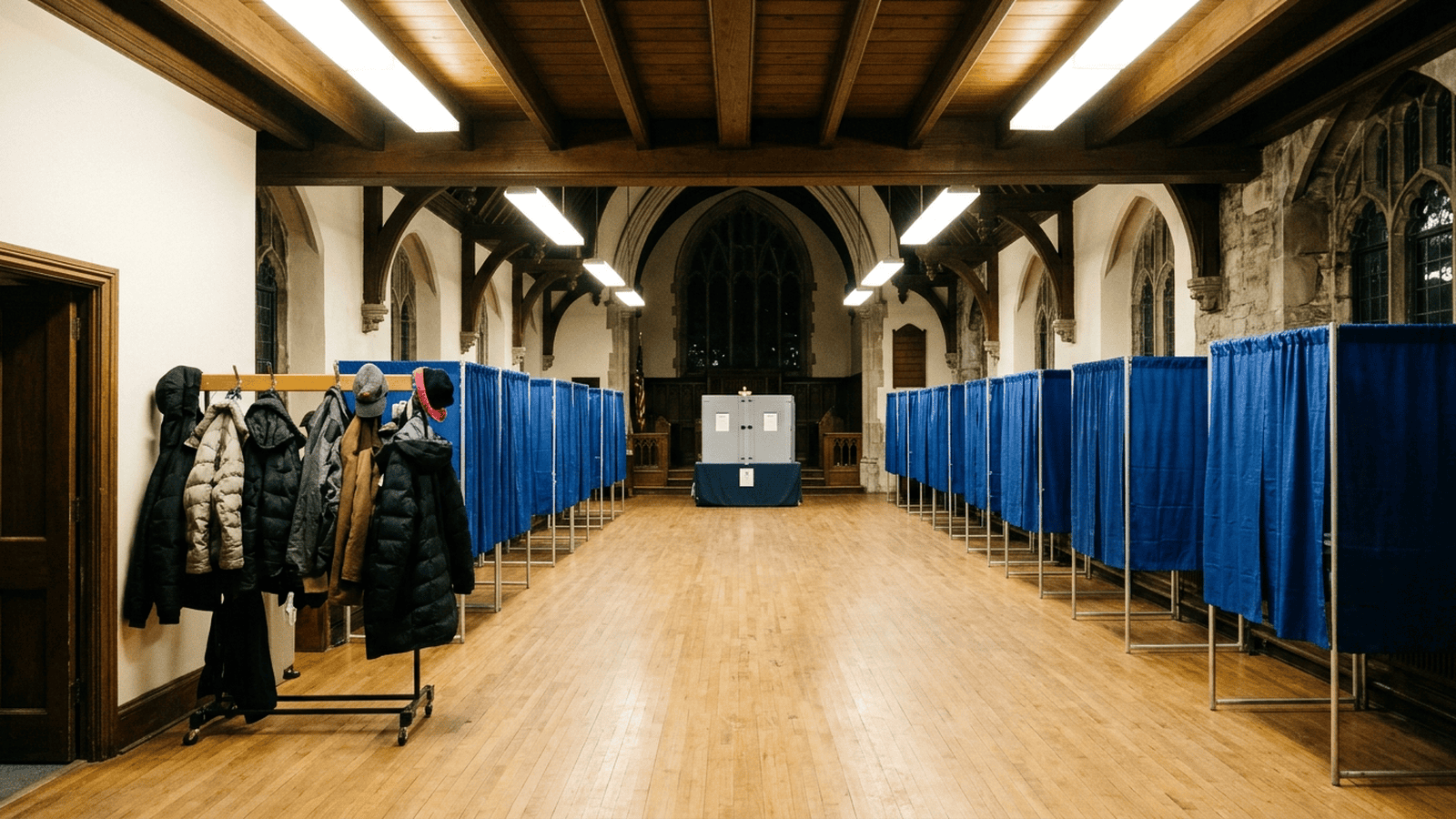
Accounts from campuses and communities across the country show young people closely engaged with the 2026 midterms, through voting, organizing, and watching results together. An estimated 72 percent of voters ages 18 to 29 chose Democratic candidates for the U.S. House, while Tufts’ youth engagement center described the 47-point preference as its largest recorded in a national election. Results included Democrat LaKesha Womack’s upset victory in North Carolina’s 14th District. The reports also connect some young voters’ choices to local concerns, including energy costs and land preservation in Nome, Alaska. At Cornell, organizers helped nearly 500 students register and distributed more than four times as many absentee-ballot forms as during the 2024 presidential election. Ballot counting and applicable oversight remain necessary next steps.
TLDR: Young voters participated in the 2026 midterms across campuses and communities, with estimates showing a strong preference for Democratic House candidates among voters ages 18 to 29. Individual reports highlighted local concerns, student-led registration work, election-day lines, and the continuing process of counting ballots.
Reports from polling places, campuses, and election-night gatherings describe a midterm vote that drew strong attention from young people across the country. The accounts span Alaska, Texas, Michigan, Indiana, Kansas, New York, Rhode Island, California, Connecticut, Massachusetts, and locations overseas. They capture individual experiences rather than a single explanation for how every young voter made a choice.
The reporting’s stated purpose is to show what students felt as they watched the 2026 midterms. It does not identify one official rationale for the election results or establish that young voters acted for one common reason. Instead, it offers personal accounts alongside estimates of youth voting patterns and several notable race results.
Nationally, an estimated 72 percent of voters ages 18 to 29 chose Democratic candidates for the U.S. House, while 25 percent voted for Republicans. Tufts University’s Center for Information & Research on Civic Learning and Engagement, a nonpartisan research organization focused on youth civic engagement, described the 47-point preference for Democrats as the largest it had recorded in a national election. Young voters also favored Democratic candidates in several Senate races: 74 percent in Florida, 80 percent in Kansas, 74 percent in Maine, and 67 percent in Michigan.
North Carolina offered one of the night’s most striking congressional outcomes. Democrat LaKesha Womack defeated Republican incumbent Tim Moore in the state’s 14th Congressional District, a seat described as widely viewed as safe for Republicans. Moore had been one of the state’s most powerful politicians and had helped draw the district while serving in the General Assembly. The district includes many students, and the reporting says young voters joined a broader wave of peers there.
In Nome, Alaska, election day unfolded in a community where daily costs and local land use came up in conversations. Electrical lineman Perry Saito said campaign promises had not been fulfilled and that he was tired of lies. Another resident, Katrina Van Vliet, described paying about $10,000 for diesel to heat her home the previous year, while noting that costs were rising as her family cared for foster children. The local price of unleaded fuel was reported at $7.39 a gallon.
Guadalupe Callahan, a recent college graduate raised in Nome, connected her vote to hunting, fishing, and preserving the land. She said she and her friends supported candidates who did not view Alaska only as a source of soil and oil. Those views are individual testimony, not evidence that all Alaska voters share the same priorities. They show how energy costs and access to land appeared in at least one account of young voters’ concerns.
At Boston College, students watched results in a setting where some described campus politics as restrained. Junior Connor Moquin compared the campus atmosphere to avoiding political debate at a family dinner to prevent a fight. The report also noted the school’s low placement in a free-speech ranking and student accounts of administrative limits on protests and self-censorship. The episode suggests that political engagement can be visible at an election gathering even when students describe everyday discussion as guarded.
Other accounts record the practical work of voting. At Cornell, student organizers helped nearly 500 students register during the semester, compared with just over 300 during the 2024 presidential election. The group also saw more than four times as many absentee-ballot forms taken. On Election Day, members were at the campus polling place from 5 a.m. to 9 p.m., helping students navigate the process.
Those details show both participation and effort. Registering requires completing the relevant process, while absentee voting involves ballot forms; the report does not specify fees or provide a full list of paperwork. Some students waited nearly half an hour in line at a polling place, and rain affected voters in another account. The source gives no general estimate of costs to voters, no nationwide enforcement details, and no additional deadlines beyond Election Day. The direct participants described include young voters, student organizers, election workers, and campus communities.
Election-night scenes varied by location. At a Brown University watch party in Providence, students gathered for games, pizza, analysis, and election-themed puzzles. In Nome, a first-time voter received a standing ovation from poll workers. In Texas, one student arrived with notes listing candidates, while another young voter said he had relied in part on the judgment of parents and mentors. These accounts show different ways people prepared and took part, without establishing a uniform youth viewpoint.
The reporting leaves several questions of scale unanswered. The national vote shares are estimates, and the excerpt does not give a detailed method for calculating them. It also does not provide a full account of final certification, recounts, or post-election oversight. The next steps reflected in the material are the ordinary completion and counting of ballots; one account states that ballots placed in an emergency box would still be counted after Election Day polls closed. Those counting steps and any applicable oversight remain necessary parts of establishing the final results.

Mark Davis serves as the Senior Correspondent for Energy, Climate, and Resource Economics at Just Right News. In an era where the conversation around the environment is often dominated by alarmism and top-down mandates, Mark provides a vital, market-oriented perspective on the complex forces shaping our world. As the lead voice behind the acclaimed feature series “Power and the Planet,” he explores the intersection of environmental policy, global energy markets, and the fundamental economic principles that sustain modern civilization.
Mark’s pragmatic approach to resource management was forged in the high desert of his hometown, Albuquerque, New Mexico. Growing up in a region defined by both its breathtaking natural beauty and its rugged, resource-dependent landscape, he developed an early appreciation for the delicate balance between conservation and utilization. New Mexico’s unique position as a hub for both traditional energy production and cutting-edge scientific research provided Mark with a front-row seat to the evolution of the American energy sector. This upbringing instilled in him a deep-seated belief that true environmental stewardship is inseparable from economic prosperity and technological innovation.
Now based in Boulder, Colorado, Mark operates from the heart of the nation’s climate research community. While Boulder is often seen as a bastion of environmental idealism, Mark utilizes his post to provide a necessary counterweight, grounded in the realities of resource economics. He understands that energy policy does not exist in a vacuum; it has tangible consequences for the American taxpayer, the stability of the national power grid, and the strength of the domestic manufacturing sector. By reporting from the front lines of the climate debate, he is able to challenge prevailing narratives with hard data and a commitment to the principles of the free market.
Throughout his tenure at Just Right News, Mark has distinguished himself by focusing on the “Resource Economics” aspect of his beat. He frequently highlights the hidden costs of rapid energy transitions and advocates for an “all-of-the-above” energy strategy that prioritizes American energy independence. His work often shines a light on the geopolitical implications of resource scarcity, arguing that a secure nation must first be an energy-secure nation. Whether he is analyzing the impact of federal land-use regulations or investigating the supply chains required for new technologies, Mark remains focused on how policy decisions affect the lives and livelihoods of everyday citizens.
In “Power and the Planet,” Mark continues to bridge the gap between complex scientific concepts and the economic realities facing the country. He rejects the false choice between a healthy environment and a thriving economy, instead seeking out solutions that leverage American ingenuity and private-sector competition. For Mark, reporting on the climate is not about following the latest trends, but about ensuring that the conversation remains tethered to the foundational values of liberty, property rights, and fiscal responsibility. His contributions ensure that Just Right News readers receive a comprehensive, clear-eyed view of the challenges and opportunities defining the future of our planet.